Did you know that a staggering 60% of individuals living with diabetes do not get routine eye exams?1
Diabetes retinopathy is a serious complication of diabetes. In many cases, vision loss can be prevented with early detection and treatment.
To increase access, the ADA 2026 Standards recommends screening for diabetes retinopathy using retinal photography for individuals who do not have access to an in person eye care professional, such as an ophthalmologist or optometrist. This screening process has been transformed using artificial intelligence (AI) to interpret retinal images.
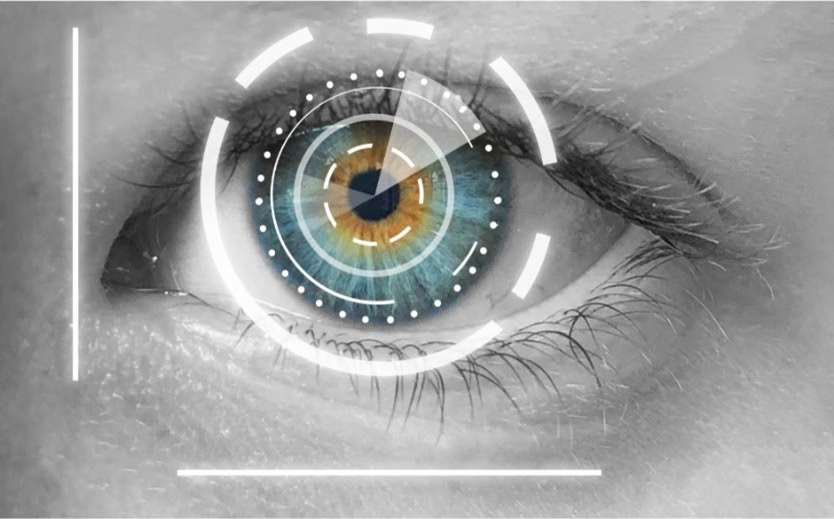
Diabetic Retinopathy Screening
Diabetic retinopathy is the development of microaneurysms in the retina’s tiny blood vessels. These microaneurysms can develop into retinal hemorrhages and ischemia. As retinopathy progresses to proliferative diabetic retinopathy, abnormal new blood vessels develop, a process called neovascularization. The blood vessels in the retina can leak fluid at any stage of retinopathy, causing macular edema. Diabetic retinopathy risk is increased with duration of diabetes and hyperglycemia.
The ADA recommends diabetic retinopathy screening2:
- Type 1 Diabetes: 5 years after diagnosis, then annually
- Type 2 Diabetes: At time of diagnosis, then annually
- Pregnancy in pre-existing type 1 or type 2 diabetes: Before pregnancy and in the first trimester. The degree of retinopathy determines the need for further follow-up during and after pregnancy.
Diabetic retinopathy screening may be extended to every 2 years if there is a history of normal screening exams. If retinopathy is detected, the follow-up frequency will be determined by the eye care professional.
An in-person dilated eye exam is recommended for screening for diabetic retinopathy. There are numerous barriers that keep clients from visiting their eye care professionals. Retinal images have been used in primary care and diabetes education clinics. These images are then uploaded to eye care professionals for interpretation. There are now FDA-approved AI systems that interpret the retinal images. Abnormal screening results or poor-quality retinal images should be followed up in person with a dilated comprehensive eye exam.
AI Screening Tools
AI screening tools for diabetic retinopathy use retinal images, which are then analyzed by AI. The AI is developed using deep learning, where the algorithm is trained by experts to identify varying degrees of diabetic retinopathy.3 The FDA-approved algorithms are programmed to identify more than mild or vision-threatening diabetic retinopathy.
FDA-approved AI Screening tools:
- AEYE diagnostic screening technology, or AEYE-DS (AEYE Health)
- EyeArt AI screening system (Eyenuk)
- LumineticsCore, formerly IDx-DR (Digital Diagnostics)
These AI screening tools are used solely for screening. They are not intended to monitor retinopathy over time. Retinopathy follow-up should be done in person by an eye care professional.
Benefits & Opportunities for Healthcare Professionals
The use of AI-analyzed retinal images offers several benefits to healthcare providers.
- Access to care: Allows screening in areas other than an eye care clinic. This improves screening rates for those who would not otherwise be screened.
- Convenience: Clients are screened during their regularly scheduled follow-up appointments at the primary care, endocrinology, or diabetes education clinic.
- Accuracy Sensitivity ranges from 87% to 96% while specificity ranges from 88% to 91% across all 3 FDA-approved screening tools for identifying more than mild or vision-threatening diabetic retinopathy.4
- Speed: Images are analyzed instantly, with reports available in under a minute.
- Education: Diabetes healthcare providers can review retinal images with the client, highlighting normal and abnormal findings.
- Collaboration: Diabetic retinopathy screening enhances collaboration between diabetes healthcare providers and eye care professionals by facilitating referrals and enabling case discussions.
References:
- Centers for Disease Control and Prevention. (2024, May 15). Promoting eye health. https://www.cdc.gov/diabetes/hcp/clinical-guidance/promote-eye-health.html
- American Diabetes Association Professional Practice Committee for Diabetes. (2026). Retinopathy, neuropathy, and foot care: Standards of care in diabetes—2026. Diabetes Care, 49 (Supplement 1), S261–S276. https://doi.org/10.2337/dc26-S012
- Rajesh, A. E., Davidson, O. Q., Lee, C. S., & Lee, A. Y. (2023). Artificial intelligence and diabetic retinopathy: AI framework, prospective studies, head-to-head validation, and cost-effectiveness. Diabetes Care, 46(10), 1728. https://doi.org/10.2337/dci23-0032
- Welch, A. (2026, February 1). Can AI close the diabetic retinopathy screening gap? American Academy of Ophthalmology. https://www.aao.org/eyenet/article/artificial-intelligence-for-diabetic-retinopathy#:~:text=Accuracy.,4%2C8
Set Yourself Up With Certification Success
Get exam-ready with confidence.
Course credits through AMA PRA Category 1 Credits™, ACPE, ANCC, and CDR!
Full accreditation details are available on the registration page

Our CDCES Boot Camp Online Prep Bundle is a comprehensive, high-impact program built specifically for healthcare professionals preparing for the Certified Diabetes Care and Education Specialist (CDCES) exam who want to level up their clinical knowledge and skills.

This evidence-based study bundle is a comprehensive BC-ADM Boot Camp designed for advanced-level healthcare professionals preparing for the Board Certified in Advanced Diabetes Management (BC-ADM) exam and will also provide you with state-of-the-art information to level up your clinical practice.
What's Included?
CDCES Boot Camp
- 30+ expert-led courses from the fundamentals to the ADA standards, to test strategies and exam mastery! Includes Levels 1, 2 and 3.
- 50+ CE credits (AMA PRA Category 1™, ACPE, ANCC, CDR accredited). IN
- 400+ practice questions to test your knowledge and build confidence
- Multiple learning formats: video presentations, audio podcasts, and downloadable handouts
- 1 full year of on-demand access to study at your own pace
BC-ADM Boot Camp
- 30+ expert-led courses covering advanced diabetes management, ADA standards, medication review, insulin calculations and tech topics! Includes advanced levels 2, 3, 4.
- 50+ CE credits (AMA PRA Category 1™, ACPE, ANCC, CDR accredited).
- 400+ practice questions to test your knowledge and build BC-ADM test confidence.
- Multiple learning formats: video presentations, audio podcasts, and downloadable handouts
- 1 full year of on-demand access to study at your own pace
Virtual DiabetesEd Training Conference
Why Should I Attend?
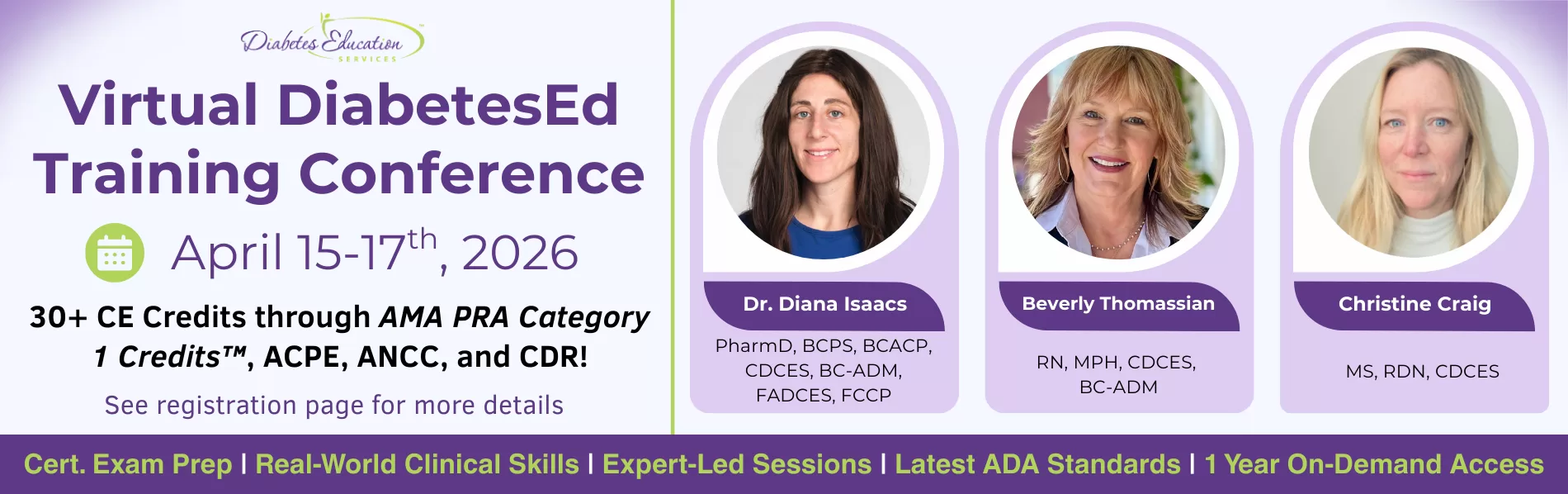
Join national experts including Dr. Diana Isaacs (Cleveland Clinic), Beverly Thomassian (30+ years of experience), and Christine Craig for high-impact, virtual learning—no travel required.
✔ Learn from National Experts — Anywhere
Get the same expert-level instruction you’d receive in person, delivered live to your home or office.
✔ Interactive & Flexible
- Live Q&A and real-time case discussions
- Direct engagement with faculty
- Full session recordings with 1-year access if you can’t attend live
What's Included?
- 19.5 CEs from the 3-day interactive conference + 17+ bonus CEs from 11 on-demand courses. (30+ total CEs are AMA PRA Category 1™, ACPE, ANCC, CDR accredited)
- Less than $15 per credit!
- Expert-led sessions: ADA Standards, medications, insulin therapy, behavior change, CGM, medical nutrition therapy
- Interactive Q&A with expert faculty during live sessions
- 1-year access to all recordings that you can watch on your schedule
- Study material for CDCES and BC-ADM exam prep
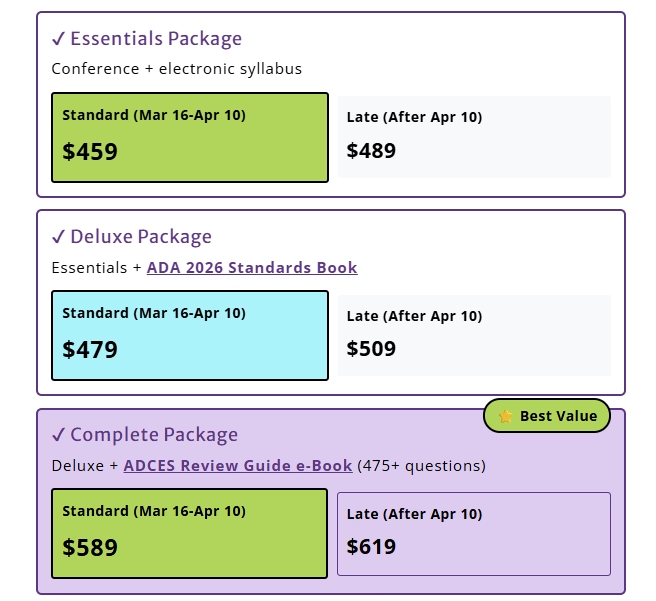
3 Ways to Register
Practical, Ready-to-Use Strategies
Walk away with tools you can apply immediately in clinical practice or while preparing for CDCES or BC-ADM exams. From insulin dosing protocols to behavior change strategies that work in the real world—this content bridges theory and practice.
Hear What Our Community Has to Say