Presenters at ADCES (pictured above, from left to right):
- Beverly Thomassian, RN, MPH, CDCES, BC-ADM
- Sarah Hormachea, MS, RD, CDCES, BC-ADM
- Russ Powell, MS, RD, CDCES, BC-ADM
- Vivian Ayuk, PharmD, CDCES
Sarah Homarchea, RD, MS, CDCES, BC-ADM, moderated the ADCES Conference Diabetes Entrepreneurs panel session, which was a hit!
With over 100 attendees and standing room only, we were pleasantly surprised with the incredible turnout. It reinforced just how much interest and appetite there is for entrepreneurship within our field.
We asked the panel of speakers, along with the panel moderator, Ms. Hormachea, to share their top pieces of wisdom for diabetes health care professionals who are thinking about starting their own side-hustle or consulting gig, each of the 4 panel members had some fantastic advice and insights to share.
Lasting Wisdom from the Panelists

Introduction by Moderator: Sarah Hormachea, MS, RD, CDCES, BC-ADM
www.sarahhormachea.com
As diabetes care and education specialists, our expertise is in high demand, but there are rarely enough of us to go around. Many clinics also lack the resources to bring that expertise on full-time. Entrepreneurship offers creative ways to bridge that gap, expanding access to high-quality diabetes care while creating new opportunities to use our expertise.
When I first ventured into entrepreneurship, it felt scary, uncertain, and largely uncharted. There was no playbook. I decided the best way to understand what was possible was to learn from those who had gone before me. Admittedly, my own desire to learn from the pros helped inspire the idea for an entrepreneurship panel, where I could ask the questions many of us want answered and perhaps uncover a few industry secrets along the way.
With that, I’m pleased to turn it over to our panelists to share their experiences, insights, and words of wisdom.

We asked the panelists to share 3 or 4 takeaways that they felt could most benefit diabetes healthcare professionals considering taking a dive into entrepreneurship. Here is what they said:

Russ Powell, MS, RD, CDCES, BC-ADM
www.russpowellnutrition.com
1. Build the business model around the outcome you want your clients to reach, not around the format you are most comfortable delivering.
When I started my practice in 2019, I assumed one-to-one care was the only serious way to do clinical work. What I learned is that the delivery model has to match where the person actually is. Someone newly diagnosed and still in shock needs a different container than someone two years in who just wants a plan they can follow on their own. That is why my practice runs as a hybrid now, with one-to-one coaching through both insurance and private pay, a self-paced course, and group programming. The clinical standard does not change across those formats. What changes is the level of access, and pricing your work along that spectrum lets you serve more people without diluting the care or burning yourself out trying to be everywhere at once.
2. You do not have to jump without a net, and staying employed while you build is not a lack of commitment.
There is a story in entrepreneurial circles that the leap must be total and immediate. That story leaves out how many of us built something durable precisely because we were not making desperate decisions with our pricing or our client selection. While starting my practice, I held a corporate role while growing my business, and that stability let me say no to work that was not the right fit, invest in systems before I technically needed them, and let the business grow at a pace that made clinical sense. Build your runway, define your exit trigger using concrete numbers rather than feelings, and then move.
3. Your systems turn a practice into a business, and you should build them before you feel ready.
The clinical training we get is excellent. The business training is nearly nonexistent, so most of us learn operations the expensive way. The things that separated my practice from a very busy job were unglamorous: a documentation workflow I could actually sustain, clear standards for when clients hear back from me, insurance credentialing done correctly the first time, and written procedures for the tasks I repeat every week. Systems protect your time, and protecting your time is what makes you available for the deep clinical thinking your clients are actually paying you for. If you are waiting until you are big enough to need SOPs, you are already past the point where they would have saved you the most.

Vivian Ayuk, PharmD, CDCES
www.sorogi.com
Fifteen Years In, Still Learning
Fifteen years ago, I did the scariest thing I have ever done. I started a business.
I have never regretted it. Have I questioned it loudly, usually around 2 a.m? Yes. Being excellent at what you do and knowing how to build a business around it are two completely different skills. The first gets you in the door. The second is the actual job. Three things I wish someone had handed me on day one.
1. The business grows the leader, not just the craft
Whatever you are brilliant at is the entry ticket, not the job. The job is a set of skills the majority of us, as diabetes care and education specialists, were never taught.
- Financial fluency. You do not need an MBA, but you do need to stop finding numbers boring. In addition to the basics of learning how to start a business, licensing, etc. You need to understand margins, cash flow, pricing, and the difference between revenue and money you can actually spend.
- Storytelling. You will sell constantly to customers, your first hire, and people who have been let down before. Selling is not manipulation. It is making something true also feel compelling.
- Choosing your people for the long horizon. Someone wiser than me once said, “Play long-term games with long-term people.” A lesson I learned the hard way, especially when choosing partners and hiring employees. A short-term win with the wrong person costs more than it returns, every time.
- Deciding anyway. Your training taught you to wait for sufficient evidence. Entrepreneurship punishes waiting. You will decide on incomplete information, be wrong sometimes, and correct fast.
2. Leverage is the whole game
The question stops being “how well can I do this?” and becomes “how does this happen a thousand times, without me in the room?” Three answers.
- Technology. Well-chosen tools let you serve more people across distance and schedules. It breaks down barriers that would otherwise keep potential customers away. We now have access to AI tools that can handle meeting prep, summaries, drafts, and follow-ups. Use them wisely. It does not replace your judgment. It gives you back the hours to apply it.
- Data. Track outcomes from day one, even when the numbers are small and unflattering. Stories move people; data moves institutions and partners.
- People. Delegate outcomes, not tasks. Hand someone the result and the authority to reach it, then step back. You must release the belief that only you can do it right. Even when it is accurate, because a business that depends entirely on you is not a business.
3. Sustainability is designed, not discovered
Burnout is not what happens when you work too hard. It is what happens when you never design for the long term.
- Protect your calendar. Block the deep work and the family time before the calendar fills. An empty calendar isn’t freedom, but it is an invitation for other people’s priorities to move in.
- Stay close to why you started. Schedule contact with the people you serve. Hearing that your work changed something for someone restores more than any time off- usually the first thing to vanish as you grow.
- Practice what you preach. Sleep, movement, rest. A founder visibly falling apart while promoting a healthier way of working is a contradiction everyone can see.
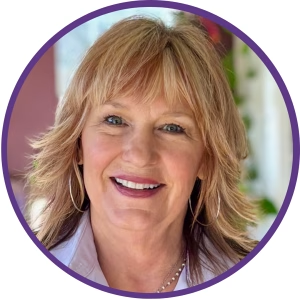
Coach Beverly Thomassian, RN, MPH, CDCES, BC-ADM
www.DiabetesEd.net
I can’t think of a better way to capture the importance of authenticity – of knowing who you are, what you stand for, and staying true to those values as you build your business – than these wise words from Dolly Parton:
“Find out who you are and do it on purpose. And do it with purpose. Don’t ever sacrifice who you are, your principles and your morals and your values to just try to get ahead in business. It ain’t worth it.”
Dolly Parton
1. Let your purpose guide your decisions.
There will always be new opportunities, competing priorities, and plenty of advice about what you should do. Keep coming back to your why.
Ask yourself: Does this opportunity align with who I am, the people I want to serve, and the difference I want to make? Your purpose can be your compass when the path forward isn’t clear.
Coach Bev wisdom: “Pursue opportunities that align with your purpose.”
2. Stay curious—and treasure the people you serve.
Successful entrepreneurs need to build community and invest in people. Ask questions. Listen carefully. Pay attention to what people are struggling with, what they’re asking for, and what would make their lives better. Your customers will help you steer the ship in uncertain waters.
Coach Bev wisdom: “The greatest growth in my business has come not from marketing campaigns, but from listening to, learning from, and cherishing the community we serve.”
3. Learn the business of running a business.
You may be passionate about your work, but being an entrepreneur also means learning how to run a healthy business. Educate yourself about bookkeeping, budgeting, taxes, contracts, pricing, insurance, and cash flow. Know your numbers, understand where your money is coming from and where it’s going, and hire experts when you need them. You don’t have to become an accountant, but you do need to understand the financial health of your business.
Coach Bev wisdom: “Follow your passion—but know your numbers.”
4. Build something that reflects your values and be generous with information sharing.
Success isn’t only about revenue or growth. It’s about creating something you’re proud to put your name on. Treat people well, surround yourself with good humans, give back when you can, and make sure your work still brings you a sense of purpose and joy.
Coach Bev wisdom: “Build a business that makes a living—but also makes a difference.”
Join us live DiabetesEd Training Conference in San Diego
for More Lasting Wisdom from Diabetes Educators for Diabetes Educators
Led by national experts Dr. Diana Isaacs, PharmD, BC-ADM, CDCES (Cleveland Clinic), Coach Beverly, RN, MPH, BC-ADM, CDCES (30+ years of experience), and Christine Craig, RDN, MS, CDCES (nutrition whiz).
Brand new agenda for 2026!
🌟Updated Schedule: ADA Boot Camp, Tech, MNT & More
Live in Beautiful San Diego – Oct 22-23, 2026
🎓 Earn 30+ CEs: AMA PRA Category 1 Credits™, ACPE, ANCC, and CDR!

📅
2-Day Conference
Oct 22–23, 2026
⏱️
15.5 Live CEs
+ 17 bonus CEs
🏅
CDCES & BC-ADM
Exam Prep + Renewal
📍
San Diego, CA
1.7 mi from airport
Advance Your Expertise and Prepare for Your Future
The field of diabetes care is expanding and evolving rapidly. This unique training conference will keep you on the cutting edge plus prepare you for certification exams. It also fulfills the Standards of Care renewal requirement. Join us for two days of intensive education that is fun and inspiring. Add on the optional Day 3 (Engaging the Disengaged), to complete your conference exeperience.
Day 1 – ADA/AACE Standards of Care Boot Camp
Coach Beverly and Diana Isaacs, PharmD, BC-ADM, CDCES co-lead an exciting day that brings the ADA and AACE Standards to life. Gain fresh insights, practical tools, and a deeper understanding of the latest in person-centered diabetes care. After attending, you will be empowered to share the latest in diabetes care with your colleagues and the people in your care.
Day 2 – Insulin, Tech, MNT and Case Studies
Take your knowledge to the next level with this intensive deep-dive into insulin therapy, dosing and pattern management with Dr. Diana Isaacs. Next, stay for the diabetes tech show-and-tell as Diana demonstrates the specs of the latest pumps and sensors. After lunch, nutrition whiz Christine Craig, MS, RDN, CDCES expertly details the latest in MNT and provides real strategies on translating this content to your clinical practice. You will have a chance to put it all together as Coach Beverly leads you through a series of case studies that integrates content from Day 1 and Day 2.
Add-On Day 3 – Engaging the Disengaged
On Saturday, join this exceptional day-long program led by William H. Polonsky, PhD, CDCES & Susan Guzman, PhD (Behavioral Diabetes Institute) that reveals psychosocial forces behind diabetes self-management — tools to break through resistance and inspire change.
Read more below
🌟Registration Options at a Glance
📜 Essentials
Registration
+ Printed Syllabus
$559.00
🌟 Deluxe
Essentials
+ ADA Standards Book
$589.00
🏆 Complete – Best Value!
Deluxe
+ ADCES Review Guide e-Book
$669.00
5 Reasons to Attend
- Led by national experts 👩⚕️Dr. Diana Isaacs (Cleveland Clinic), Coach Beverly 🧢 (30+ years of experience), and Christine Craig (nutrition whiz).
- 🌴 Location makes for a great vacation
- Networking, walking paths, connection
- Ready yourself for the diabetes future🚀
- Have fun, win prizes, play DiaBingo 😄
What's Included?
- 🍽️ Healthy breakfasts, lunch, refreshments and coffee ☕
- 📘 100-page printed syllabus
- 🎤 2 days of engaging, expert-led education with case studies.
- 🎓 12 FREE online courses ($375 value)
- Free MedPocketCard & Coach Bev’s Book 📗 Healing through Connection.
Add on a 3rd Day!
Enroll in
ENGAGING THE DISENGAGED
Strategies for Promoting Behavior Change in Diabetes
October 24, 2026

Transform how you engage patients with diabetes — master behavior change, reduce distress, and overcome medication hesitancy.
Why do so many patients know what they should do — but still struggle to do it?
The answer lies in the psychology of diabetes.
In this transformative full-day course, world-renowned experts William H. Polonsky, PhD, CDCES, and Susan Guzman, PhD, from the Behavioral Diabetes Institute reveal the hidden psychosocial forces that drive — or derail — diabetes self-management.
You’ll walk away with a completely new toolkit for breaking through patient resistance, dissolving medication hesitancy, and creating clinical encounters that actually inspire change!