
Subscribe
eNewsletter

Ready to get certified?
Free CDCES Coach App

eNewsletter
Free CDCES Coach App

JR wants to lose weight in the next 30 days by drinking less juice. There are 100 calories per glass of juice and JR usually drinks 3 glasses a day.
How much weight would JR lose by only drinking 1 glass a day?
Click here to test your knowledge!
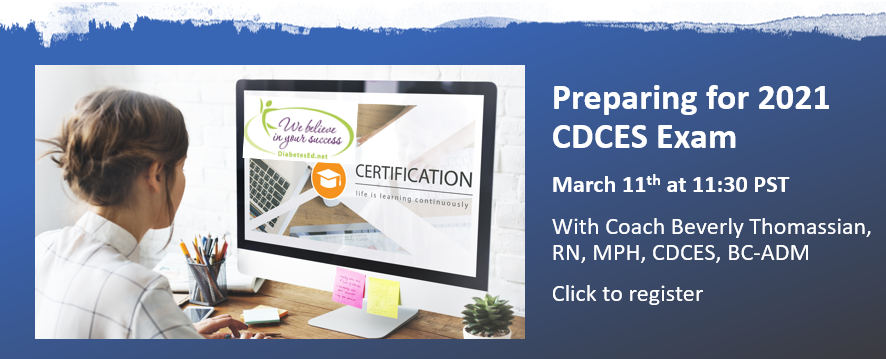
This course will transform your test anxiety into calm self-confidence and test-taking readiness.
Sign up for Diabetes Blog Bytes – we post one daily Blog Byte from Monday to Friday. And of course, Tuesday is our Question of the Week. It’s Informative and FREE! Sign up below!
[yikes-mailchimp form=”1″]Accreditation: Diabetes Education Services is an approved provider by the California Board of Registered Nursing, Provider 12640, and Commission on Dietetic Registration (CDR), Provider DI002. Since these programs are approved by the CDR it satisfies the CE requirements for the CDCES regardless of your profession.*
The use of DES products does not guarantee the successful passage of the CDCES exam. CBDCE does not endorse any preparatory or review materials for the CDCES exam, except for those published by CBDCE.
To celebrate Registered Dietitians, we are interviewing an emerging leader in the field and our Virtual Conference Speaker, Ashley LaBrier.
Ashley LaBrier, MS, RD, CDES, is an innovator in the field of diabetes, nutrition, and technology. Ashley is a consultant, and the Diabetes Education Program Coordinator at the Salinas Valley Medical Clinic’s Diabetes & Endocrine Center.
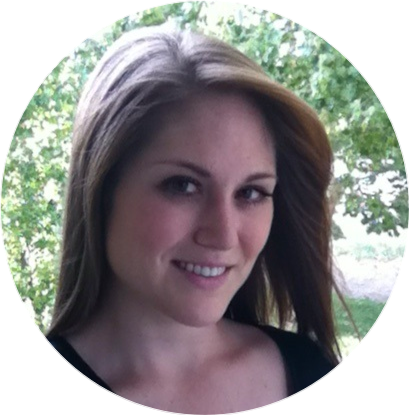
Ms. LaBrier is passionate about providing person-centered education to empower those who live with diabetes. Having been diagnosed with type 1 diabetes herself nearly 20 years ago, she combines her professional knowledge with personal experience and understanding.
Meet Ashley in person at our Virtual Diabetes Specialist Course on April 17, 2021
1. Question – What do you love about being a RD and Diabetes Specialist?
Ms. Labrier – There are a few things I REALLY love about being a dietitian and working with those living with diabetes:
At our clinic, education visits are purposely scheduled to allow adequate time to really understand the needs of each individual and make personalized suggestions. I LOVE that our work allows us to get to know the people we work with so intimately. This knowledge ultimately translates into providing meaningful support based on individual needs.
I also love teaching group education classes. There are few things more energizing than a room full of people who have come together to learn more about their diabetes. These classes always lead to great questions, dialogue, and connection. Hearing people leave an education class feeling empowered to conquer their diabetes and live a more healthful life is so satisfying for me personally and professionally.
Lastly, translating nutrition and diabetes so it “makes sense” – I find it satisfying to see that “light bulb moment” after explaining a new concept.
Question – How do you anticipate nutrition recommendations changing for people with diabetes lives over the next few years?
Ms. LaBrier – I’m not sure how nutritional guidelines will change in the next few years, but I’d like to see more research exploring the long-term health impact of the popular diets, particularly the ketogenic diet and other higher fat and protein diets. I also hope that dietary guidelines begin to factor in the social and environmental consequences of what we eat, not just nutrition alone. What we eat impacts our health and the planet – sustainability is key.
Question – Over the past year, what has been most challenging about providing diabetes care during the pandemic?
Ms. LaBrier – The pandemic has brought so much uncertainty to our lives. In working with our participants at the clinic, many have lost their jobs and are experiencing financial hardship. Some are busy caring for children or elderly or have lost a loved one. Others are more isolated from their social circles and support systems. Many have found it difficult to manage stress because certain activities that bring joy have been suspended. All of these factors, and many more, have complicated the picture for our community. Although every person has individual concerns, it seems like many individuals and families are stretched thin. They may have competing priorities and concerns that make managing a chronic condition more difficult than ever before.
Question – What actions can Diabetes Specialists take to counsel people with diabetes who are facing food insecurity?
Ms. LaBrier – a key in working with individuals who face food insecurity is approaching the situation with compassion and a desire to understand.
Ask questions and make an honest effort to understand the struggles that they are facing around obtaining food. Not only does this help to build trust between the specialist and person with diabetes, but providing effective assistance is more realistic when you know what struggles they are facing. Being aware of the resources in your local community is especially important. Social workers can assist in applying for financial and food assistance programs. Plus local and affordable farmers markets and food banks can help sustain people through rough times. f
Question: Would you share your hobby (ies) and how you maintain work life balance?
Ms. LaBrier – My fiancé and I make an effort to get outside for fresh air cocktails regularly. We live in a beautiful area and enjoy paddle boarding, runs on the beach, hiking, camping trips, or walks in the neighborhood. Even on the busy days we maintain our work life balance by prioritizing time together doing these activities.
Accreditation: Diabetes Education Services is an approved provider by the California Board of Registered Nursing, Provider 12640, and Commission on Dietetic Registration (CDR), Provider DI002. Since these programs are approved by the CDR it satisfies the CE requirements for the CDCES regardless of your profession.*
The use of DES products does not guarantee the successful passage of the CDCES exam. CBDCE does not endorse any preparatory or review materials for the CDCES exam, except for those published by CBDCE.
This month we are celebrating our amazing sister organization, Just One Person.
Just One Person is a sustainable model program that prepares girls in rural Kenya for post-secondary opportunities, supporting their development towards economic independence. Diabetes Education Services donates the profit from the sale of the Pancreas Pillow to help fund school scholarships and seminars for other girls in rural Kenya.

Mwanaidi’s story:
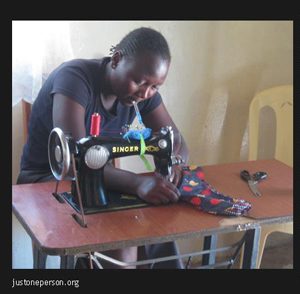
Mwanaidi, of Just One Person, has hand-sewn hundreds of beautiful Pancreas Partners in her hometown in Kenya and shipped them to the Diabetes Education Services office in California, so we can share them with you.
While Mwanaidi was waiting for admission to college she began sewing the “pancreas pillows” that Diabetes Education Services sells in the US. She used a donated treadle sewing machine, a pattern designed by Just One Person (JOP) Executive Director, Emma Sisia, and traditional leso cloth.
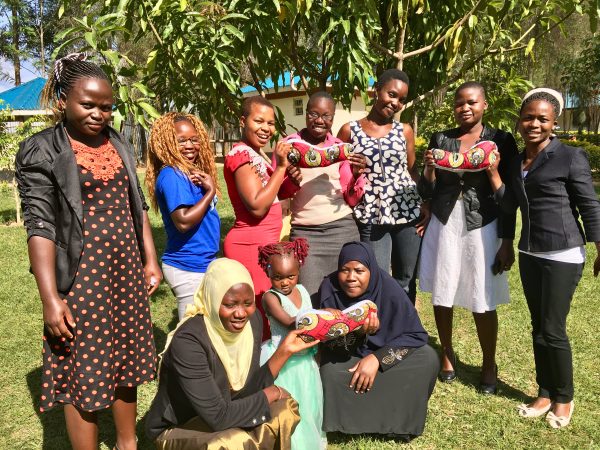
Mwanaidi joined the Just One Person (JOP) project in rural Kenya after her high school recognized her potential. Mwanaidi graduated from high school in 2010 and subsequently, became a certified chef. She uses the income from her job to help support her family of 7 siblings along with her mother and father.
After paying Mwanaidi for her beautiful work, Diabetes Education Services donates the profit from the sale of the Pancreas Pillow to help fund school scholarships and seminars for other girls in rural Kenya. Other alumnae of JOP have followed suit and are continuing to produce these wonderful pillows to help ensure the sustainability of our program.
Just One Person’s philosophy is that girls are members of our organization for life. They are committed to sharing their knowledge and resources with their mothers, sisters, neighbors, and daughters for generations to come.
At Diabetes Education Services we are dedicated to supporting the growth and well-being of our future generations.
Save your spot for our
Virtual DiabetesEd Specialist Conference | April 15-17, 2021
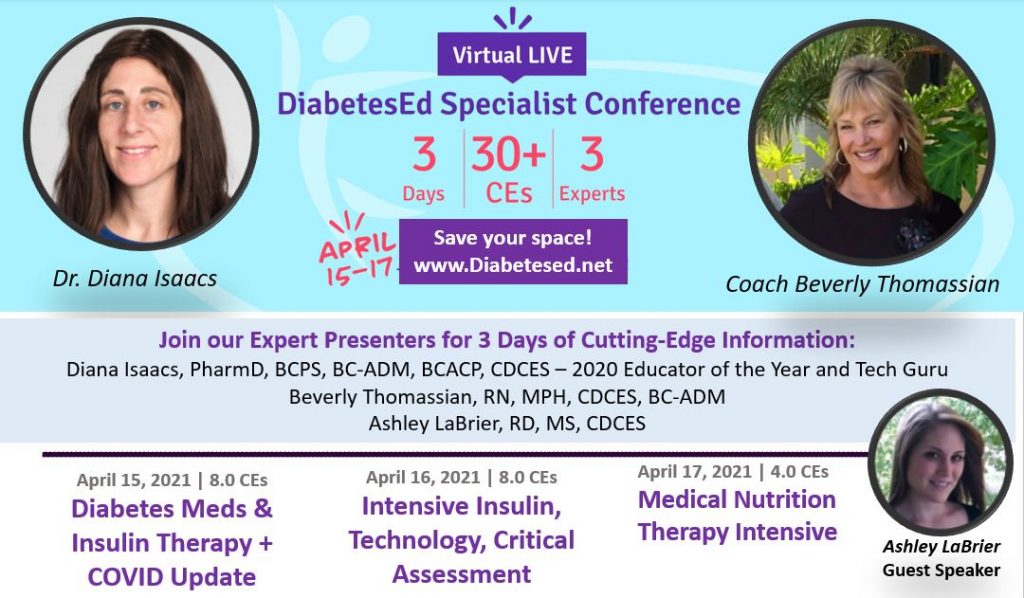
Whether you are new to diabetes or a seasoned expert, you’ll benefit from this virtual conference with the latest research plus critical content that you can immediately apply to your clinical practice. If you are interested in taking the CDCES or BC-ADM exam or are seeking a state-of-the-art review of current diabetes care, this course is for you.
Entire Program Fee: $399
Dates: April 15-17, 2021
3 Expert Speakers
CEs: 30+ CE hours
Live Webinar Schedule: All webinars start and end times are in Pacific Standard Time
Come join our Virtual DiabetesEd Specialist Program.
Team of expert faculty includes:
In addition to informative lectures, we also use group activities and case studies to highlight the essential knowledge, skills, and strategies needed to succeed in diabetes education today!
Prepare for CDCES or BC-ADM certification or earn hours for renewal.
Your registrations include access to all the Online Sessions plus Bonus Courses through December 31st, 2021.
This virtual program includes:
3 day live webinar courses from April 15th-17th (20 CEs) + enrollment in our Bonus Bundle (14.0+ CEs) from now through December 2021.
View full Conference Schedule and Faculty.
Sign up for Diabetes Blog Bytes – we post one daily Blog Byte from Monday to Friday. And of course, Tuesday is our Question of the Week. It’s Informative and FREE! Sign up below!
[yikes-mailchimp form=”1″]Accreditation: Diabetes Education Services is an approved provider by the California Board of Registered Nursing, Provider 12640, and Commission on Dietetic Registration (CDR), Provider DI002. Since these programs are approved by the CDR it satisfies the CE requirements for the CDCES regardless of your profession.*
The use of DES products does not guarantee the successful passage of the CDCES exam. CBDCE does not endorse any preparatory or review materials for the CDCES exam, except for those published by CBDCE.

For our February 23rd Question of the Week, over 94% of respondents chose the best answer!
Before we start though, if you don’t want any spoilers and haven’t tried the question yet, you can answer below: Answer Question
Question: A 59 year old with type 2 diabetes, A1c of 7.2%, takes bolus insulin before meals, plus basal insulin at night and metformin. They ask you how to best work in a piece of birthday cake for their grandchild’s upcoming birthday celebration.
What is the best advice?
Answer Choices:
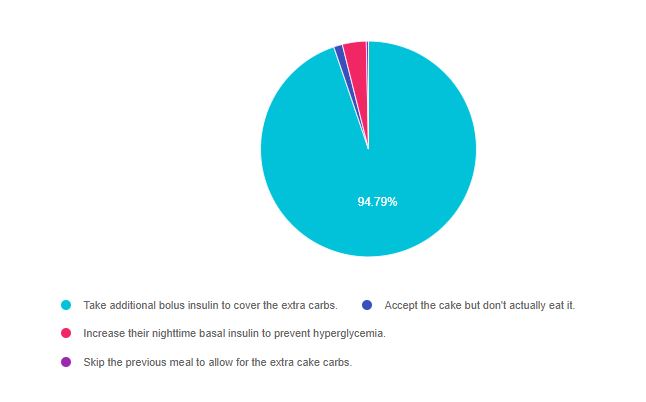
As shown above, the most common choice was option 1, the second most common answer was option 3, then option 2, and finally option 4.
If you are thinking about taking the certification exam, the content of this practice test question will set you up for success. The exam often presents vignettes that compel test takers to determine which option incorporates a person centered approach. Person centered choices are usually the BEST answer.

Answer 1 is correct, 94.79% chose this answer. ” Take additional bolus insulin to cover the extra carbs”. Yes, this is the BEST person-centered answer. People with diabetes can choose to increase their bolus insulin to cover for special occasions, like birthday cake.
Answer 2 is incorrect, 1.29% of you chose this answer. “Accept the cake but don’t actually eat it”. Based on this vignette, the person with diabetes wants to “work” the cake into their meal plan. A person centered approach honors their choice and helps them determine how to enjoy the cake while managing blood sugars.
Answer 3 is incorrect, 3.56% of you chose this answer “Increase their nighttime basal insulin to prevent hyperglycemia”. Since basal insulin does not cover carbohydrates or protect against post prandial hyperglycemia, increasing nighttime basal is not the best answer. As a matter of fact, increasing nighttime basal could cause morning hypoglycemia.
Answer 4 is incorrect, 0.36% of you chose this answer. “Skip the previous meal to allow for the extra cake carbs”. This action could lead to hypoglycemia since this person is on basal bolus insulin. For this reason, it is not the best answer.
We hope you appreciate this week’s rationale! Thank you so much for taking the time to answer our Question of the Week and participate in this fun learning activity!
Accreditation: Diabetes Education Services is an approved provider by the California Board of Registered Nursing, Provider 12640, and Commission on Dietetic Registration (CDR), Provider DI002. Since these programs are approved by the CDR it satisfies the CE requirements for the CDCES regardless of your profession.*
The use of DES products does not guarantee the successful passage of the CDCES exam. CBDCE does not endorse any preparatory or review materials for the CDCES exam, except for those published by CBDCE.
JR is 53 yrs old with type 2 diabetes, BMI of 24.3 and is recovering from a COVID infection. In addition to metformin, a SGLT-2i and a weekly GLP-1 RA, JR is on daily prednisone. Morning blood glucose levels are in the low 100’s, lunch and dinner blood glucose levels are in the 250-300 range.
Which of the following is the best treatment intervention to get lunch and dinner blood glucose levels to goal?
Click here to test your knowledge!
Virtual DiabetesEd Specialist Conference | April 15-17, 2021
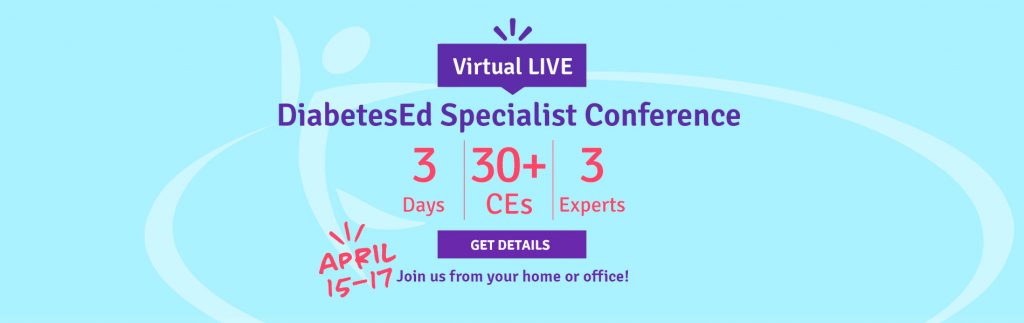
Whether you are new to diabetes or a seasoned expert, you’ll benefit from this virtual conference with the latest research plus critical content that you can immediately apply to your clinical practice.
Entire Program Fee: $399
Dates: April 15-17, 2021
Course Expiration: December 31, 2021
Live Webinar Schedule: All webinars start and end times are in Pacific Standard Time
Virtual DiabetesEd Specialist Program Flyer 2021
*Dates and times subject to change. Course start and end time are for Pacific Standard Timezone.
Virtual DiabetesEd Specialist Program Flyer 2021
This virtual program includes:
3 day live webinar courses from April 15th-17th (20 CEs) + enrollment in our Bonus Bundle (14.0+ CEs) from now through December 2021.
Team of expert faculty includes:
In addition to informative lectures, we also use group activities and case studies to highlight the essential knowledge, skills, and strategies needed to succeed in diabetes education today!
Prepare for CDCES or BC-ADM certification or earn hours for renewal.
Your registrations include access to all the Online Sessions plus Bonus Courses through December 31st, 2021.
View full Conference Schedule and Faculty.
Sign up for Diabetes Blog Bytes – we post one daily Blog Byte from Monday to Friday. And of course, Tuesday is our Question of the Week. It’s Informative and FREE! Sign up below!
[yikes-mailchimp form=”1″]Accreditation: Diabetes Education Services is an approved provider by the California Board of Registered Nursing, Provider 12640, and Commission on Dietetic Registration (CDR), Provider DI002. Since these programs are approved by the CDR it satisfies the CE requirements for the CDCES regardless of your profession.*
The use of DES products does not guarantee the successful passage of the CDCES exam. CBDCE does not endorse any preparatory or review materials for the CDCES exam, except for those published by CBDCE.
Are you considering pursuing certification in diabetes care, but are not sure which certification is right for you and how to get started?
Join Coach Beverly for this FREE Webinar on March 8th at 11:30 am PST to explore which certification best suits your professional and personal goals.
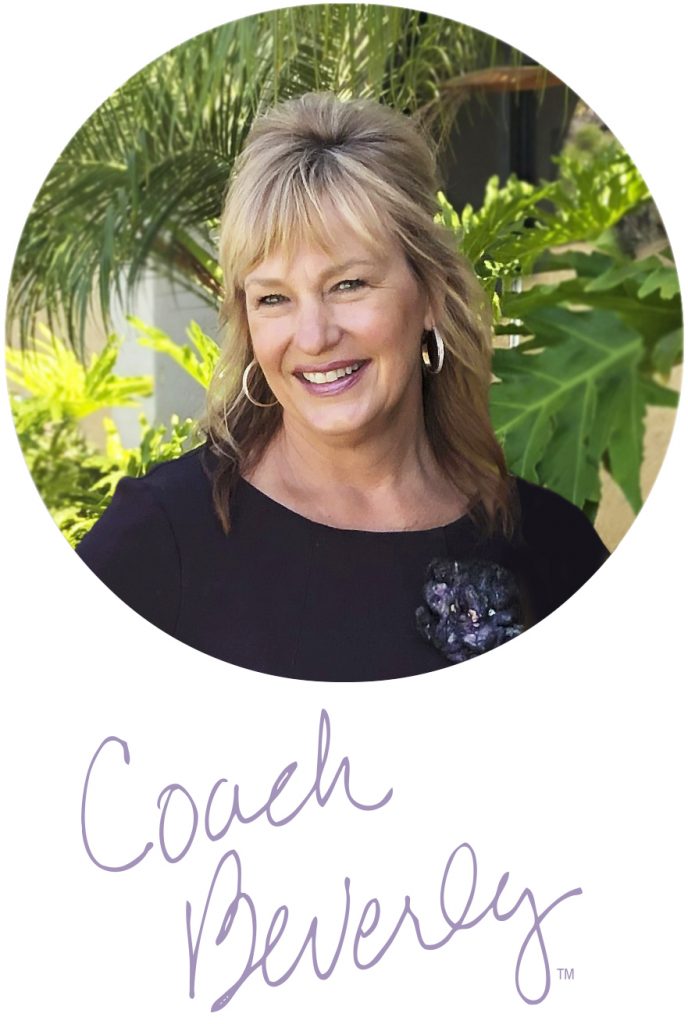
Coach Beverly is excited to share her insights on determining the best certification choice and the pathway to success. She will share her personal journey on achieving both her CDCES and BC-ADM over 20 years ago and how these credentials have impacted her opportunities as a diabetes specialist and president of her own company. We hope you can join us!
Webinar Topics
We hope you can join this FREE live webinar. Coach Beverly will stay after class for a live Question and Answer Session.
Can’t make it live? No worries, once you register for this course, you will receive a link to the recorded version within hours of the broadcast.
Sign up for Diabetes Blog Bytes – we post one daily Blog Byte from Monday to Friday. And of course, Tuesday is our Question of the Week. It’s Informative and FREE! Sign up below!
[yikes-mailchimp form=”1″]The use of DES products does not guarantee the successful passage of the CDCES exam. CBDCE does not endorse any preparatory or review materials for the CDCES exam, except for those published by CBDCE.
For our February 16th Question of the Week, over 76% of respondents chose the best answer!
Before we start though, if you don’t want any spoilers and haven’t tried the question yet, you can answer below: Answer Question
Question: LS is 79 years old and their most recent A1c is 7.4%. LS takes metformin 1000 mg twice daily and sitagliptin (Januvia) plus 14 units of basaglar at before sleep at 2am. LS is excited that they started using a Freestyle Libre sensor and shows you the glucose trends. You notice that glucose levels rise to 250 – 350 in between noon to 4pm.
What is the next best action?
Answer Choices:
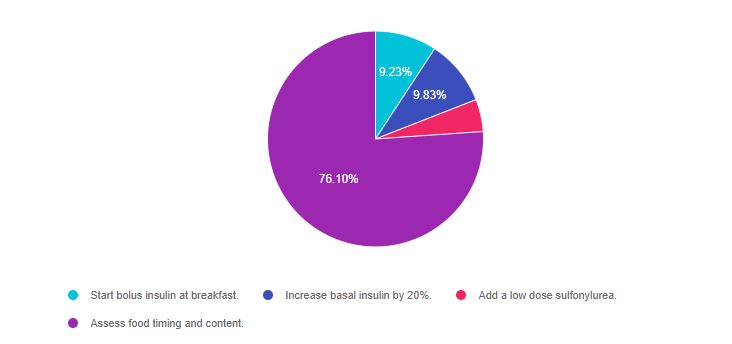
As shown above, the most common choice was option 4, the second most common answer was option 2, then option 1, and finally option 3.
If you are thinking about taking the certification exam, the content of this practice test question will set you up for success. The exam often present vignettes that compel test takers to weed through the details and figure out the key intent of the question and chose the BEST answer.
Answer 1 is incorrect, 9.23% chose this answer. “Start bolus insulin at breakfast”. Giving bolus insulin at breakfast would not prevent the glucose elevations from 12pm to 4pm. If we were to start bolus insulin to help with these afternoon spikes, we would need to give it before lunch to match post lunch glucose elevations.
Answer 2 is incorrect, 9.83% of you chose this answer. “Increase basal insulin by 20%”. Basal insulin helps to manage overnight and between-meal blood glucose levels. It is not effective at preventing post-prandial hyperglycemia. We evaluate if a person is taking enough basal insulin by seeing if fasting blood glucose is in the 80-130 mg/dl range.
Answer 3 is incorrect, 4.84% of you chose this answer “Add a low dose sulfonylurea”. Generally speaking, if a person is on basal insulin we are reluctant to add a sulfonylurea, since it can potentiate hypoglycemia (LS’s A1c is 7.4%) and may not address this specific issue of lunch time post-prandial spike. In addition, since the A1c is so close to target, it might be a good idea to take a closer look at food intake and activity and it’s impact on post lunch blood sugars.
Answer 4 is correct, 76.10% of you chose this answer. “Assess food timing and content”. GREAT JOB team. Most of you chose the best answer. As it turns out, LS was eating cereal and “mini” bagels for lunch. This explained the post meal spike. By helping LS understand which foods are carbohydrates and their impact on blood glucose, LS was eager to make adjustments at lunch to get blood sugar to target.
We hope you appreciate this week’s rationale! Thank you so much for taking the time to answer our Question of the Week and participate in this fun learning activity!

You are invited to join Coach Beverly for this FREE Webinar. And, if you want to have access to an additional 220+ sample practice online questions, you can purchase the complete Test Taking Toolkit.
During this webinar, Coach Beverly will help you transform your nervousness into focused energy that will help you succeed. She will provide test-taking tips based on her experience taking the certification exam six times.
To provide plenty of practice, Coach Beverly will sample 20 test questions that have been plucked from our Test Taking Toolkit during this free webinar.
She will explain how to dissect the question, eliminate wrong answers and avoid getting lured in by juicy answers.
This includes access to the recorded version of this webinar on your Online University Student Portal.
Plus, the Test Taking Toolkit provides you over 220 sample online practice questions, simulating the exam experience. A perfect way to assess your knowledge and create a focused study plan, while increasing your test-taking confidence.
This includes a review of 20 sample test questions with test-taking strategies. This does not include access to the recorded webinar or the practice questions.
Sign up for Diabetes Blog Bytes – we post one daily Blog Byte from Monday to Friday. And of course, Tuesday is our Question of the Week. It’s Informative and FREE! Sign up below!
[yikes-mailchimp form=”1″]
Accreditation: Diabetes Education Services is an approved provider by the California Board of Registered Nursing, Provider 12640, and Commission on Dietetic Registration (CDR), Provider DI002. Since these programs are approved by the CDR it satisfies the CE requirements for the CDCES regardless of your profession.*
The use of DES products does not guarantee the successful passage of the CDCES exam. CBDCE does not endorse any preparatory or review materials for the CDCES exam, except for those published by CBDCE.
A 59 year old with type 2 diabetes, A1c of 7.2%, takes bolus insulin before meals, plus basal insulin at night and metformin. They ask you how to best work in a piece of birthday cake for their grandchild’s upcoming birthday celebration.
What is the best advice?
Click here to test your knowledge!
For many of us, taking the certification exam is a nerve-wracking process.
During this webinar, Coach Beverly will help you transform your nervousness into focused energy that will help you succeed. She will provide test-taking tips based on her experience taking the certification exam six times.
To provide plenty of practice, Coach Beverly will sample 20 test questions that have been plucked from our Test Taking Toolkit during this live webinar.
She will explain how to dissect the question, eliminate wrong answers and avoid getting lured in by juicy answers.
Can’t make it live? No worries, if you purchase the Test Taking Exam Practice Webinar, we will automatically update the course in your Online University so you can access the new content later that day.
The Test-Taking Exam Practice Webinar provides you with the opportunity to take over 210 sample practice questions online, simulating the exam experience.
This includes access to the recorded version of this webinar on your Online University Student Portal.
Plus, the Test Taking Toolkit provides you over 220 sample online practice questions, simulating the exam experience. A perfect way to assess your knowledge and create a focused study plan, while increasing your test-taking confidence.
This includes a review of 20 sample test questions with test-taking strategies. This does not include access to the recorded webinar or the practice questions.
Sign up for Diabetes Blog Bytes – we post one daily Blog Byte from Monday to Friday. And of course, Tuesday is our Question of the Week. It’s Informative and FREE! Sign up below!
[yikes-mailchimp form=”1″]Accreditation: Diabetes Education Services is an approved provider by the California Board of Registered Nursing, Provider 12640, and Commission on Dietetic Registration (CDR), Provider DI002. Since these programs are approved by the CDR it satisfies the CE requirements for the CDCES regardless of your profession.*
The use of DES products does not guarantee the successful passage of the CDCES exam. CBDCE does not endorse any preparatory or review materials for the CDCES exam, except for those published by CBDCE.