
Subscribe
eNewsletter

Ready to get certified?
Free CDCES Coach App

eNewsletter
Free CDCES Coach App
“This Webinar is filled with Bev’s energy, knowledge, and passion for diabetes that she replicates in all her teachings. She puts a demand on herself to be a mentor to all. Her information is well organized, full of current/relevant research, and helps CDCES’ view into the future as a changing world impacts diabetics. I find her to be the most exciting and engaging educator and … OUTSTANDING teacher!!” – recent participant
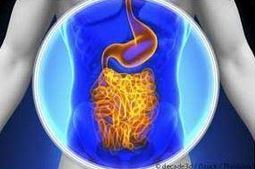
This one-hour complimentary journey will expand your view of how the trillions of bacterial hitchhikers profoundly influence our health. We will discuss how foods, the environment, and our medical practices have impacted our gut bacteria over time and strategies we can take to protect these old friends.
Webinar topics:

Unsure about updates for the 2020 exam?
Coach Beverly offers this FREE webinar to help get you to prepare for the CDCES Exam. All her tips and tricks are meant to ease your mind and reflect the updates to the CDCES content outline.
Instructor: Beverly Thomassian RN, MPH, CDCES, BC-ADM is a working educator who has passed her CDCES Exam 6 times. She is a nationally recognized diabetes expert for over 25 years.
See our Preparing for CDCES Resource Page >>
Sign up for Diabetes Blog Bytes – we post one daily Blog Byte from Monday to Friday. And of course, Tuesday is our Question of the Week. It’s Informative and FREE! Sign up below!
[yikes-mailchimp form=”1″]
Accreditation: Diabetes Education Services is an approved provider by the California Board of Registered Nursing, Provider 12640, and Commission on Dietetic Registration (CDR), Provider DI002. Since these programs are approved by the CDR it satisfies the CE requirements for the CDCES regardless of your profession.*
The use of DES products does not guarantee the successful passage of the CDCES exam. CBDCE does not endorse any preparatory or review materials for the CDCES exam, except for those published by CBDCE.
Unsure about updates for the 2020 exam?
Coach Beverly offers this FREE webinar to help get you to prepare for the CDCES Exam. All her tips and tricks are meant to ease your mind and reflect the updates to the CDCES content outline.
Instructor: Beverly Thomassian RN, MPH, CDCES, BC-ADM is a working educator who has passed her CDCES Exam 6 times. She is a nationally recognized diabetes expert for over 25 years.
See our Preparing for CDCES Resource Page >>
Sign up for Diabetes Blog Bytes – we post one daily Blog Byte from Monday to Friday. And of course, Tuesday is our Question of the Week. It’s Informative and FREE! Sign up below!
[yikes-mailchimp form=”1″]
Accreditation: Diabetes Education Services is an approved provider by the California Board of Registered Nursing, Provider 12640, and Commission on Dietetic Registration (CDR), Provider DI002. Since these programs are approved by the CDR it satisfies the CE requirements for the CDCES regardless of your profession.*
The use of DES products does not guarantee the successful passage of the CDCES exam. CBDCE does not endorse any preparatory or review materials for the CDCES exam, except for those published by CBDCE.

Our October 20th Question of the week quizzed test takers on determining the type of diabetes based on lab results and the history. 68% of respondents chose the correct answer, while 32% did not. We thought that this was an important topic to discuss further, so we can pass on correct info to people living with diabetes.
Before we start though, if you don’t want any spoilers and haven’t tried the question yet, you can answer below: Answer Question
Question: JR has had prediabetes for several years, with A1c’s of 6.0-6.4%. JR is now experiencing sudden hyperglycemia and an A1c is 9.2%, GAD is positive, transglutaminase is negative and TSH is 1.4.
What is the most likely diagnosis?
Answer Choices:
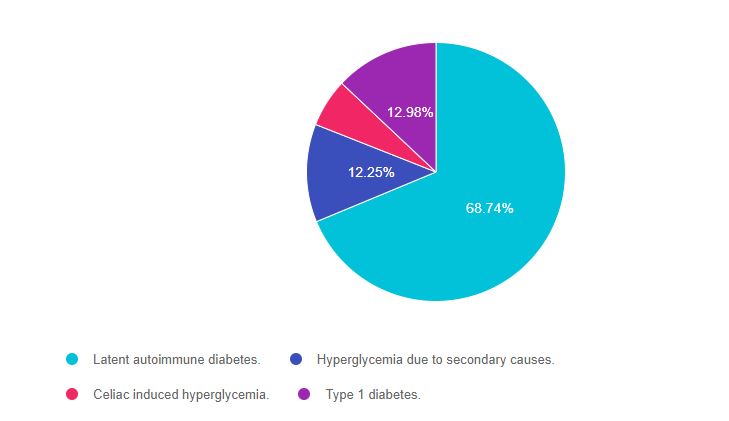
As shown above, the most common choice was option 1, the second most common answer was option 4, then option 2, and finally option 3.
If you are thinking about taking the certification exam, this practice test question will set you up for success. Test writers anticipate possible answers based on the details in the question. They will wave those “juicy answers” right under your nose. Your job is to weed through the particulars, pluck out the most important elements and choose the BEST answer.
Answer 1 is correct. 68.74% chose this answer. “Latent autoimmune diabetes.” To diagnose LADA, the Immunology of Diabetes Society has established three main criteria including: (1) adult age of onset (>30 years); (2) presence of any islet cell autoantibody; and (3) absence of insulin requirement for at least 6 months after diagnosis.
Even though we don’t know the age of this person, the sudden increase in blood glucose and one positive autoantibody (GAD – glutamic acid decarboxylase) plus an elevated A1c without urgent need for insulin therapy, indicate a diabetes 1.5 or LADA. LADA is a slower moving autoimmune attack of the pancreas, but also has features of type 2 diabetes, with some insulin resistance. People with LADA will need insulin therapy, usually with in 6 months, to help with beta cell preservation and prevent glucose toxicity. They are also at risk for other autoimmune co-conditions like thyroid and celiac disease.
Answer 2 is incorrect. 12.25% of you chose this answer, “Hyperglycemia due to secondary causes.” This is a juicy answer, but there is no other factors in the included in the question that indicates any other “secondary” cause (like medications or tube feedings). Also, a positive GAD is a specific test that measures and indicates autoimmune diabetes.
Answer 3 is incorrect. About 6.03% of respondents chose this, “Celiac induced hyperglycemia.” This answer is tempting, since the question mentions transglutaminase, which is a autoimmune blood test for celiac disease. However, the test comes back negative, so there is no celiac disease. Most importantly, there is no diagnosis category of “celiac induced hyperglycemia.”
Finally, Answer 4 is incorrect. 12.98% chose this answer, ” Type 1 diabetes.” Based on the info in the test question, especially that JR had prediabetes” and the fact that only the GAD is positive and the A1c is only modestly elevated, this person is best described as having LADA.
We hope you appreciate this week’s rationale! Thank you so much for taking the time to answer our Question of the Week and participate in this fun learning activity!
Unsure about updates for the 2020 exam?
Coach Beverly offers this FREE webinar to help get you to prepare for the CDCES Exam. All her tips and tricks are meant to ease your mind and reflect the updates to the CDCES content outline.
Instructor: Beverly Thomassian RN, MPH, CDCES, BC-ADM is a working educator who has passed her CDCES Exam 6 times. She is a nationally recognized diabetes expert for over 25 years.
See our Preparing for CDCES Resource Page >>
Sign up for Diabetes Blog Bytes – we post one daily Blog Byte from Monday to Friday. And of course, Tuesday is our Question of the Week. It’s Informative and FREE! Sign up below!
[yikes-mailchimp form=”1″]
Accreditation: Diabetes Education Services is an approved provider by the California Board of Registered Nursing, Provider 12640, and Commission on Dietetic Registration (CDR), Provider DI002. Since these programs are approved by the CDR it satisfies the CE requirements for the CDCES regardless of your profession.*
The use of DES products does not guarantee the successful passage of the CDCES exam. CBDCE does not endorse any preparatory or review materials for the CDCES exam, except for those published by CBDCE.
[yikes-mailchimp form=”1″]
The holidays are upon us in the midst of a pandemic.
In past holiday seasons, I would check in with my clients to see how the holiday season was affecting their health. We would talk about getting enough sleep and adapting exercise routines to adjust for cold weather and shorter days.

We would talk about stress management tools to help cope with the pressures to overeat and the pressures to eat foods that we have been attempting to avoid.
This year is challenging because we are already taxed by the unbelievable stress of living in a pandemic.
I have found that I am already struggling with insomnia and less exercise. I have been overeating and craving sweets. In fact, I think that I have developed a sugar addiction during these last 7 months. I have been substituting ice cream, donuts, and chocolate for the hugs that I used to take for granted. I am missing gatherings, parties, and shared dinners with friends.
Sugar is a powerful stimulant of serotonin that is lacking in my brain these days. I thought that I was developing a cavity and this woke me up.
I had to make a commitment to cut back on sugar.
I thought about the World Health Organization’s sugar recommendation of lowering our free sugar intake to less than 5% of our total daily calories. This works out to about 6 teaspoons a day, depending on the person.
Free sugar applies to
Whole fruit and milk sugar are not included in free sugar.
I started to look at the total amount of free sugar that I was consuming. On some days it added up to over 12 teaspoons per day! And I am a dietitian.
The average American consumes 17 teaspoons of sugar daily. This translates to 57 pounds of sugar consumed each year.
Many people don’t realize that a lot of the sugar they take in are “hidden” in processed foods, according to the World Health Organization.

Research does show that for some people eating sugar produces characteristics of craving and withdrawal, along with chemical changes in the brain’s reward center, the limbic region. These changes are linked to a heightened craving for more sugar.
I am grateful to be able to consciously choose to lower my sugar intake to improve my health.
I am grateful that the whole fruit can be used as a sweet substitute for my sugar cravings.
I love the new fall crop of apples, pears, kiwi, and persimmons.
Below are my recipes for baked apples and poached pears that are a delicious holiday dessert.
Mix the melted butter or coconut oil, walnuts, and cinnamon together and pour over the apples. Bake in the preheated oven until the apples are soft, about 20 – 30 minutes. Stir once during the baking.
Enjoy!

Pour the wine into a small saucepan along with the orange zest and juice and all of the spices
Bring almost to a boil and add the pear halves. Turn down the heat and let the pears simmer gently for 20 – 30 minutes, or until they have slightly softened. Carefully turn the pears over a few times throughout the cooking time to ensure they color evenly. When the pears are cooked remove them from the wine and place them on plates. Add a tablespoon of yogurt to each plate and sprinkle with toasted almonds.
Visit our Joy of 6 Page for sugar info and resources to share with your clients!
Written by Dawn DeSoto RD, CDCES, our resident Nutrition Content Writer

Language use while interviewing someone with diabetes can have a profound impact on the meaningfulness of the interaction.
Which of the following comments uses a person-centered approach and exemplifies the use of updated diabetes language?
Click here to test your knowledge!

As educators, advocates, spouses, friends, and providers, our use of language can deeply affect the self-view of people living with diabetes every day.
Intentional communication is a powerful tool that can uncover trauma, identify barriers, and move both the provider and person with diabetes toward a greater understanding of the issues involved.
The language used in the health care setting is immensely important in determining trust, mutual respect, and meaningful long term relationships.
Sign up for Diabetes Blog Bytes – we post one daily Blog Byte from Monday to Friday. And of course, Tuesday is our Question of the Week. It’s Informative and FREE! Sign up below!
[yikes-mailchimp form=”1″]
Accreditation: Diabetes Education Services is an approved provider by the California Board of Registered Nursing, Provider 12640, and Commission on Dietetic Registration (CDR), Provider DI002. Since these programs are approved by the CDR it satisfies the CE requirements for the CDCES regardless of your profession.*
The use of DES products does not guarantee the successful passage of the CDCES exam. CBDCE does not endorse any preparatory or review materials for the CDCES exam, except for those published by CBDCE.

By taking time for self-compassion, you can decrease your body’s threat response, lower heart rate, and even boost your immune system.
This is especially important to keep in mind and share with our clients during the pandemic since many people are struggling with feelings of isolation, fear, and sorrow.
According to a study conducted by the Universities of Exeter and Oxford, thinking compassionate thoughts about yourself and others has physical benefits.
Researchers believe that meeting negative thoughts with self-compassionate thoughts can be highly beneficial to not only mental health but physical health as well.
In the past, studies have shown a link between self-care and higher levels of overall health and well-being, but scientists didn’t understand why.
“Our study is helping us understand the mechanism of how being kind to yourself when things go wrong could be beneficial in psychological treatments. By switching off our threat response, we boost our immune systems and give ourselves the best chance of healing.”
Mindfully decreasing our threat response, increases relaxation, which is a key factor in allowing the body to regenerate and heal. Our threat response, includes “increased heart rate and sweating, the release of the stress hormone cortisol and over-activity of the amygdala, an integral part of the brain’s emotional network. And a persistent threat response can impair the immune system.”
The study asked participants to listen to either compassionate audio recordings or critical and competitive recordings. Scientists would then record their vitals and ask them a series of questions.
Those encouraged to practice self-compassion had a lower heart rate and a general feeling of “safety.” While those who listen to negative critical audio statements had an increase in heart rate and higher sweat response.
We invite you to watch our FREE Mindful Diabetes Encounter Webinar designed for diabetes professionals.
To learn more: Self-Compassion Exercises Show Physical, Psychological Benefits – Psych Central
Sign up for Diabetes Blog Bytes – we post one daily Blog Byte from Monday to Friday. And of course, Tuesday is our Question of the Week. It’s Informative and FREE! Sign up below!
[yikes-mailchimp form=”1″]
Accreditation: Diabetes Education Services is an approved provider by the California Board of Registered Nursing, Provider 12640, and Commission on Dietetic Registration (CDR), Provider DI002. Since these programs are approved by the CDR it satisfies the CE requirements for the CDCES regardless of your profession.*
The use of DES products does not guarantee the successful passage of the CDCES exam. CBDCE does not endorse any preparatory or review materials for the CDCES exam, except for those published by CBDCE.
Our October 13th Question of the week quizzed test-takers insulin pump management for an older person with type 1 and dementia. The majority of respondents (82%) chose the correct answer! Great job. Even though most of you got it right, we think it is an important topic to explore and discuss.
Before we start though, if you don’t want any spoilers and haven’t tried the question yet, you can answer below: Answer Question
Question: AJ is 89 years old with type 1 diabetes and is a caretaker for a partner with dementia. AJ is on an insulin pump and uses a meter to check blood glucose levels 4-7 times a day. AJ mentions that they were surprised the other morning that their blood glucose was 59 mg/dl and they felt fine.
Based on this, what is the best action?
Answer Choices:
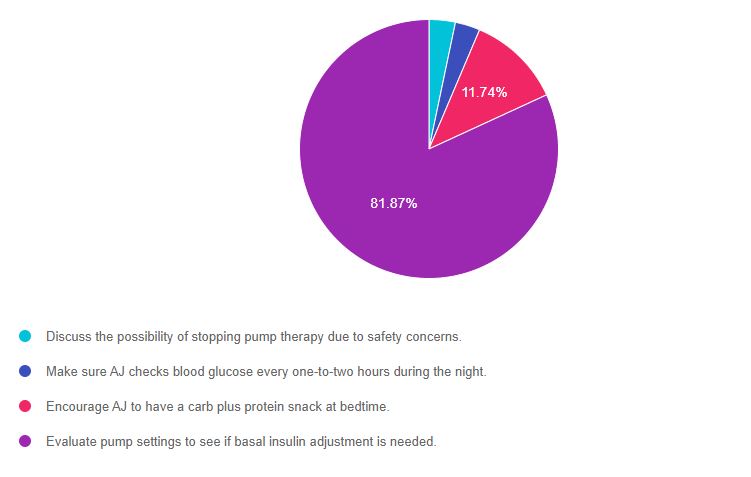
As shown above, the most common choice was option 4, the second most common answer was option 3, then option 1, and finally option 2.
If you are thinking about taking the certification exam, this practice test question will set you up for success. Test writers anticipate possible answers based on the details in the question. They will wave those “juicy answers” right under your nose. Your job is to weed through the particulars, pluck out the most important elements and choose the BEST answer.
Answer 1 is incorrect. 3.28% chose this answer, “Discuss the possibility of stopping pump therapy due to safety concerns”. For older clients, safety is a top priority. However, based on this vignette, there has not been a pattern of lows and AJ is able to check glucose levels on a regular basis. In addition, for people with type 1, insulin pump therapy decreases the ups and downs associated with multiple daily injections and offers more dosing flexibility. So instead of stopping the pump, suggesting the use of continuous glucose monitor could be another option.
Answer 2 is incorrect. 3.11% of you chose this answer, “Make sure AJ checks blood glucose every one-to-two hours during the night”. Safety is a big issue for older adults, but checking every one-to-two hours is not realistic and would be very disruptive to sleep. They could consider a 2-3am glucose check to see if blood sugars are trending down. If blood sugars are trending down, they could decrease the basal rate overnight to protect against morning hypoglycemia.
Answer 3 is incorrect. About 11.74% of respondents chose this, ” Encourage AJ to have a carb plus protein snack at bedtime”. This is not the best answer because we don’t have any information on the level of nighttime glucose. It is true, that for older people on insulin pumps, going to sleep with a glucose of 150 mg/dl or greater is important to protect against nocturnal hypoglycemia. But, if the bedtime glucose was less than 150 mg/dl, AJ would just need a 15-30 gm carbohydrate snack. Studies have found that adding protein doesn’t help prevent hypoglycemia, it is the carbohydrates that protect against falling blood sugars.
Lastly, we don’t want to have to “feed the insulin”. If basal insulin is set correctly overnight, AJ would wake up with glucose on target, even without eating a bedtime snack.
Finally, Answer 4 is correct. 81.87% chose this answer, “Evaluate pump settings to see if basal insulin adjustment is needed”. YES! If basal insulin is set correctly overnight, AJ would wake up with glucose on target.
I encourage people on insulin pumps to write down their basal rates, carb to insulin ratios, and corrections factors, on a piece of paper with a date. Then take a picture of it on their phone, so they can always access it and evaluate if those calculations might need a little tweaking as the body changes over time. And of course, we need to include the support person in all these discussions since AJ is living with dementia.
We hope you appreciate this week’s rationale! Thank you so much for taking the time to answer our Question of the Week and participate in this fun learning activity!
“This is one of the best review courses I’ve ever taken.”
“I learned so much from the CDCES Exam Prep Toolkit. I now have an assessment after taking the practice exam on the areas I need to focus my studying.”
Student Feedback

Whether you are preparing for the CDCES or BC-ADM exam, this test-taking toolkit is designed to prepare you for success. This toolkit includes two courses with over 200 practice questions to help you prepare and simulate the exam. Plus, we have added a FREE bonus course, Language, and Diabetes – What we say matters. Coach Beverly added this course because she believes it contains critical content for the exam and for our clinical practice!
Sign up for Diabetes Blog Bytes – we post one daily Blog Byte from Monday to Friday. And of course, Tuesday is our Question of the Week. It’s Informative and FREE! Sign up below!
[yikes-mailchimp form=”1″]
Accreditation: Diabetes Education Services is an approved provider by the California Board of Registered Nursing, Provider 12640, and Commission on Dietetic Registration (CDR), Provider DI002. Since these programs are approved by the CDR it satisfies the CE requirements for the CDCES regardless of your profession.*
The use of DES products does not guarantee the successful passage of the CDCES exam. CBDCE does not endorse any preparatory or review materials for the CDCES exam, except for those published by CBDCE.
JR has had prediabetes for several years, with A1c’s of 6.0-6.4%. JR is now experiencing sudden hyperglycemia and an A1c is 9.2%, GAD is positive, transglutaminase is negative and TSH is 1.4.
What is the most likely diagnosis?
Click here to test your knowledge!

Beverly has custom designed this deluxe course bundle to prepare you for your CDCES (formerly known as CDE) or BC-ADM Exam.
This Deluxe Prep Bundle includes:
Use code “SUCCESS10” by October 31st to receive 10% off.
Sign up for Diabetes Blog Bytes – we post one daily Blog Byte from Monday to Friday. And of course, Tuesday is our Question of the Week. It’s Informative and FREE! Sign up below!
[yikes-mailchimp form=”1″]
Accreditation: Diabetes Education Services is an approved provider by the California Board of Registered Nursing, Provider 12640, and Commission on Dietetic Registration (CDR), Provider DI002. Since these programs are approved by the CDR it satisfies the CE requirements for the CDCES regardless of your profession.*
The use of DES products does not guarantee the successful passage of the CDCES exam. CBDCE does not endorse any preparatory or review materials for the CDCES exam, except for those published by CBDCE.