
Subscribe
eNewsletter

Ready to get certified?
Free CDCES Coach App

eNewsletter
Free CDCES Coach App
Click here to read our full October newsletter.
Greetings to our awesome diabetes community.
For this newsletter, we are excited to share three diabetes medication announcements. Our updated PocketCards are ready for downloading and viewing with these changes.
We know how much you love testing your knowledge, so we have created 3 new quizzes in our CDCES Coach App. For now, you can access these quizzes for free, so flex your test-taking muscle today.
The pandemic has taken a toll on people with diabetes and exposed the impact of health inequities. We take a moment to pause and reflect on the impact of this pandemic, with a special focus on food insecurity and actions we can take to address gaps in health care.
Lainey Koski was the first full-time employee at my company. She was not only an exceptional colleague, she was a wonderful human and friend. We pay tribute to Lainey, who left us way too soon.
Finally, since November 3rd is around the corner, we have included information on finding a polling place near you.
Be safe, take care of yourself, and take time to enjoy the small wonders.
Coach Beverly, Bryanna, and Jackson
Click here to read our full October newsletter.
Sign up for our newsletter

We are so excited that the 5th edition The Art and Science of Diabetes Care and Education is finally here!
This specialist’s one-volume, go-to resource for the core knowledge and skills for providing person-centered care and education to persons with diabetes and related chronic conditions. This is a core resource for those who are studying for the Certified Diabetes Care and Education Specialist® (CDCES) exam.
Updates:
Sign up for Diabetes Blog Bytes – we post one daily Blog Byte from Monday to Friday. And of course, Tuesday is our Question of the Week. It’s Informative and FREE! Sign up below!
[yikes-mailchimp form=”1″]Accreditation: Diabetes Education Services is an approved provider by the California Board of Registered Nursing, Provider 12640, and Commission on Dietetic Registration (CDR), Provider DI002. Since these programs are approved by the CDR it satisfies the CE requirements for the CDCES regardless of your profession.*
The use of DES products does not guarantee the successful passage of the CDCES exam. CBDCE does not endorse any preparatory or review materials for the CDCES exam, except for those published by CBDCE.

Quick confession. I had an ulterior motive to last week’s question of the week. I saw a disturbing and heartbreaking report, that during the pandemic, the rate of lower extremity amputations has tripled. This sudden increase is due to combination of wound clinic closures and people’s reluctance to enter health care settings to receive treatment and expose themselves to COVID. This article in Diabetes Care reports success remotely treating ulcerations and lower extremity infections with antibiotics and other modalities.
As Diabetes advocates, we can help decrease amputation rates during this pandemic. We can encourage people to report lower extremity sores, ulcers or other problems promptly, so they can receive early treatment and prevent far worse outcomes.
Our September 30th Question of the week quizzed test takers on reasons behind a sudden spike in glucose levels. 87% of respondents chose the correct answer, our best score to date. Congratulations!
Before we start though, if you don’t want any spoilers and haven’t tried the question yet, you can answer below: Answer Question
Question: LT, a 59-year old with type 2 diabetes presents to the hospital in a hyperglycemic crisis. LT has a history of hypertension, peripheral vascular disease and smokes a pack per day. LT states they have been taking 1000mg metformin BID and 10 units basaglar every night as usual. LT tells you they are stressed out and concerned about a foot sore that doesn’t seem to be getting better. LT is trying to stay home and avoid other people, to prevent getting COVID. LT’s A1C is 8.8%.
What is the most likely cause of this sudden hyperglycemia?
Answer Choices:
As shown above, the most common choice was option 2, the second most common answer was option 1, then option 4, and finally option 3.
If you are thinking about taking the certification exam, this practice test question will set you up for success. Test writers anticipate possible answers based on the details in the question. They will wave those “juicy answers” right under your nose. Your job is to weed through the particulars, pluck out the most important elements and choose the BEST answer.
Answer 1 is incorrect. 6.41% chose this answer, “Stress eating due to isolation”. It is true that people often respond to stressful situations by eating more or sometimes decreasing food intake. However, since LT is taking diabetes medication and insulin, increasing food intake is very unlikely to create a hyperglycemic crisis. And, more than that, there is a better answer.
Answer 2 is correct. 87% of you chose this answer, ” Untreated infection”. Sometimes the “no-frills” answer is the best answer. In the vignette, “LT tells you they are stressed out and concerned about a foot sore that doesn’t seem to be getting better”. During the pandemic, the rate of lower extremity amputations has tripled due to wound clinic closures and people’s reluctance to enter health care settings to receive treatment and expose themselves to COVID. This article in Diabetes Care reports success remotely treating ulcerations and lower extremity infections with antibiotics and other modalities. Please encourage people to report lower extremity sores, ulcers or other problems so they can receive prompt treatment and prevent far worse outcomes.
Answer 3 is incorrect. About 2% of respondents chose this, “Rationing medications due to financial hardship.” Although this is a tempting choice, there is no mention that LT has financial problems, so we can’t infer that he does. We can only use the information contained in the vignette.
Finally, Answer 4 is incorrect. 5% chose this answer, “Insulin resistance secondary to cigarette smoking”. While it is true that smoking increases insulin resistance, this isn’t a new habit. He is an established smoker so his usual smoking wouldn’t lead to a sudden glucose spike.
We hope you appreciate this week’s rationale! Thank you so much for taking the time to answer our Question of the Week and participate in this fun learning activity!
Sign up for Diabetes Blog Bytes – we post one daily Blog Byte from Monday to Friday. And of course, Tuesday is our Question of the Week. It’s Informative and FREE! Sign up below!
[yikes-mailchimp form=”1″]Accreditation: Diabetes Education Services is an approved provider by the California Board of Registered Nursing, Provider 12640, and Commission on Dietetic Registration (CDR), Provider DI002. Since these programs are approved by the CDR it satisfies the CE requirements for the CDCES regardless of your profession.*
The use of DES products does not guarantee the successful passage of the CDCES exam. CBDCE does not endorse any preparatory or review materials for the CDCES exam, except for those published by CBDCE.
[yikes-mailchimp form=”1″]
JR has type 2 diabetes and an A1c of 9.4%. He is on 3 medications for diabetes and now needs to start insulin. JR says, “I just don’t know if insulin would help me. My brother took insulin and he had all kinds of problems.”
What best describes JR’s stage of change using the transtheoretical model?
Click here to test your knowledge!
Join us for our free webinar Preparing for the BC-ADM Exam
October 8th at 11:30 am (PST)

This free webinar will review BC-ADM requirements for the current year.
Coach Beverly will discuss:
She will also review sample test questions and reasoning behind choosing the right answers. We hope you can join us.
Sign up for Diabetes Blog Bytes – we post one daily Blog Byte from Monday to Friday. And of course, Tuesday is our Question of the Week. It’s Informative and FREE! Sign up below!
[yikes-mailchimp form=”1″]Accreditation: Diabetes Education Services is an approved provider by the California Board of Registered Nursing, Provider 12640, and Commission on Dietetic Registration (CDR), Provider DI002. Since these programs are approved by the CDR it satisfies the CE requirements for the CDCES regardless of your profession.*
The use of DES products does not guarantee the successful passage of the CDCES exam. CBDCE does not endorse any preparatory or review materials for the CDCES exam, except for those published by CBDCE.
Looking for awe helps us move from dis-ease to a sense of well-being.

We all know the physical health benefits of walking, but what if we add the intention to experience “awe” during our jaunts?
Researchers divided older subjects, (60 years plus) into 2 different groups. Both groups walked for 15 minutes and logged how they were feeling and thinking about during their walks.
However, the experimental group was asked to walk for 15 minutes in a natural setting and to intentionally look for moments of “awe” during their outings.
In the study, people who took a fresh look at the objects, moments and vistas that surrounded them during brief, weekly walks felt more upbeat and hopeful in general than walkers who did not. The findings are subjective but indicate that awe walks could be a simple way to combat malaise and worry.
Gretchen Reynolds
Examples of “awe” discoveries could include simple things like noticing a frog peeking at you from a nearby pond. Or observing the variety of hues during sunset. Or looking up at the sky through a rainbow of trees.

As expected, the study participants who simply looked for these moments of awe, had an associated improvement in their sense of well being. Overall, the awe walkers felt happier, less upset, and more socially connected than the men and women in the control group.
As diabetes specialists, we encourage people to walk to help lower glucose, improve balance, and gain muscle mass. By adding this element of awe, we just might be helping people gain enhanced quality of life too.
Life is hard right now and many people are feeling isolated and sorrowful. By taking a fresh look at these little wonders all around us, it reminds us that we are a part of something bigger than ourselves. And in that knowing, that each of us is important, meaningful, and loved.
Happy Monday. Love, Coach Beverly
Sign up for Diabetes Blog Bytes – we post one daily Blog Byte from Monday to Friday. And of course, Tuesday is our Question of the Week. It’s Informative and FREE! Sign up below!
[yikes-mailchimp form=”1″]Accreditation: Diabetes Education Services is an approved provider by the California Board of Registered Nursing, Provider 12640, and Commission on Dietetic Registration (CDR), Provider DI002. Since these programs are approved by the CDR it satisfies the CE requirements for the CDCES regardless of your profession.*
The use of DES products does not guarantee the successful passage of the CDCES exam. CBDCE does not endorse any preparatory or review materials for the CDCES exam, except for those published by CBDCE.
Our September 22nd Question of the week explored making adjustments in insulin pump therapy to prevent hypoglycemia. 38% of respondents chose the correct answer, while 62% did not. We thought that this was an important topic to discuss further, so we can pass on correct info to people living with diabetes.
Before we start though, if you don’t want any spoilers and haven’t tried the question yet, you can answer below: Answer Question
Question: AR is a 39-year-old on an insulin pump and CGM. AR’s basal rates are:
AR’s insulin to carb ratio is 1:15 and the correction is 1:50 with a blood sugar target 100-120.
When looking at AR’s report, they are bolusing for meals at 7 am, noon and 7 pm. AR is experiencing blood sugars of 60 -70 around 10 am and 3 pm every day.
Based on this data, what is the best recommendation?
Answer Choices:
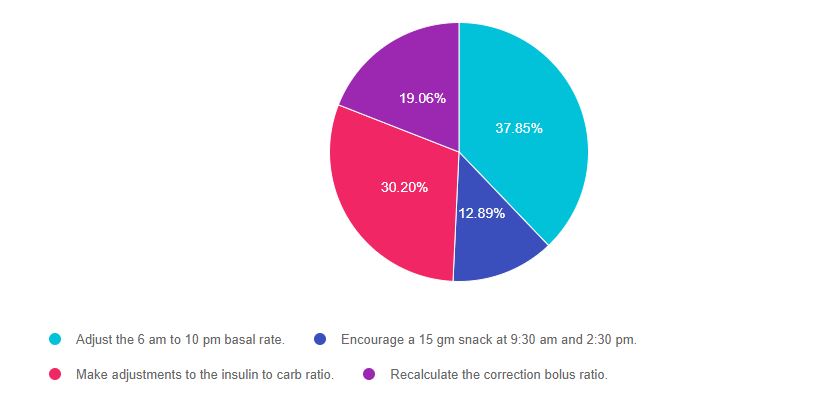
As shown above, the most common choice was option 1, the second most common answer was option 3, then option 4, and finally option 3.
If you are thinking about taking the certification exam, this practice test question will set you up for success. Test writers anticipate possible answers based on the details in the question. They will wave those “juicy answers” right under your nose. Your job is to weed through the particulars, pluck out the most important elements and choose the BEST answer.
Answer 1 is correct. 38% chose this answer. “Adjust the 6 am to 10 pm basal rate.” This is the best answer. When someone is on an insulin pump, the basal insulin is being delivered 24 hours a day. If blood sugars are dropping in-between meals or through the night, too much basal insulin is the usual culprit. People with this problem might complain of having to eat frequently throughout the day to prevent or treat hypoglycemic events. We could describe this as “feeding the insulin” which leads to unwanted weight gain. The goal of insulin therapy is to take the least amount of insulin needed to manage blood sugars. Over insulinization leads to weight gain and hypoglycemia.
Answer 2 is incorrect. 13% of you chose this answer. “Encourage a 15 gm snack at 9:30 am and 2:30 pm”. This is not the best answer because we want to focus on PREVENTING hypoglycemia instead of chasing after it. This is best accomplished by decreasing the insulin delivered.
Answer 3 is incorrect. About 30% of respondents chose this. “Make adjustments to the insulin to carb ratio.” Although this answer is tempting, it is not the best answer. These low blood sugars are occurring over 3 hours after eating and taking bolus insulin to cover for carbs. If AR was taking too much insulin to cover carbs, we would expect a low blood sugar closer to the meal time. Since it is 3 hours post-meal and bolus, basal insulin is more suspect. However, if we reduce the basal rate between 6 am to 10 pm and the person is still getting low blood sugars three hours post-meal, we could certainly reconsider adjusting the insulin-to-carb ratio.
Finally, Answer 4 is incorrect. 19% chose this answer. “Recalculate the correction bolus ratio”. Although this is another tempting answer, we don’t’ have enough information in the vignette question to choose this answer. The question doesn’t say, for example, at breakfast the blood sugar was 202, so AR took 2 units to correct plus insulin for carbs. We can only base our answer on the information provided in the question.
We had over 1000 people take this practice test question. We sure appreciate your participation and enthusiasm!
Want to learn more pumps, sensors, and calculations?
Enroll in our Technology Toolkit

Due to technical difficulty during our July 21st course, we are re-recording session 1 and adding a new date for session 2. We apologize in advance for the inconvenience and we appreciate your patience.
Tech 101 – Pumps and Sensors Update and Overview
Join Coach Beverly for an overview of the complex world of insulin pumps and continuous glucose monitors. This webinar will discuss the features of available technologies, basic functions and how to integrate these into our practice. We will discuss the benefits, considerations and critical information to share with clients and providers.
Tech 102 – Insulin Pump Calculations; From basal to square bolus
Determining basal and bolus rates for insulin pumps can seem overwhelming. This course provides participants with a step-by-step approach to determine basal rates, bolus ratios and how to problem solve when blood glucose levels aren’t on target. Included is a discussion on DKA recognition and an explanation of the safe use of technology in the hospital setting.
Sign up for Diabetes Blog Bytes – we post one daily Blog Byte from Monday to Friday. And of course, Tuesday is our Question of the Week. It’s Informative and FREE! Sign up below!
[yikes-mailchimp form=”1″]Accreditation: Diabetes Education Services is an approved provider by the California Board of Registered Nursing, Provider 12640, and Commission on Dietetic Registration (CDR), Provider DI002. Since these programs are approved by the CDR it satisfies the CE requirements for the CDCES regardless of your profession.*
The use of DES products does not guarantee the successful passage of the CDCES exam. CBDCE does not endorse any preparatory or review materials for the CDCES exam, except for those published by CBDCE.
[yikes-mailchimp form=”1″]LT, a 59-year old with type 2 diabetes presents to the hospital in a hyperglycemic crisis. LT has a history of hypertension, peripheral vascular disease and smokes a pack per day. LT states they have been taking 1000mg metformin BID and 10 units basaglar every night as usual. LT tells you they are stressed out and concerned about a foot sore that doesn’t seem to be getting better. LT is trying to stay home and avoid other people, to prevent getting COVID. LT’s A1C is 8.8%.
What is the most likely cause of this sudden hyperglycemia?
Click here to test your knowledge!
We are so excited that the 5th edition The Art and Science of Diabetes Care and Education is finally here!
This specialist’s one-volume, go-to resource for the core knowledge and skills for providing person-centered care and education to persons with diabetes and related chronic conditions. This is a core resource for those who are studying for the Certified Diabetes Care and Education Specialist® (CDCES) exam.
Updates:
2020 Boot Camp Live Stream Webinar Schedule with Coach Beverly
All courses air at 11:30 a.m. (PST)
Sign up for Diabetes Blog Bytes – we post one daily Blog Byte from Monday to Friday. And of course, Tuesday is our Question of the Week. It’s Informative and FREE! Sign up below!
[yikes-mailchimp form=”1″]Accreditation: Diabetes Education Services is an approved provider by the California Board of Registered Nursing, Provider 12640, and Commission on Dietetic Registration (CDR), Provider DI002. Since these programs are approved by the CDR it satisfies the CE requirements for the CDCES regardless of your profession.*
The use of DES products does not guarantee the successful passage of the CDCES exam. CBDCE does not endorse any preparatory or review materials for the CDCES exam, except for those published by CBDCE.
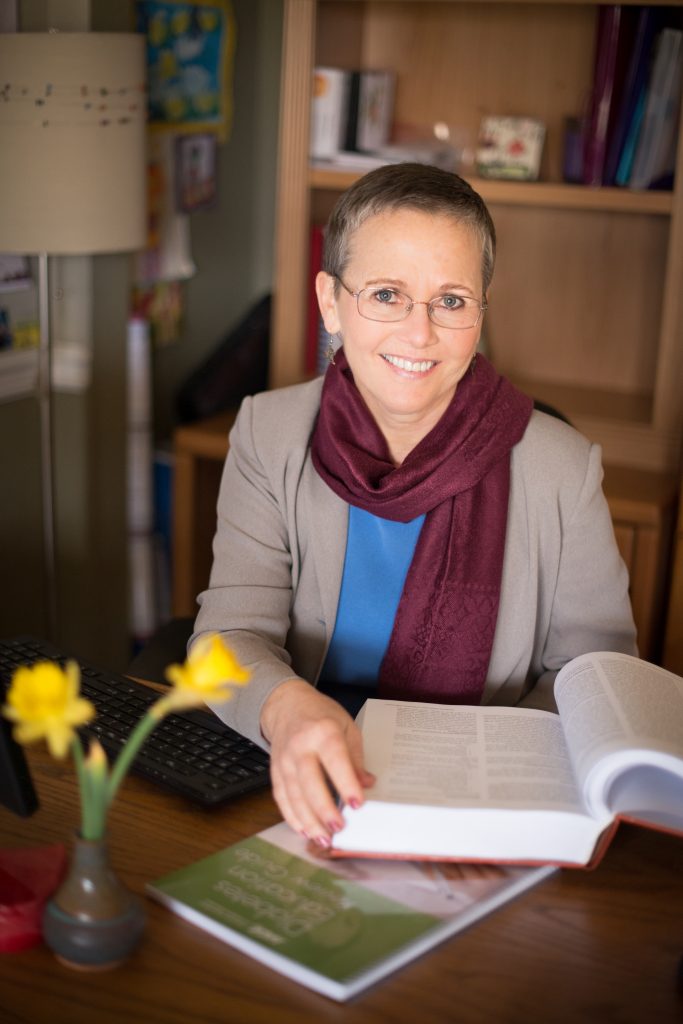
It was a beautiful warm evening when I interviewed Lainey Koski in the spring of 2012. Fifteen minutes into our conversation, I was tearing up with joy, because I knew she was exactly the person I didn’t know I needed.
Lainey had just moved to Chico a few weeks earlier to be closer to her grandchildren and answered my ad for an Administrative Assistant.
From our brief interview, a few critical things stood out. She had built a computer from scratch. She was calm and kindhearted, but she had a certain fierceness and determination about her too. She had a wealth of technology and administrative experience. In short, she was the perfect person to become the first full-time employee of my small, but growing, business.
Lainey elevated our customer service by making sure our website platforms were user-friendly and easy to navigate. In addition, she had a certain technological magic that assured our platforms, and Online University was working right on the back-end. Her genuine concern, skills, knowledge, and attention to detail helped move our company to the next level.
Lainey loved calling customers to speak to them directly.
Even when people emailed with questions about the online university or our website, she would pick up the phone and make sure they had a complete understanding and a fantastic experience.
When Lainey first started, I asked her to believe that together, we were going to grow this little company called Diabetes Education Services.
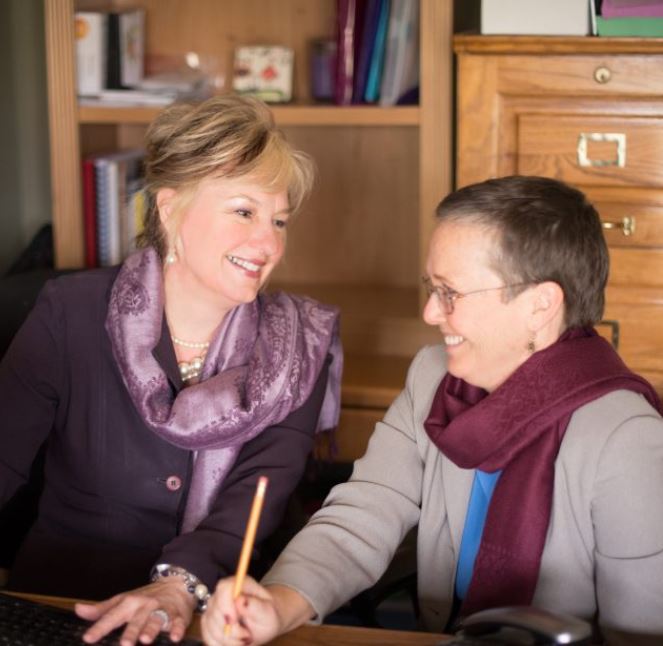
Lainey was such a great sport. For the first year of working together, we were squeezed into a 10×10 bedroom with 2 desks, our products, a packing station, and my treadmill desk. In addition, my boys, who were 7 and 10 at the time, were frequent visitors. And then there were the two dogs and two cats, who contributed to the overall experience of working in a home-based- office.
Through all the commotion and chaos, Lainey was gracious and understanding. She provided helpful insights on parenting and had a lot of wisdom to share on canning, gardening, and jam making. She shared stories about her adventurous parents, who, with all the kids in tow, traveled extensively plus created a family band.
But it was when she spoke of her grandchildren, that her whole face and being beamed with joy. She would share funny and heartwarming stories about sleepovers with Grandma and their special outings together. Over time, I was fortunate enough to become friends with her daughter, son-in-law, grandchildren, sisters, and husband. My life is richer and better because of knowing Lainey and by extension, her wonderful family.
We worked hard together and had fun too!
In January 2012, Lainey and I conjured up a plan to do a virtual walk across the country to the Banting Museum (where insulin was discovered) in Ontario, Canada. We wanted to make it in time to celebrate World Diabetes Day on November 14th. We both got pedometers and started tracking our daily steps. The Banting Museum was 2,642 miles away. We set a goal of each of us walking at least 50 miles a week, for a combined total of 400 miles a month. We plotted our journey on maps, made virtual stops at all kinds of fun places, and shared our walking path on our Facebook posts and in our monthly newsletter.
We made it to Canada in time to virtually celebrate with the Banting Folk and we continued our U.S virtual tour back home. To this day, I am still walking at least 50 miles a week to continue this tradition that Lainey and I started over 8 years ago.
Finally, in early 2013, we broke ground on our new office. Lainey and I had so much fun picking out paint colors, countertops, and designing our product storage area and packing station.

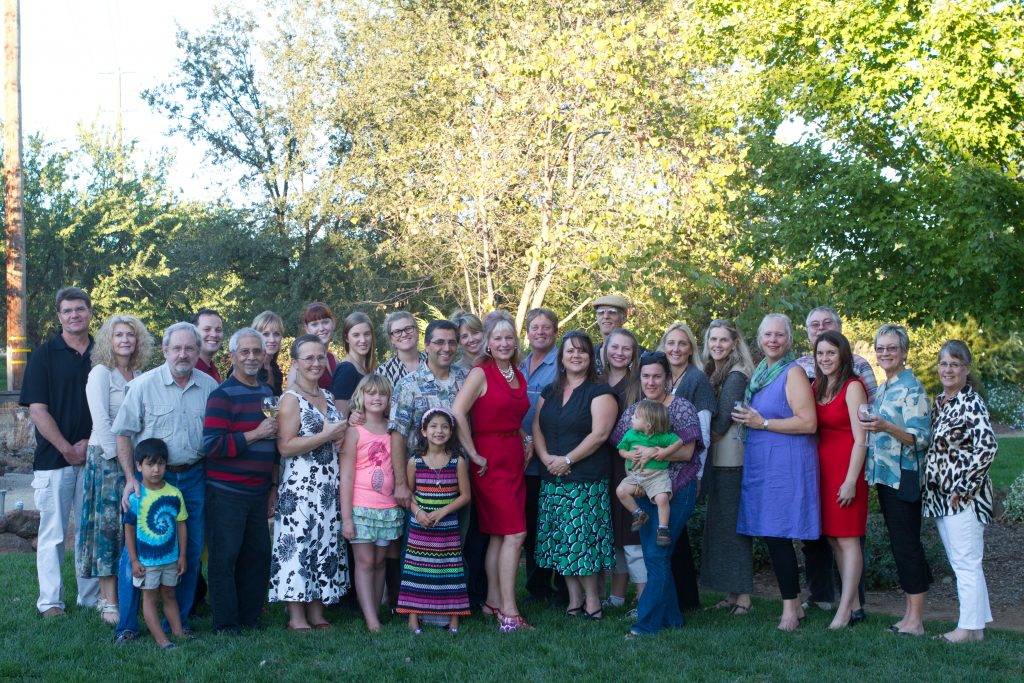
Lainey is pictured here donning a hard hat in a photoshoot that I had to coax her into doing. She was shy and humble, but with a little encouragement, she was game for almost anything.
To this day, when I look around the beautiful office design and layout, I am reminded of all of Lainey’s ideas and contributions as we created our dream working space.
Early in 2015, Lainey announced that she and her husband Willie would be moving to a homestead near her parents, where she could plant a garden, raise goats, and reconnect with the land.
I didn’t want to see her go, but I was so appreciative of how much she had improved my business and set me up for ongoing success. And, of course, I was joyful that she was moving to live her dream. We agreed that she would continue to provide tech consulting services and help keep our Medication PocketCards up-to-date and posted on our website and CDCES Coach app. Just a few months ago, Lainey helped to design and publish our first Glucagon Emergency Medication PocketCard.
Sadly, Lainey unexpectedly passed away on September 12, 2020. She was young at heart, vibrant, and living her life just as she wanted, on her ranch near her family and connected to the earth, all the way through.
This post is my opportunity to share my profound sorrow and grief of losing such a wonderful human and dear friend way too soon. Many of you reading this might have met or talked to Lainey along the way, and I know that like me, you were blessed for having known her.
But even more important, this is my note of joy and celebration for having the great honor of working with, dreaming with, and loving Lainey Koski as a friend, colleague, role model, and teacher.
Thank you Lainey and know that your light shines on in all the lives you have touched, including mine!
Our new Diabetes Cheat Sheets are available on our CDCES Coach app!
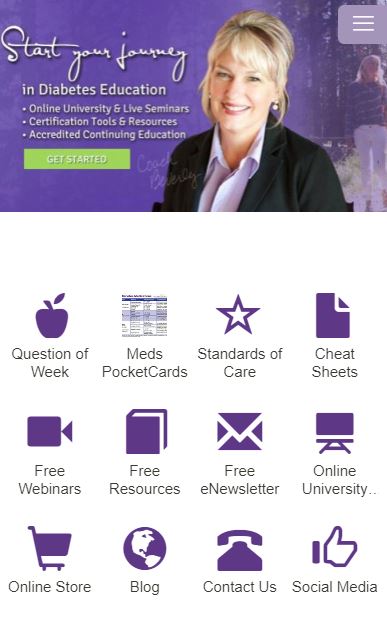
We know how helpful these resources are for busy diabetes educations specialists so we wanted to make accessing them even easier!
If you don’t have it already, you can download our free CDCES Coach app and view or print the Cheat Sheets directly from the app.
These sheets and cards include information to study for certification exams and to use in your clinical setting. Plus, we have included teaching sheets for people with diabetes.
Studying for the CDCES Exam?
Join us for our free Preparing for the CDCES Exam Webinar on October 1st at 11:30 am

Unsure about updates for the 2020 exam?
Coach Beverly offers this FREE webinar to help get you to prepare for the CDCES Exam. All her tips and tricks are meant to ease your mind and reflect the updates to the CDCES content outline.
Instructor: Beverly Thomassian RN, MPH, CDCES, BC-ADM is a working educator who has passed her CDCES Exam 6 times. She is a nationally recognized diabetes expert for over 25 years.