
Subscribe
eNewsletter

Ready to get certified?
Free CDCES Coach App

eNewsletter
Free CDCES Coach App

Young adults and youth with diabetes in the United States have rising HgbA1c’s despite advances in diabetes technologies.
At the recent virtual ADA Scientific Sessions, Faisal Malik MD, MSHS, shared findings from the SEARCH for Diabetes in Youth studies, which are funded by the National Institute of Diabetes and Digestive and Kidney Diseases and the CDC.
According to Dr. Faisal Malik, by comparing results found in 2002-2007 (HbA1c mean, 8.6%) SEARCH studies to more recent data from 2014-2019 (HbA1c mean, 8.7%), we see that glycemic responses continue to rise for younger people.
“These results suggest that not all youth and young adults with diabetes are directly benefiting from the increased availability of diabetes technology, newer therapies, and the use of more aggressive glycemic targets for youth with diabetes over time,” said Dr. Faisal Malik.
For many, our teenage years and early adulthood are challenging, this pivotal time in our lives becomes even more challenging when we have the responsibility of managing diabetes. This population needs a lot of support.
We can offer more support through an increase of interventions including support groups, scheduled routine follow up visits, family and peer support groups, in addition to the newer therapies and advanced technology.
In addition, support networks like The College Diabetes Network for college-age youth transitioning to college is another resource for this age group.
This age group needs our support, empathy, and compassion, to successfully meet the challenges of managing type 1 and type 2 diabetes.
Written by Catherine Cullinane RN, CDCES, our resident Tech Thursday Content Writer
Read more here.
Sign up for Diabetes Blog Bytes – we post one daily Blog Byte from Monday to Friday. And of course, Tuesday is our Question of the Week. It’s Informative and FREE! Sign up below!
[yikes-mailchimp form=”1″]
Accreditation: Diabetes Education Services is an approved provider by the California Board of Registered Nursing, Provider 12640, and Commission on Dietetic Registration (CDR), Provider DI002. Since these programs are approved by the CDR it satisfies the CE requirements for the CDCES regardless of your profession.*
The use of DES products does not guarantee the successful passage of the CDCES exam. CBDCE does not endorse any preparatory or review materials for the CDCES exam, except for those published by CBDCE.
Click here to view our Top 3 Blogs Newsletter

Happy Wednesday Diabetes Community!
We are excited to announce our new feature; Top 3 blog posts of the Month.
Coach Beverly and team are committed to keeping you apprised of the latest findings in diabetes.
We promise to keep this end-of-the-month wrap-up announcement short and sweet while providing links to references so you can dig deeper.
As part of our commitment to sharing information, we are offering FREE webinar viewing of our Level 2 Standards Intensive Series. See upcoming topics and dates below.
Our top 3 blogs this month include the recall of some long-acting metformin brands, Medicare’s $35 monthly cap on insulin starting in 2021, and the rationale for this month’s most popular question of the week.
Happy early July 4th weekend. Please stay safe and take good care.
Coach Beverly
Click here to view our Top 3 Blogs Newsletter
Check out our new bundle!
Level 3 | Boot Camp + Expert Team Bundle
Join us live starting September 16th!
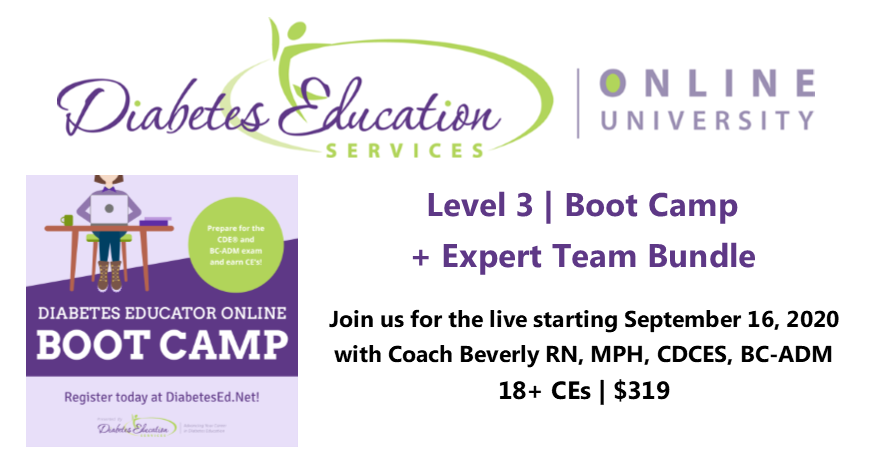
When you join our DiabetesEd Certification Boot Camp, it’s like having your own online coaching staff.
?In each webinar, either Coach Beverly, Dr. Isaacs, or Ms. Armstrong, highlight the critical content of each topic area, so you can focus your study time most efficiently. They also launch multiple poll questions to help participants focus on key concepts and assess their knowledge while learning the best test-taking strategies.
Mastery of this content is critical to ensure certification exam success and to improve clinical outcomes.
Click here to download Level 3 + Expert Bundle flyer
Sign up for Diabetes Blog Bytes – we post one daily Blog Byte from Monday to Friday. And of course, Tuesday is our Question of the Week. It’s Informative and FREE! Sign up below!
[yikes-mailchimp form=”1″]
Accreditation: Diabetes Education Services is an approved provider by the California Board of Registered Nursing, Provider 12640, and Commission on Dietetic Registration (CDR), Provider DI002. Since these programs are approved by the CDR it satisfies the CE requirements for the CDCES regardless of your profession.*
The use of DES products does not guarantee the successful passage of the CDCES exam. CBDCE does not endorse any preparatory or review materials for the CDCES exam, except for those published by CBDCE.

AJ is admitted to the hospital for the second time this month for DKA. The 28-year-old has type 1 diabetes, wears a CGM, and uses insulin pen injections. AJs last A1c was 11.3%. AJs admitting glucose is 498 mg/dl, his pH is 7.05, and is anion gap is above 12.
What are the next steps?
Click here to test your knowledge!

Unsure about updates for the 2020 exam?
Coach Beverly offers this FREE webinar to help get you to prepare for the CDCES Exam. All her tips and tricks are meant to ease your mind and reflect the updates to the CDCES content outline.
Instructor: Beverly Thomassian RN, MPH, CDCES, BC-ADM is a working educator who has passed her CDCES Exam 6 times. She is a nationally recognized diabetes expert for over 25 years.
See our Preparing for CDCES Resource Page >>
Test Taking Toolkit (220+ practice questions)
Whether you are preparing for the updated CDCES or BC-ADM exam, this test-taking toolkit is designed to prepare you for success.
This toolkit includes two courses with over 220 practice questions to help you prepare and simulate the exam.
Sign up for Diabetes Blog Bytes – we post one daily Blog Byte from Monday to Friday. And of course, Tuesday is our Question of the Week. It’s Informative and FREE! Sign up below!
[yikes-mailchimp form=”1″]
Accreditation: Diabetes Education Services is an approved provider by the California Board of Registered Nursing, Provider 12640, and Commission on Dietetic Registration (CDR), Provider DI002. Since these programs are approved by the CDR it satisfies the CE requirements for the CDCES regardless of your profession.*
The use of DES products does not guarantee the successful passage of the CDCES exam. CBDCE does not endorse any preparatory or review materials for the CDCES exam, except for those published by CBDCE.
Our May 26th Question of the week was a question about carb counting. Although 56% of respondents chose the correct answer, 44% did not. We thought that this was an important topic to discuss further, so we can pass on correct info to people living with diabetes.
Before we start though, if you don’t want any spoilers and haven’t tried the question yet, you can answer below: Answer Question
Question: AJ is motivated to decrease weight. AJ eats an egg sandwich and hash browns 5 times a week. You look up the calories on an app and find that the egg sandwich has 370 calories and the medium hash browns have 390 calories.
If AJ doesn’t eat the hash browns for one month, how much weight would AJ lose?
Answer Choices:
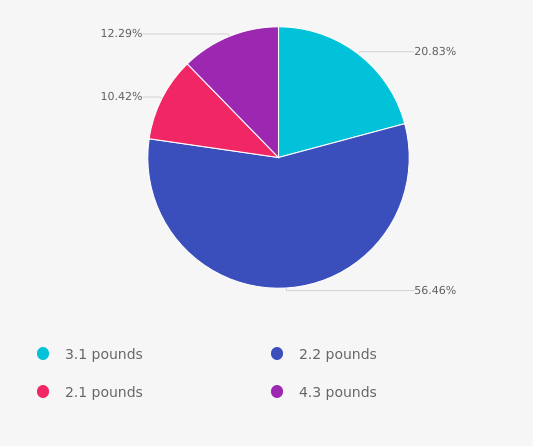
As shown above, the most common choice was option 1, the second most common answer was option 4, then option 2, and finally option 3.

If you are thinking about taking a certification exam, this practice test question will set you up for success. The test writers will anticipate possible answers based on the details in the question. They will wave those “juicy answers” right under your nose. Your job is to weed through the particulars, pluck out the most important elements and do the math with care.
Answer 1 is incorrect. 20% chose this answer. This question is all about paying attention to details. AJ eats the hash browns 5 times a week or 20 times a month. If you chose this answer, you had AJ eating hash browns every day.
Answer 2 is correct! 56% of you chose this correct answer. AJ eats hash browns 5 times a week or 20 times a month. Each hash brown has 390 calories. 20 x 390 = 7, 800 calories. There are 3,500 calories in a pound. So, 7,800 / 3,500 = 2.2 pounds loss in a month. Yay. Great job.
Answer 3 is incorrect. About 10% of respondents chose this. If you chose this answer, you might have been calculating the number of calories in the egg sandwich instead of the hash browns.
Finally, Answer 4 is incorrect. 12% chose this answer. You probably thought AJ was stopping eating both the egg sandwich and hash browns, which would lead to a 4.3-pound weight loss.
We hope you appreciate this week’s rationale! Thank you so much for taking the time to answer our Question of the Week and participate in this fun learning activity!
Want more practice questions?
Try our Test Taking Toolkit!
$49 | 220+ Questions
In this course, Coach Beverly details the content of the exam and test-taking tips. Plus, she reviews a sampling of the questions, and explains how to dissect the question, eliminate the wrong answers and avoid getting lured in by juicy answers.
Sign up for Diabetes Blog Bytes – we post one daily Blog Byte from Monday to Friday. And of course, Tuesday is our Question of the Week. It’s Informative and FREE! Sign up below!
[yikes-mailchimp form=”1″]
Accreditation: Diabetes Education Services is an approved provider by the California Board of Registered Nursing, Provider 12640, and Commission on Dietetic Registration (CDR), Provider DI002. Since these programs are approved by the CDR it satisfies the CE requirements for the CDCES regardless of your profession.*
The use of DES products does not guarantee the successful passage of the CDCES exam. CBDCE does not endorse any preparatory or review materials for the CDCES exam, except for those published by CBDCE.
[yikes-mailchimp form=”1″]
COVID-19 has changed the landscape of how healthcare services are delivered in the U.S.
In our new “normal,” many healthcare professionals have begun to adopt telehealth/telemedicine services.

Is this new method leading to positive outcomes?
In a Veterans Health Administration program that combined Intensive telemonitoring, self-management and medication support, there were improved A1c levels within six months for those with diabetes residing in rural areas.
After 6 months of telehealth interventions, researchers of the Advanced Comprehensive Diabetes Care (ACDC), found a 1.36% reduction of HBA1c levels.
Specialists created custom-tailored intensive diabetes management interventions by using telehealth and electronic records systems.
People living in rural areas tend to have limited access to specialty care and diabetes management programs. By using telemedicine services we can create more opportunities for people living in rural areas to better manage their diabetes.
To read more, click here.
MS has type 1 diabetes and is on a low carb diet to help her keep her weight on target. She has a BMI of 24.3. MS has a friend with type 1 who is taking a SGLT-2 in addition to insulin to help with weight management. MS wants to know if she could add on a SGLT-2 to her insulin treatment plan.
What is the Diabetes Specialist’s best response?
Click here to test your knowledge!

Our May 19th Question of the week was a question about carb counting. Although 58% of respondents chose the correct answer, 42% did not. We thought that this was an important topic to discuss further, so we can pass on correct info to people living with diabetes.
Before we start though, if you don’t want any spoilers and haven’t tried the question yet, you can answer below: Answer Question
Question: LS uses an insulin pump and the 500 rule for carbohydrate coverage. For breakfast, LS plans to eat ½ cup of oatmeal, 3/4 cup of blueberries, a cup of skim milk, a tablespoon of peanut butter, and a cup of coffee with a packet of Splenda. Her insulin to carb ratio is 1 to 12 for breakfast and lunch. Her insulin to carb ratio is 1 to 15 for dinner.
How much insulin does LS need for breakfast?
Answer Choices:
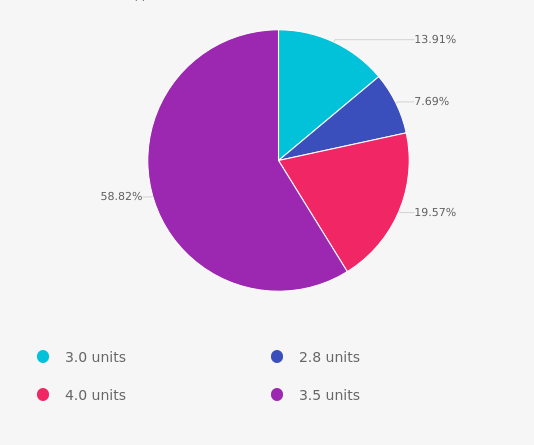
As shown above, the most common choice was option 4, the second most common answer was option 3 then option 1 and finally option 2.

Answer 1 is incorrect. 14% chose 3.0 units as the answer. This answer was juicy but wrong. Maybe this group thought the total carb count was 45 gms and then divided by insulin to carb ratio of 1:15? If yes, read the question again to see what insulin to carb ratio is a better choice. Also, rethink the total carb count.
Answer 2 is incorrect. Only 8% of respondents chose 2.8 units as an answer. This group got the carb count correct but may want to read the question again to see which insulin to carb ratio is a better choice.
Answer 3 is also incorrect. About 20% of respondents chose 4.0 units. This group might need to reassess the carb count, keeping in mind that milk is 12gms of carb. And, more importantly, keep in mind that LS uses an insulin pump that can deliver very precise insulin doses. No need to round up for this question.
Finally, Answer 4 is correct. 58% of test takers chose this correct answer.
First, lets count up the carbs for breakfast:
Now, let’s do the math:
LS’s insulin to carb ratio is 1 to 12 for breakfast. She is going to eat 42 gms of carb. 42/12 = 3.5 units of insulin to cover breakfast.
We hope you appreciate this week’s rationale! Thank you so much for taking the time to answer our Question of the Week and participate in this fun learning activity!
This course is an essential review for anyone in the field of diabetes. This course summarizes the 2021 updates to the American Diabetes Association’s Standards of Medical Care in Diabetes and provides critical teaching points and content for health care professionals involved in diabetes care and education.
Earn 2.0 CEs and get ready to lead the charge to implement best care practices for the New Year.
Topics Include:
Sign up for Diabetes Blog Bytes – we post one daily Blog Byte from Monday to Friday. And of course, Tuesday is our Question of the Week. It’s Informative and FREE! Sign up below!
[yikes-mailchimp form=”1″]
Accreditation: Diabetes Education Services is an approved provider by the California Board of Registered Nursing, Provider 12640, and Commission on Dietetic Registration (CDR), Provider DI002. Since these programs are approved by the CDR it satisfies the CE requirements for the CDCES regardless of your profession.*
The use of DES products does not guarantee the successful passage of the CDCES exam. CBDCE does not endorse any preparatory or review materials for the CDCES exam, except for those published by CBDCE.