
Subscribe
eNewsletter

Ready to get certified?
Free CDCES Coach App

eNewsletter
Free CDCES Coach App

Our Diabetes Detective Team scans the diabetes news to discover the most relevant info that Diabetes Educators need in their daily practice. We post one daily Blog Byte from Monday to Friday. And of course, Tuesday is our Question of the Week. It’s Informative and FREE! Sign up below!

We’re updating our DiabetesEd Boot Camp throughout February and March. See full schedule here.
In each webinar, Coach Beverly highlights the critical content of each topic area, so you can focus your study time most efficiently. She also launches multiple poll questions to helps students focus on key concepts and assess their knowledge while learning the best test-taking strategies.
Sign up for Diabetes Blog Bytes – we post one daily Blog Byte from Monday to Friday. And of course, Tuesday is our Question of the Week. It’s Informative and FREE! Sign up below!
[yikes-mailchimp form=”1″]

A study done by the department of neurology at Mokdong Hospital at Ewha Womans University College of Medicine in Seoul, South Korea analyzed data from over 160,000 people who had no history of heart failure or atrial fibrillation. Information collected during the study included weight, height, lifestyle questionnaires, lab tests, oral health disease, dental visits in the past year, and oral hygiene behaviors.
All study participants were examined for periodontal disease. Of all participants present, 3% developed atrial fibrillation and 4.9% developed heart failure after a follow up 10.5 years later.
The study found that people who frequently brushed their teeth (3 or more times per day) had a lower risk of heart failure and atrial fibrillation. Getting teeth professionally cleaned also lessened risked of these problems.
More research is needed to see if there is a causal relationship. However, recommending active oral hygiene is always a great idea!
Read more here.
Sign up for Diabetes Blog Bytes – we post one daily Blog Byte from Monday to Friday. And of course, Tuesday is our Question of the Week. It’s Informative and FREE! Sign up below!
[yikes-mailchimp form=”1″]
January 25th marks the first day of Chinese New Year, and 2020 is the year of the rat: the first of the zodiac animals. The Rat is meant to represent diligence and thriftiness. Diabetes Education Services wishes everyone happiness and prosperity in this new year!

Join us for our free BC-ADM webinar on January 30 @ 11:30 a.m. PST to benefit from free practice questions and test taking strategies:
Sign up for Diabetes Blog Bytes – we post one daily Blog Byte from Monday to Friday. And of course, Tuesday is our Question of the Week. It’s Informative and FREE! Sign up below!
[yikes-mailchimp form=”1″]
Researchers may have developed a way for parents to avoid having to prick their babies with type 1 to check blood sugar. A sugar sensing pacifier collects saliva, tests the glucose levels, and wirelessly sends result to a receiver which the parent or caregiver can see.

This device was tested on adults first to see if the concept would work. Initial results were positive, showing changes in saliva sugar levels which corresponded to changes in blood sugar levels. Researchers noted that there was great correlation in the study and that they were able to tell when blood glucose was high with great accuracy.
The small parts involved in the pacifier, and the fact that saliva was tested after adults were instructed to brush their teeth (unlikely to be replicated in infants), may be barriers to a patent and this device getting on the market. Researchers are hopeful to find ways to overcome these and be able to offer the market a truly non-invasive option for babies with type 1.
Sign up for Diabetes Blog Bytes – we post one daily Blog Byte from Monday to Friday. And of course, Tuesday is our Question of the Week. It’s Informative and FREE! Sign up below!
[yikes-mailchimp form=”1″]
Expert Interview with Theresa Garnero, APRN, BC-ADM, MSN, CDE President of Sweet People Club

I heard a researcher at a national conference go on and on about needing to screen the daughters of women with polycystic ovarian syndrome (PCOS) for diabetes since there is a strong link between PCOS and type 2. She never discussed the population of women that have the highest rates of PCOS – lesbians (38% of lesbians have PCOS vs. 14% of heterosexual women1). So I went up to the mic and asked her if she was aware of Agrawal’s work showing lesbians have the highest rate of PCOS. I was flabbergasted when she said yes. I responded she might want to include that most vulnerable population in her talk as we need to screen all women at risk.
It got me thinking about how could a well-known professor at a national diabetes conference willingly withhold data about an under-served population? So, I began to comb through the existing research that impacts the LGBTQ community with regards to diabetes care and prevention. And I was astonished what I found. So, I wrote the article and was so glad the ADA published it. But why wasn’t this part of the conversation back then? Even now? And I still ask, why won’t ADA reply to my inquiries to include this special population within their Standards of Care?
Actually take steps to include this special population. I think there are several opportunities to do this, starting with making sure their environment gives clues that it is a safe place for the LGBTQ community to seek care. Remember, this community is used to outright hostility from within the healthcare system and are often reluctant to self-disclose out of fear for getting substandard care. I once worked with a man with type 1 diabetes who was gay tell me that his endocrinologist told him he deserved every low he got, and that when he’d go to the emergency department, they refused for his husband to be by his side And that happened in the gay mecca of San Francisco! Imagine other “less tolerant” places.
If they see you don’t have a clue because you have old forms with old terms, they most likely won’t come out. And if they don’t come out, then you don’t have all the data to make an individualized plan. So, you can check your assessment forms to see if you use inclusive terms. Do you actually ask for LGBTQ status by asking for sexual orientation, gender identification and relationship status (not marital status)? And collect the aggregate data! Just because it’s not measured doesn’t mean it doesn’t exist. Do you have clues in your waiting room that it’s safe and friendly for this group (like post a little rainbow flag)? Do you include LGBTQ risk factors for health outcomes in your materials? Do you tell people you are here to help everyone, no matter their situation or who they’re with? I realize change is slow, but collectively as individuals, and nationally, we can make it a better place for this underserved population.
Because if you don’t even know a certain segment of those you care for have unique risk factors, and arguably worse – you have no clue who that vulnerable population is in your practice – you aren’t doing all you can to provide quality care to all you serve. It’s estimated that the number of LGBTQ individuals with diabetes equals that of the amount of people with type 1, so it’s not a small number we’re talking about. As an example, let’s apply this to Social Determinants of Health. We talk about the research showing how your zip code has more to do with your health than your DNA, particularly as it relates to food insecurity. But did you know LGBTQ individuals and families have the highest rates of food insecurity? Why isn’t that research included in diabetes mainstream publications and conferences?
According to research presented by the Williams Institute2, more than 1 in 4 LGBTQ adults (27%), approximately 2.2 million people, experienced a time in the last year when they did not have enough money to feed themselves or their families, compared to 17% of non-LGBTQ adults.
And when you add racial/ethnic sub-populations within the LGBTQ community, the stats are staggering:
Thank you! I am so excited to see our national organization pay attention to the LGBTQ population and help get the word out about what we can do. I think because they are interested in us being the best diabetes care and education specialist that we can and including everyone is part of that. I had also just spoken at the AADE conference in Houston. We had a panel of professionals and researchers that represented the LGBTQ community. (I had spoken previously at AADE, but that was just by myself and this last time was so special.) I’m truly impressed with how much research that has transpired in these 10 years.
I’d say that a willingness to learn is so important. As is recognizing one’s personal biases. We certainly don’t agree with the lifestyles of all we serve, but it is not our role to judge or let those biases interfere with helping someone find a path to thriving with diabetes. And just know, it takes time to get up to speed. I’d encourage readers to check out the AADE handout and watch this funny video clip that a colleague sent me. Honestly, it is hard to keep up with the terms, even for someone like me who helped to get this topic on the diabetes radar. This video made me crack up and appreciate the nuance of all the terms. I bet your audience would like it too. You can check out the “What “The Sex Talk” Looks Like Now, by Alternatino. Thanks so much, Beverly, for your willingness to discuss the topic. I truly hope it helps your readers improve their care delivery.
Ms. Theresa Garnero, APRN, BC-ADM, MSN, CDE trail-blazed several innovations in the field of diabetes in the years that followed being awarded the national Diabetes Educator of the Year by the American Association of Diabetes Educators (2004).
Her latest efforts involve trying to reach people with prediabetes and type 2 who are currently not being reached with our face-to-face programs. How? She created the Sweet People Club an all online program which uses a flipped classroom concept so people can follow the Diabetes Prevention Program and also manage type 2 through a series of professionally-made videos (ahem, nearly 150 of them!) that they can watch at a time that is convenient for them, then ask questions through the portal, as well as meet virtually face-to-face real time with a Registered Dietitian twice a month.
If you’d like access to experience what the program is like, she is sharing her work and invites your feedback. Visit https://www.sweetpeopleclub.com/pro/ or email her for questions at [email protected]
Sign up for Diabetes Blog Bytes – we post one daily Blog Byte from Monday to Friday. And of course, Tuesday is our Question of the Week. It’s Informative and FREE! Sign up below!
[yikes-mailchimp form=”1″]
Our Diabetes Detective Team scans the diabetes news to discover the most relevant info that Diabetes Educators need in their daily practice. We post one daily Blog Byte from Monday to Friday. And of course, Tuesday is our Question of the Week. It’s Informative and FREE! Sign up below!

This brand new course airs January 28, 2020 @ 1:00 p.m. PST and is able to be purchased individually or as part of the Level 4 bundle.
Enroll to earn 2.0 CEs and a detailed overview of the pathophysiology of type 2 diabetes, prevention strategies and cardiovascular risk reduction, and more! Read full description here.
Sign up for Diabetes Blog Bytes – we post one daily Blog Byte from Monday to Friday. And of course, Tuesday is our Question of the Week. It’s Informative and FREE! Sign up below!
[yikes-mailchimp form=”1″]
The BC-ADM certification is an ever-growing field in diabetes care. It’s an advanced certification which validates a health care professional’s knowledge of advanced clinical practice and diabetes skills. This certification verifies a health care professionals expert ability to adjust medications, identify, treat and monitor acute and chronic complications, and more!

Join Coach Beverly as she reviews test taking strategies, study tips, and eligibility requirements of the BC-ADM in this FREE webinar.
Preparing for the BC-ADM Webinar airs February 17 @ 11:30 a.m. PST
Sign up for Diabetes Blog Bytes – we post one daily Blog Byte from Monday to Friday. And of course, Tuesday is our Question of the Week. It’s Informative and FREE! Sign up below!
[yikes-mailchimp form=”1″]
Happy Friday! As I get older, font sizes seem to be getting smaller. Excited to see the updated Injectables Algorithm, I turned my ADA Book to Standard 9 and quickly realized that in order to read the print, I had to hold the page inches from my nose. And there was no way could I read the footnotes even using my iphone flashlight to illuminate the words.
Thank goodness I collaborate with wonderful staff who boast youthful eyes and 2020 vision.
Robert (our Assistant Director and my high school senior) set to work recreating a draft of the document on Word. Getting the arrows to line up and fitting all the content in little boxes, was challenging, but he persevered. Taryn added the footnotes and I completed the final editing and the creation of the PDF.
We created this readable version because the algorithm is an important document that can be used to promote a collaborative practice.
Coach Beverly
I consider the ADA Standards my clinical “playbook”. The medication algorithms are of particular importance because it provides us with the opportunity to engage in a collaborative practice with our referring providers. “These are the evidence based medication recommendations from the ADA. I use it as a guide to recommend medication additions or changes”.
Enjoy our font enhanced Figure 9.2: Intensifying to Injectable Therapy
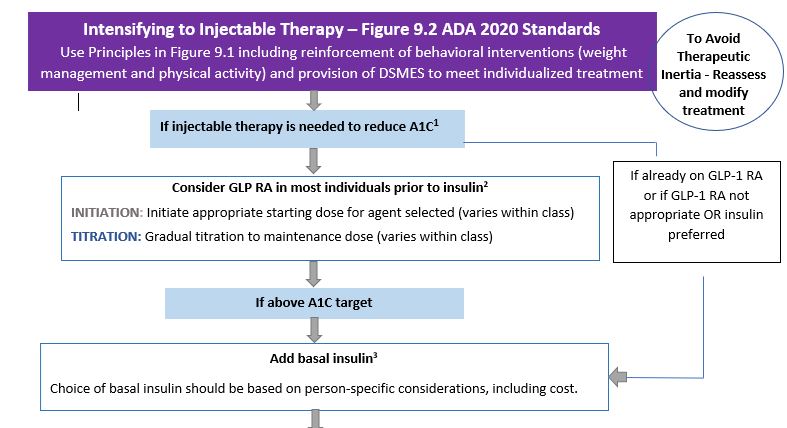
Then we can start a conversation exploring if a collaborative practice and medication adjustments using the algorithm is comfortable for the provider and perhaps include into our practice guidelines.
Enjoy this helpful 2 page reference guide, on us!
The 2020 Standards of Care is ready for viewing. Coach Beverly highlighted changes from 2019-2020 and summarized important need-to-know content for CDCES’s!
Purchase our Level 1 Standards of Care, or buy the full Level 1 bundle to benefit from all the 2020 updates! Earn 9.0 CEs for $109
Sign up for Diabetes Blog Bytes – we post one daily Blog Byte from Monday to Friday. And of course, Tuesday is our Question of the Week. It’s Informative and FREE! Sign up below!
[yikes-mailchimp form=”1″]