
Subscribe
eNewsletter

Ready to get certified?
Free CDCES Coach App

eNewsletter
Free CDCES Coach App

Join us live with your questions on October 10, 2019 @ 11:30 a.m. PST!
Coach Beverly offers this FREE webinar to help get you prepare for the CDCES Exam. All her tips and tricks are meant to ease your mind and reflect the updates to the CDCES content outline. Register below with a name and email and you can join us live next Thursday!
Topics covered include:
We will review sample test questions and the reasoning behind choosing the right answers.
After registering, you will receive a confirmation email containing information about joining the webinar.
Intended Audience: This FREE webinar is designed for individual or groups of diabetes educators, including RNs, RDs, Pharmacists, Nurse Practitioners, Clinical Nurse Specialists, Physician Assistants and other health care providers interested in achieving excellence in diabetes care and becoming Certified Diabetes Care and Education Specialists®.
Instructor: Beverly Thomassian RN, MPH, CDCES, BC-ADM is a working educator who has passed her CDCES Exam 6 times. She is a nationally recognized diabetes expert for over 25 years.
See our Preparing for CDCES Resource Page >>
Sign up for Diabetes Blog Bytes – we post one daily Blog Byte from Monday to Friday. And of course, Tuesday is our Question of the Week. It’s Informative and FREE! Sign up below!
[yikes-mailchimp form=”1″]For Question of the week, test takers usually choose the correct answer 70-80% of the time. However, for this Tuesday’s question of the week, only 25% of respondents chose the correct answer.
We thought this presented a perfect opportunity to explore this question and the best answer in more detail and throw in some test-taking tips along the way.
Question of week on October 1:
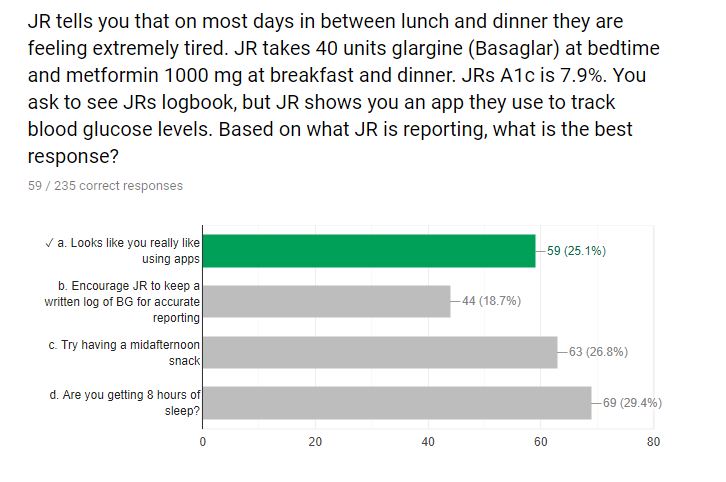
As shown above, the most common choice was option 4, the second most common answer was option 3, then option 1, and finally option 2.
Test taking strategies:
A good strategy for the exam for questions that give multiple distracting facts at once, is to read through each answer carefully and use process of elimination. First, get rid of one to two false answers that are either wrong or don’t address the main intent of the question. This leaves two answers and a 50% chance of choosing the BEST answer.
The key sentence here is “You ask to see JRs logbook, but JR shows you an app they use to track blood glucose levels.” Then there is a prompt to give a response.
Option 4 is a “juicy” answer because the first sentence shows JR admitting they’re tired. But the answer does not address the main intent of the question. Another distraction in the question includes that that they’re specifically feeling tired between lunch and dinner.
Option 4 also ignores the fact the educator asked to see their logbook and they respond by showing an app. Option 4 gets the test taker off-topic from the core question.
Also off-topic is Option 3. The test question vignette includes another distraction when it highlights that JR is specifically feeling tired between lunch and dinner. It would be easy to assume they are tired because of low blood sugar, which a midafternoon snack could fix, but there is no data to support that JR is having hypoglycemia. When reading the entire question, the core issue is that the educator asked to see a logbook but are shown an app instead.
Option 2 nods to the key intent of the question, but the educator fails to acknowledge that JR is trying to use an app to track blood glucose levels and other self-care behaviors. Instead, the educator ignores the app usage and instructs JR to keep a written log. This does not convey a person-centered approach, but instead asks JR to track blood glucose in a way that is familiar to the educator.
Option 1 is the person-centered option that acknowledges the individual and their preference for tracking their diabetes data using technology. “Looks like you really like using apps.” At that point in an appointment, the educator can use a curiosity based approach, “Can I please see the data you are collecting on your app? Have you noticed any trends or incidence of hypoglycemia in the afternoon?”
Together, JR and the educator might even explore other apps that might be useful and support JR in living with diabetes).
Language & Diabetes is a great, free resource to gain more insight into why Option 1 is the best answer to this question. Thank you so much for taking the time to answer our Question of the Week and participate in this fun learning activity!
Sign up for Diabetes Blog Bytes – we post one daily Blog Byte from Monday to Friday. And of course, Tuesday is our Question of the Week. It’s Informative and FREE! Sign up below!
[yikes-mailchimp form=”1″]Our October Newsletter is brimming with medication updates! From Oral GLP-1 to Semaglutide and pre-filled Glucagon, we’re keeping you up to date AND updating our PocketCards. Did you know you can hire Coach Beverly to come speak in your hometown? Read this month’s Newsletter to find out how to request her time.
Sign up for Diabetes Blog Bytes – we post one daily Blog Byte from Monday to Friday. And of course, Tuesday is our Question of the Week. It’s Informative and FREE! Sign up below!
[yikes-mailchimp form=”1″]
Our Diabetes Detective Team scans the diabetes news to discover the most relevant info that Diabetes Educators need in their daily practice. We post one daily Blog Byte from Monday to Friday. And of course, Tuesday is our Question of the Week. It’s Informative and FREE! Sign up below!
Sign up for Diabetes Blog Bytes – we post one daily Blog Byte from Monday to Friday. And of course, Tuesday is our Question of the Week. It’s Informative and FREE! Sign up below!
[yikes-mailchimp form=”1″]Happy Mindful Monday! Today we’re offering a new perspective by showcasing dishes around the world. This comes from the New York Times after they interviewed 18 families around the world to see what their typical weeknight dinner is:

Omelet with carrots, stir-fried minced pork and eggplant, and Thai sour curry with cauliflower is a common meal. Family members are expected to clean up after themselves and help cook at least one night a week.

The Osan family eats around 9 p.m., normally with palak paneer (spinach with cheese), raita, kadai aloo (potatoes with onions and spices), cucumber salad and roasted chapatis.

The mother normally cooks for the rest of her family, and an easy weeknight meal includes saltimbocca (veal rolled with ham and sage), homemade pesto with trofie pasta, and baked tomatoes au gratin.

The Khojandi family eats a mix of prepared and homemade foods during the weeknight. This includes smashed beans, shakshuka (eggs poached in a tomato and green pepper stew with onions and garlic), and masoob (a mix of banana, bread, dates, cream, and honey.

Many Haitian families take their main meal at midday. The Charles’ family prepares avocado, white rice, sos pwa nwa (black bean puree), beef and blue crabs marinated in orange and lime, and lalo (boiled jute leaves and chopped spinach).

The Levy family eats Yemeni soup, chicken schnitzel, chraime (white fish in tangy and spicy tomato sauce with smoked paprika and cilantro), with challah (bread) and rice.

In Paris, roasted chicken and couscous were part of an early dinner for the Devouges. Their meal ended with various cheeses (Petit Suisse, Comte, and Emmental).

Chakalaka (relish made with fried peppers, grated carrots, and baked beans) is a South African favorite. Ujeqe (steamed bread) and braised oxtail is a common weeknight meal.

The Opie family eats pan-fried nannygai (red snapper), broccolini, and sweet potato fries for dinnr. Their children get extra fruits and vegetables like strawberries, raspberries, snow peas, and carrots.

The Henkets eat a dinner of salmon with basmati rice and broccoli and a dessert of homemade custard with fresh raspberries and berry jam.

In Lagos, their meal revolves around the sauces. With plantain flatbreads and chicken suya, condiments include peanut butter sauce, papaya chutney, hibiscus green chile sauce, mint and spring onion oil, tamarind ginger sauc, and beet and carrot sauerkraut.

Huevos revueltos (scrambled eggs with chorizo and onions, served with flour tortillas) is a staple, even for dinner.

Liza prepares dinner for her husband and six children. While she cooks, the children and her husband are in charge of setting the table. Kotleti (beef patties with bread, egg, and onion), rice, green salad, and an eggplant, red pepper, basil salad make for a perfect weeknight meal.

Fish, rice, and miso soup are a classic Japanese meal. Yasuko cooks for her adult son a few nights a week, with mebaru (rockfish) being on the menu that night. Fresh fruit serves as dessert.

Kofte (meatballs), lentil soup, bulgur pilaf with tomato and bell pepper, dolmas (stuffed grape leaves) and red beans in olive oil make up the Terzi family dinner. A rice pudding called sutlac with tahini and walnuts is for dessert.

In Brazil, the mom cooks the meal of picadinho (beef, potato and carrot stew) with rice and salad, while the dad sets the table. The children are expected to clean up afterward.
Read full descriptions and see in-home photography from the New York Times report!
Sign up for Diabetes Blog Bytes – we post one daily Blog Byte from Monday to Friday. And of course, Tuesday is our Question of the Week. It’s Informative and FREE! Sign up below!
[yikes-mailchimp form=”1″]A new study published in Nature Medicine shows just an extra kilogram of visceral fat can raise a woman’s risk of type 2 diabetes by more than seven times, compared to men, whose risk goes up by two times. This visceral fat also associated with more heart attacks, high blood pressure, and hyperlipidemia.

Research on 325,000 people in the UK Biobank cohort revealed more than 200 distinct genes influencing visceral fat, many of which are tied to how much or little a person eats or exercises.
Findings in this study were based on a simple method of estimating an individual’s amount of deep belly fat, which can be replicated in most clinics, rather than relying on the more advanced and costly diagnostic imaging techniques.
Although the gender implications of the study are interesting, a great accomplishment of the study is simplifying measurements of visceral fat to make it easier to identify people at higher risk of developing diabetes or cardiovascular disease. Read fully study results here.
Sign up for Diabetes Blog Bytes – we post one daily Blog Byte from Monday to Friday. And of course, Tuesday is our Question of the Week. It’s Informative and FREE! Sign up below!
[yikes-mailchimp form=”1″]Happy Pharmacist Appreciation Day! Today is extra special since Coach Beverly fell in love with and married a Pharmacist, Kristapor Thomassian, PharmD, BCPS, over 20 years ago. He works as a critical care specialist in a local hospital and is also on the Board of Directors at Diabetes Education Services.

In celebration of Pharmacists Day, please enjoy our FREE medication summary sheets co-developed by Dr. Thomassian; Statin, Hypertension and Neuropathy Medication Summary Sheets
We want to take today as a chance to highlight some fantastic findings from a study published in the Diabetes Spectrum on what happens when pharmacists are involved in the diabetes care and education process:
“Pharmacists are well positioned to provide comprehensive diabetes services, including basic education and counseling.”
Lisa T Meade, Rebecca C. Tart, and Hillary L. Buzby; Diabetes Spectrum 2018, Feb. 31 (1): 90-95.
With general practitioners’ limited appointment time, pharmacists are uniquely positioned to help improve diabetes education. Pharmacists’ combination of medication expertise and ability to monitor and evaluate lab results, allows them to make informed recommendations for therapies to treat hypertension, dyslipidemia, cardiovascular disease, and microvascular complications – all often seen in advanced diabetes.
In a study reviewing rural clinics in Northern California, pharmacist intervention with diabetes education resulted in an A1c reduction of 1% or greater!
Pharmacists play a vital role in the inter-professional health care team, particularly with the increasing number and complexity of medications for diabetes. Read the full study published in Diabetes Spectrum here and thank the pharmacists on your team today!
Sign up for Diabetes Blog Bytes – we post one daily Blog Byte from Monday to Friday. And of course, Tuesday is our Question of the Week. It’s Informative and FREE! Sign up below!
[yikes-mailchimp form=”1″]Our Diabetes Detective Team scans the diabetes news to discover the most relevant info that Diabetes Educators need in their daily practice. We post one daily Blog Byte from Monday to Friday. And of course, Tuesday is our Question of the Week. It’s Informative and FREE! Sign up below!
Sign up for Diabetes Blog Bytes – we post one daily Blog Byte from Monday to Friday. And of course, Tuesday is our Question of the Week. It’s Informative and FREE! Sign up below!
[yikes-mailchimp form=”1″]