Did you know that in ancient times, diabetes was identified by the sweet taste of a person’s urine?
Thankfully, science has come a long way from this ancient practice! The introduction of fingerstick blood glucose meters in the 1970s and continuous glucose monitors (CGMs) in the early 2000’s marked significant advancements in blood glucose monitoring. With more than 800 million people worldwide living with diabetes, interest in pain-free glucose testing is growing.1
Although current CGMs and fingerstick methods still require skin penetration, needle-free alternatives are being promoted, prompting many questions. Let’s discuss how healthcare professionals can address these products using evidence-based information.
What Is Noninvasive Glucose Monitoring?
Noninvasive (NI) glucose monitoring is a method of measuring blood glucose that does not involve breaking the skin. NI glucose monitoring technology under development includes: 2
- Electrochemical technology measuring glucose in alternative fluids such as saliva, sweat, and tears
- Near-infrared spectroscopy using a light source to measure glucose levels in blood vessels through the skin
- Infra-red light and AI technology, using a sensor on the finger, creating photo images that AI technology evaluates to measure blood glucose levels
- Radiofrequency and microwave sensors to measure glucose levels through tissue
- EEG sensor placed behind the ear to monitor blood glucose variations
Are Noninvasive Glucose Monitoring Devices Approved?
FDA approval is granted for glucose monitoring devices used for either medical or lifestyle management. FDA approval for medical management is based on sufficient evidence of safety and accuracy for people living with diabetes. FDA approval ensures adequate evidence to guide treatment decisions, such as insulin dosing. FDA approval for lifestyle use applies to individuals who do not use the device for the medical management of diabetes and who are not on insulin therapy.
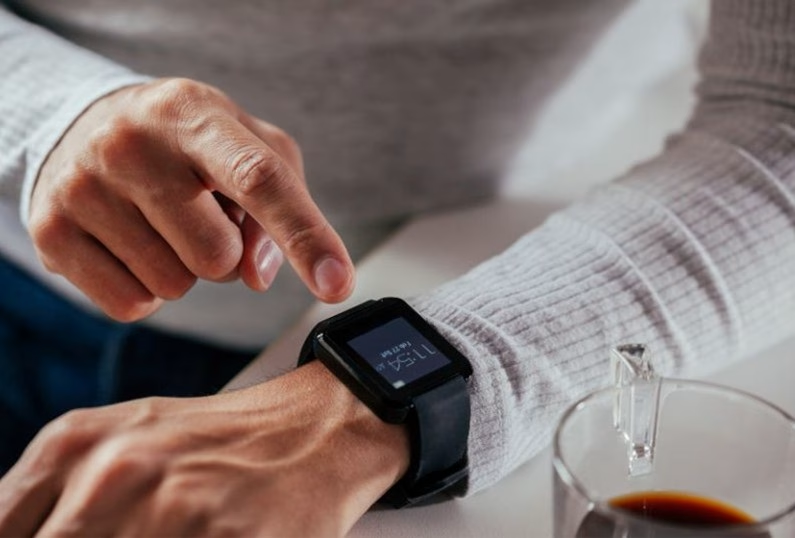
Currently, no NI glucose monitoring devices have received FDA approval for medical management of diabetes. In 2024, the FDA issued a safety announcement that NI glucose devices could pose a possible threat to those with diabetes, as the FDA has not approved them.3 Numerous companies are currently in the research process to advance NI glucose monitoring devices toward FDA approval.
Using Noninvasive Glucose Monitoring in Diabetes Care
When considering noninvasive glucose monitoring, it’s essential to understand how these devices fit into everyday diabetes care. Despite the lack of FDA approval, clients can purchase NI glucose monitoring devices without a prescription. Clients may be using these before the healthcare provider is ever aware.
Individuals living with diabetes should be aware that many factors, including hydration status, skin characteristics, temperature, and movement, can affect NI glucose device readings. These devices may be better suited for detecting general trends but are not approved for making real-time treatment decisions. As diabetes healthcare professionals, we can provide guidance on the use of FDA-approved devices to verify readings and inform treatment decisions. Arming our clients with this information can help avoid frustration and unsafe treatment decisions.
Discussing Noninvasive Glucose Monitoring and Misinformation
Diabetes healthcare providers often approach noninvasive (NI) glucose monitoring with cautious optimism. While the appeal of “no more pokes” is understandable, clients may be influenced by strong marketing claims. As providers, our role is to meet clients where they are to start the conversation.
As with any other FDA-approved diabetes technology, not every device is the right fit for everyone. Ask clients about their diabetes goals, barriers, and assess their digital literacy. Address what clients are seeing on social media and online ads, and how these NI devices compare to current FDA-approved blood glucose monitoring technology.
Here are some helpful tips that can further the conversation:
- Work to understand the clients’ reasoning for wanting to use NI glucose monitoring
- Remain open-minded
- Encourage continued discussion with open-ended questions
- Provide education on risks, benefits, and available alternatives in a non-judgmental manner
As technology advances, we hope to see accurate and safe NI glucose monitoring options for those living with diabetes. Until then, we can partner with our clients to provide education and clinical insights on the latest trends in diabetes technology.
References:
- World Health Organization. (2024, November 14). Diabetes. https://www.who.int/news-room/fact-sheets/detail/diabetes#:~:text=Key%20facts,stroke%20and%20lower%20limb%20amputation.
- Wu, J., Liu, Y., Yin, H., & Guo, M. (2023). A new generation of sensors for non-invasive blood glucose monitoring. American Journal of Translational Research, 15(6), 3825. https://pmc.ncbi.nlm.nih.gov/articles/PMC10331674/
- U.S. Food & Drug Administration. (2024, February 1). Do not use smartwatches or smart rings to measure blood glucose levels. [FDA Drug Safety Communication]. https://www.fda.gov/medical-devices/safety-communications/do-not-use-smartwatches-or-smart-rings-measure-blood-glucose-levels-fda-safety-communication
Set Yourself Up With Certification Success
Get exam-ready with confidence.
Course credits through AMA PRA Category 1 Credits™, ACPE, ANCC, and CDR!
Full accreditation details are available on the registration page

Our CDCES Boot Camp Online Prep Bundle is a comprehensive, high-impact program built specifically for healthcare professionals preparing for the Certified Diabetes Care and Education Specialist (CDCES) exam who want to level up their clinical knowledge and skills.

This evidence-based study bundle is a comprehensive BC-ADM Boot Camp designed for advanced-level healthcare professionals preparing for the Board Certified in Advanced Diabetes Management (BC-ADM) exam and will also provide you with state-of-the-art information to level up your clinical practice.
What's Included?
CDCES Boot Camp
- 30+ expert-led courses from the fundamentals to the ADA standards, to test strategies and exam mastery! Includes Levels 1, 2 and 3.
- 50+ CE credits (AMA PRA Category 1™, ACPE, ANCC, CDR accredited). IN
- 400+ practice questions to test your knowledge and build confidence
- Multiple learning formats: video presentations, audio podcasts, and downloadable handouts
- 1 full year of on-demand access to study at your own pace
BC-ADM Boot Camp
- 30+ expert-led courses covering advanced diabetes management, ADA standards, medication review, insulin calculations and tech topics! Includes advanced levels 2, 3, 4.
- 50+ CE credits (AMA PRA Category 1™, ACPE, ANCC, CDR accredited).
- 400+ practice questions to test your knowledge and build BC-ADM test confidence.
- Multiple learning formats: video presentations, audio podcasts, and downloadable handouts
- 1 full year of on-demand access to study at your own pace
Virtual DiabetesEd Training Conference
Why Should I Attend?
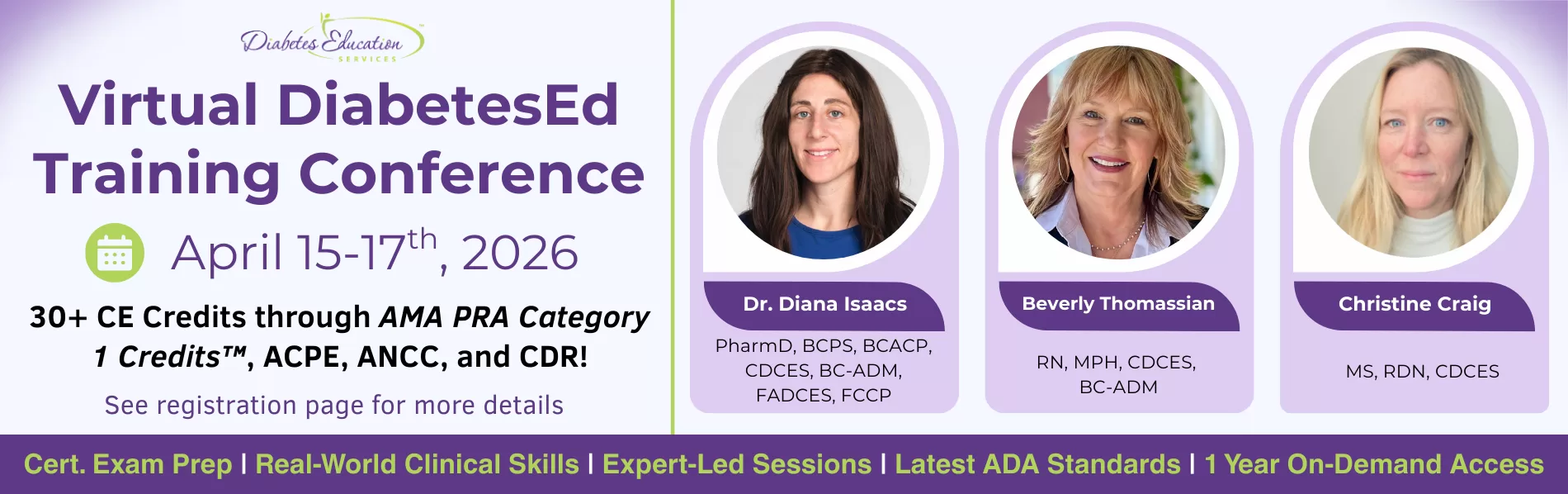
Join national experts including Dr. Diana Isaacs (Cleveland Clinic), Beverly Thomassian (30+ years of experience), and Christine Craig for high-impact, virtual learning—no travel required.
✔ Learn from National Experts — Anywhere
Get the same expert-level instruction you’d receive in person, delivered live to your home or office.
✔ Interactive & Flexible
- Live Q&A and real-time case discussions
- Direct engagement with faculty
- Full session recordings with 1-year access if you can’t attend live
What's Included?
- 19.5 CEs from the 3-day interactive conference + 17+ bonus CEs from 11 on-demand courses. (30+ total CEs are AMA PRA Category 1™, ACPE, ANCC, CDR accredited)
- Less than $15 per credit!
- Expert-led sessions: ADA Standards, medications, insulin therapy, behavior change, CGM, medical nutrition therapy
- Interactive Q&A with expert faculty during live sessions
- 1-year access to all recordings that you can watch on your schedule
- Study material for CDCES and BC-ADM exam prep
3 Ways to Register
Practical, Ready-to-Use Strategies
Walk away with tools you can apply immediately in clinical practice or while preparing for CDCES or BC-ADM exams. From insulin dosing protocols to behavior change strategies that work in the real world—this content bridges theory and practice.
Hear What Our Community Has to Say