For last week’s practice question, we quizzed participants on how much protein is recommended. 73% of respondents chose the best answer. We want to clarify and share this important information, so you can pass it on to people living with diabetes and your colleagues, plus prepare for exam success!
Before we start though, if you don’t want any spoilers and haven’t tried the question yet, you can answer it by clicking here.
AR is a 63-year-old with type 1 diabetes and mild hypertension. Their GFR is 41 mL/min/1.73m² and UACR is 312 mg/g and their BMI is 24. The provider asks you to instruct AR on a low-protein diet, since AR is in stage 3 CKD. What is your best response?
- A. Agree to provide education for AR low protein (0.6 -0.8 g/kg/day) to slow kidney disease progression.
- B. Reframe and suggest protein intake of about 0.8 g/kg/day as supported by ADA guidelines.
- C. Suggest AR eliminates most protein sources and focus primarily on fiber, carbohydrates and fats.
- D. Reinforce that a protein intake of 1.3 g/kg/day is warranted to prevent sarcopenia and maintain muscle mass.

Getting to the Best Answer
Answer A is incorrect. 16.88% chose this answer, “Agree to provide education for AR low protein (0.6 -0.8 g/kg/day) to slow kidney disease progression.” This answer is incorrect. Very low-protein diets (<0.6 g/kg/day) have not consistently shown additional renal benefit and may increase the risk of malnutrition, sarcopenia, and frailty, especially in older adults like AR (age 63).
Answer B is correct. 73.05% of you chose this answer, “Reframe and suggest protein intake of about 0.8 g/kg/day as supported by ADA guidelines.” This answer is correct. GREAT Job! People with stage 3 CKD need adequate plant-based or animal protein intake to maintain muscle mass and optimize health and well-being.
Answer C is incorrect. About 2.52% of respondents chose this: “Suggest AR eliminates most protein sources and focus primarily on fiber, carbohydrates and fats.” This answer is incorrect. Since people with diabetes need to consume adequate amounts of either plant-based on animal protein (~0.8 g/kg/day) to maintain muscle mass and optimize health.
Finally, Answer D is incorrect. 7.56% chose this answer, “Reinforce that a protein intake of 1.3 g/kg/day is warranted to prevent sarcopenia and maintain muscle mass.” This answer is incorrect. Higher protein intake (>1.3 g/kg/day) may increase intraglomerular pressure and albuminuria, potentially accelerating kidney decline.
We hope you appreciate this week’s rationale! Thank you so much for taking the time to answer our Question of the Week and participate in this fun learning activity!
Want to learn more about this question?
Enroll in our
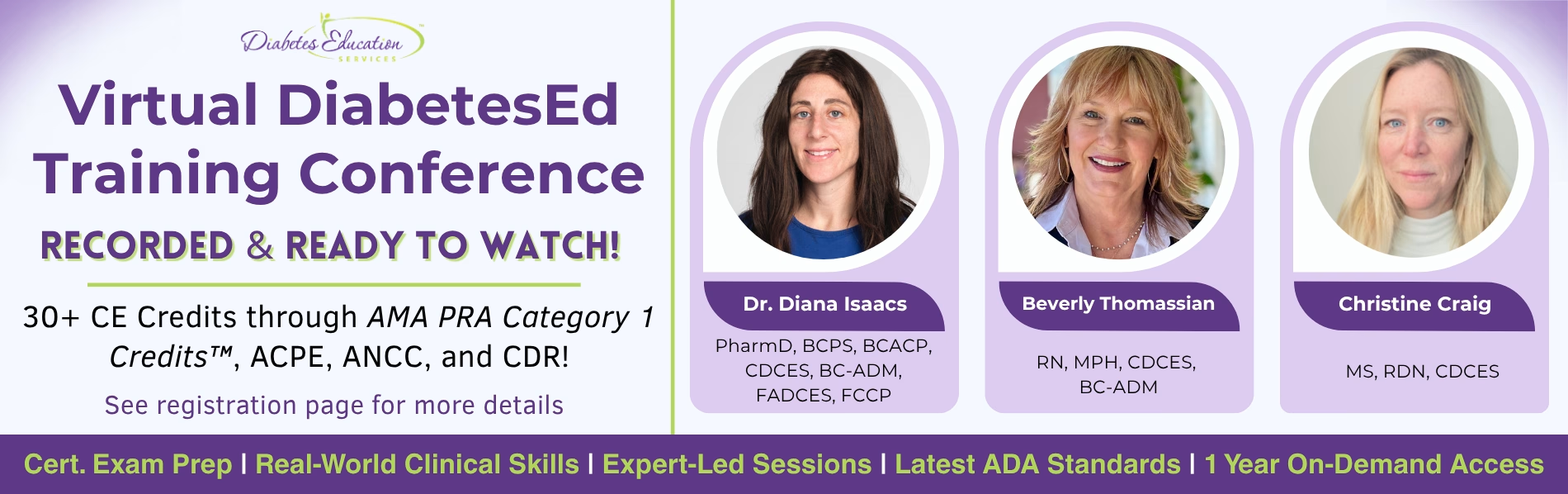
Virtual DiabetesEd Training Conference
Why Should I Attend?
Join national experts including Dr. Diana Isaacs (Cleveland Clinic), Beverly Thomassian (30+ years of experience), and Christine Craig for high-impact, virtual learning—no travel required.
✔ Learn from National Experts — Anywhere
Get the same expert-level instruction you’d receive in person, delivered live to your home or office.
✔ Interactive & Flexible
- Full session recordings with 1-year access if you can’t attend live
What's Included?
- 19.5 CEs from the 3-day interactive conference + 17+ bonus CEs from 11 on-demand courses. (30+ total CEs are AMA PRA Category 1™, ACPE, ANCC, CDR accredited)
- Less than $15 per credit!
- Expert-led sessions: ADA Standards, medications, insulin therapy, behavior change, CGM, medical nutrition therapy
- 1-year access to all recordings that you can watch on your schedule
- Study material for CDCES and BC-ADM exam prep
Set Yourself Up With Certification Success
Get exam-ready with confidence.
Course credits through AMA PRA Category 1 Credits™, ACPE, ANCC, and CDR!
Full accreditation details are available on the registration page

Our CDCES Boot Camp Online Prep Bundle is a comprehensive, high-impact program built specifically for healthcare professionals preparing for the Certified Diabetes Care and Education Specialist (CDCES) exam who want to level up their clinical knowledge and skills.

This evidence-based study bundle is a comprehensive BC-ADM Boot Camp designed for advanced-level healthcare professionals preparing for the Board Certified in Advanced Diabetes Management (BC-ADM) exam and will also provide you with state-of-the-art information to level up your clinical practice.
What's Included?
CDCES Boot Camp
- 30+ expert-led courses from the fundamentals to the ADA standards, to test strategies and exam mastery! Includes Levels 1, 2 and 3.
- 50+ CE credits (AMA PRA Category 1™, ACPE, ANCC, CDR accredited). IN
- 400+ practice questions to test your knowledge and build confidence
- Multiple learning formats: video presentations, audio podcasts, and downloadable handouts
- 1 full year of on-demand access to study at your own pace
BC-ADM Boot Camp
- 30+ expert-led courses covering advanced diabetes management, ADA standards, medication review, insulin calculations and tech topics! Includes advanced levels 2, 3, 4.
- 50+ CE credits (AMA PRA Category 1™, ACPE, ANCC, CDR accredited).
- 400+ practice questions to test your knowledge and build BC-ADM test confidence.
- Multiple learning formats: video presentations, audio podcasts, and downloadable handouts
- 1 full year of on-demand access to study at your own pace