Author: Beverly Thomassian, RN, MPH, CDCES, BC-ADM
CEO: DiabetesEd Services
AI and the Future of Health Care: Why Technology May Help Us Become More Human
At my recent physical, my provider noticed the crumpled list of questions I was clutching and asked to see my list of concerns. I reluctantly handed it over, explaining they were just mental notes for myself. My practitioner—usually kind and curious—scanned the paper, handed it right back, and said, “I can’t address all of these today. Pick your top three.”
What happened over the past 6 months that impacted our connection?
Can AI help Healthcare Professionals reclaim their Time?
What if the greatest future contribution of artificial intelligence (AI) in health and diabetes care isn’t replacing healthcare professionals—but giving us back the time and emotional energy to be fully present with the people we serve?
That is one of the most inspiring messages from the recent Diabetes Care article, “Diabetes Care in 2050: A Human-Centered Road Map From Time in Range to Time in Happiness.”
Rather than imagining a future in which technology overshadows human relationships, the authors envision a healthcare system where AI and digital innovation reduce administrative burdens, personalize care, and allow clinicians to focus on what matters most: meaningful human connection.
Healthcare has become increasingly complex, especially in diabetes. New medications, continuous glucose monitoring, automated insulin delivery systems, and sophisticated data platforms are being released at a record-breaking pace. Yet many healthcare professionals find themselves spending more time documenting, interpreting data, and navigating electronic health records than they do sitting face-to-face with the people they care for.
The article argues that by 2050, AI could be tasked with managing much of this cognitive and administrative workload—organizing information, identifying trends, generating documentation, and supporting clinical decision-making. This shift has the potential to return our attention to listening, coaching, and partnering with people living with diabetes.
Changing the Diabetes Metric of Success
One idea that particularly resonated with me is the authors’ proposal to redefine diabetes success from solely focusing on clinical metrics such as hemoglobin A1C, Time in Range, blood pressure, and cholesterol levels to a more human-based metric. While clinical measures are important, they don’t fully capture what matters to the individual.
The vision presented in this paper expands our perspective from “Time in Range” to “Time in Happiness.”
As caregivers, we can shift to a goal not solely focused on numbers, but to help people spend more of their time free from the constant burden of managing diabetes.
As diabetes healthcare professionals, this concept aligns beautifully with person-centered care. Our role has never been to prescribe medications or interpret glucose reports.
We help people navigate fear, frustration, competing priorities, financial barriers, family responsibilities, and the emotional weight of living with a chronic condition.
AI can never replace empathy, curiosity, trust, or human connection
However, it can create conditions that allow those human qualities to flourish by handling repetitive tasks and providing clinicians with timely, actionable insights.
AI should augment—not replace—clinical judgment.
Imagine beginning a visit with an AI-generated summary highlighting glucose trends, medication-taking patterns, potential barriers, and individualized recommendations based on current evidence.
Instead of spending the first ten minutes gathering information, you could begin with a meaningful question such as, “What has been the hardest part of managing your diabetes since we last met?” Technology becomes the assistant, allowing the healthcare professional to remain the healer.
Instead of staying late to chart, your conversation with the individual is transcribed in the patient’s own words and language and uploaded to the electronic medical record.
AI Can Give Healthcare Professionals Time to be Human

Administrative responsibilities continue to grow while visit lengths frequently remain unchanged. Documentation, prior authorizations, inbox management, and data review play a major role in clinician fatigue. If AI can safely automate many of these tasks, healthcare professionals may experience greater professional satisfaction and more opportunities to practice the type of medicine that originally inspired them to enter healthcare. Caring for others becomes less about managing paperwork and more about building relationships.
Of course, the authors wisely acknowledge that this future is not guaranteed. Achieving a human-centered healthcare system will require deliberate implementation, ethical attention, equitable access to technology, and healthcare reforms that value people over processes. AI is only a tool. Its value depends on how thoughtfully we integrate it into care. The article calls for co-designed solutions that include healthcare professionals and people living with diabetes in shaping these innovations, so technology improves rather than fragments the care experience.
Technology to Strengthen Human Connection
This future vision reinforces a belief I’ve held throughout my career: diabetes care is not about choosing between technology and interpersonal connection. It is about using technology to strengthen human connections. Every innovation should ultimately answer one question: Does this help us better understand, support, and partner with the person sitting in front of us?
As we look toward the future, I hope AI becomes the quiet partner working behind the scenes—organizing information, identifying patterns, and simplifying complexity—while healthcare professionals do what only humans can do: listen deeply, inspire hope, foster trust, and walk alongside people through life’s challenges. If we achieve that balance, perhaps by 2050 we really will measure success not only by Time in Range but also by Time in Happiness. And that is a future worth building.
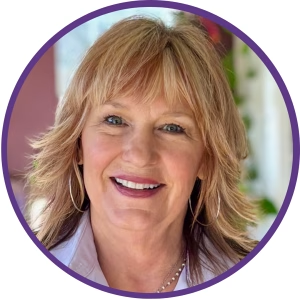
Coach Beverly Thomassian, RN, MPH, CDCES, BC-ADM
Founder & CEO: DiabetesEd Services
References
Diabetes Care in 2050: A Human-Centered Road Map From Time in Range to Time in Happiness Guy Fagherazzi, Emmanuel Cosson, Chantal Mathieu, Renza Scibilia, Kyle Jacques Rose, Kamil Armacky, Korey Hood, Bart Torbeyns, Elise Bismuth, Stéphane Besancon, Pratik Choudhary, Roberto Mallone, Pierre-Yves Benhamou, Dianna J. Magliano, Carine de Beaufort, Jean-Pierre Riveline, Michael Joubert; Diabetes Care in 2050: A Human-Centered Road Map From Time in Range to Time in Happiness. Diabetes Care 2026; dci260059. https://doi.org/10.2337/dci26-0059
Want to Learn More the Diabetes Future?
Join us live in San Diego for our
DiabetesEd Training Program
Brand new agenda for 2026!

🌟Updated Schedule: ADA Boot Camp, Tech, MNT & More
Live in Beautiful San Diego – Oct 22-23, 2026
Re-Ignite your Passion & Prepare for Diabetes Certification Exams
🎓 Earn 30+ CEs: AMA PRA Category 1 Credits™, ACPE, ANCC, and CDR!
📅
2-Day Conference
Oct 22–23, 2026
⏱️
15.5 Live CEs
+ 17 bonus CEs
🏅
CDCES & BC-ADM
Exam Prep + Renewal
📍
San Diego, CA
1.7 mi from airport
Advance Your Expertise and Prepare for Your Future
The field of diabetes care is expanding and evolving rapidly. This unique training conference will keep you on the cutting edge plus prepare you for certification exams. It also fulfills the Standards of Care renewal requirement. Join us for two days of intensive education that is fun and inspiring. Add on the optional Day 3 (Engaging the Disengaged), to complete your conference exeperience.
Day 1 – ADA/AACE Standards of Care Boot Camp
Coach Beverly and Diana Isaacs, PharmD, BC-ADM, CDCES co-lead an exciting day that brings the ADA and AACE Standards to life. Gain fresh insights, practical tools, and a deeper understanding of the latest in person-centered diabetes care. After attending, you will be empowered to share the latest in diabetes care with your colleagues and the people in your care.
Day 2 – Insulin, Tech, MNT and Case Studies
Take your knowledge to the next level with this intensive deep-dive into insulin therapy, dosing and pattern management with Dr. Diana Isaacs. Next, stay for the diabetes tech show-and-tell as Diana demonstrates the specs of the latest pumps and sensors. After lunch, nutrition whiz Christine Craig, MS, RDN, CDCES expertly details the latest in MNT and provides real strategies on translating this content to your clinical practice. You will have a chance to put it all together as Coach Beverly leads you through a series of case studies that integrates content from Day 1 and Day 2.
Add-On Day 3 – Engaging the Disengaged
On Saturday, join this exceptional day-long program led by William H. Polonsky, PhD, CDCES & Susan Guzman, PhD (Behavioral Diabetes Institute) that reveals psychosocial forces behind diabetes self-management — tools to break through resistance and inspire change.
Read more below
🌟Registration Options at a Glance
📜 Essentials
Registration
+ Printed Syllabus
$559.00
🌟 Deluxe
Essentials
+ ADA Standards Book
$589.00
🏆 Complete – Best Value!
Deluxe
+ ADCES Review Guide e-Book
$669.00
5 Reasons to Attend
- Led by national experts 👩⚕️Dr. Diana Isaacs (Cleveland Clinic), Coach Beverly 🧢 (30+ years of experience), and Christine Craig (nutrition whiz).
- 🌴 Location makes for a great vacation
- Networking, walking paths, connection
- Ready yourself for the diabetes future🚀
- Have fun, win prizes, play DiaBingo 😄
What's Included?
- 🍽️ Healthy breakfasts, lunch, refreshments and coffee ☕
- 📘 100-page printed syllabus
- 🎤 2 days of engaging, expert-led education with case studies.
- 🎓 12 FREE online courses ($375 value)
- Free MedPocketCard & Coach Bev’s Book 📗 Healing through Connection.
Add on a 3rd Day!
Enroll in
ENGAGING THE DISENGAGED
Strategies for Promoting Behavior Change in Diabetes
October 24, 2026

Transform how you engage patients with diabetes — master behavior change, reduce distress, and overcome medication hesitancy.
Why do so many patients know what they should do — but still struggle to do it?
The answer lies in the psychology of diabetes.
In this transformative full-day course, world-renowned experts William H. Polonsky, PhD, CDCES, and Susan Guzman, PhD, from the Behavioral Diabetes Institute reveal the hidden psychosocial forces that drive — or derail — diabetes self-management.
You’ll walk away with a completely new toolkit for breaking through patient resistance, dissolving medication hesitancy, and creating clinical encounters that actually inspire change!