For last week’s practice question, we quizzed participants on which response BEST reflects PERMA framework. 77% of respondents chose the best answer. We want to clarify and share this important information, so you can pass it on to people living with diabetes and your colleagues, plus prepare for exam success!
Before we start though, if you don’t want any spoilers and haven’t tried the question yet, you can answer it by clicking here.
You are working with SL, who understands the benefits of physical activity but has struggled to maintain a regular routine. SL says, “I know I should exercise, but every plan I try eventually feels like another diabetes chore.”
Which response BEST reflects a positive psychology (PERMA) approach to supporting sustainable behavior change?
- A. “Let’s set a goal of 150 minutes of moderate-intensity activity each week and track your progress.”
- B. “What types of movement have you enjoyed in the past, and who might you enjoy doing them with?”
- C. “Regular activity can lower your glucose and reduce your risk of cardiovascular complications.”
- D. “Let’s identify the barriers that have prevented you from following your previous activity plans.”

Getting to the Best Answer
If you are thinking about taking the certification exam, this practice test question will set you up for success. Test writers anticipate possible answers based on the details in the question. They will wave those “juicy answers” right under your nose. Your job is to weed through the particulars, pluck out the most important elements and choose the BEST answer.
Answer A is incorrect. 2.11% chose this answer: “Let’s set a goal of 150 minutes of moderate-intensity activity each week and track your progress.” Establishes an evidence-based activity goal, but a prescribed target does not address SL’s concern that exercise feels like another obligation. pattern identified above was post-prandial hyperglycemia, making a recommendation for basal increase without additional information inappropriate.
Answer B is correct. 77.11% of you chose this answer, “What types of movement have you enjoyed in the past, and who might you enjoy doing them with?” Great job! This is the correct answer. Positive psychology expands the conversation beyond what a person should do and explores what can make a healthy behavior rewarding and sustainable. Asking about enjoyable activities and social connection incorporates several elements of the Positive Emotion, Engagement, Relationships, Meaning, and Accomplishment (PERMA) framework—particularly Positive Emotion, Engagement, and Relationships. The approach also supports autonomy by inviting SL to identify an activity that fits their life.
Answer C is incorrect. 0.35% of respondents chose this: “Regular activity can lower your glucose and reduce your risk of cardiovascular complications.” Provides important health information, but SL already understands why physical activity matters. More education about risk and benefits may not increase motivation.
Finally, Answer D is incorrect. 20.42% chose this answer, “Let’s identify the barriers that have prevented you from following your previous activity plans.” Uses a useful problem-solving approach and could be appropriate, but it remains focused primarily on what is getting in the way. A positive psychology approach also asks what could make the behavior enjoyable, meaningful, and worth continuing.
We hope you appreciate this week’s rationale! Thank you so much for taking the time to answer our Test You Knowledge Tuesday and participate in this fun learning activity!
Want to Learn More about this Question?
Join Evgeniya Evans on Sept. 14th for the
From Compliance to Connection: Positive Psychology Strategies for Lasting Change in Diabetes Care Webinar
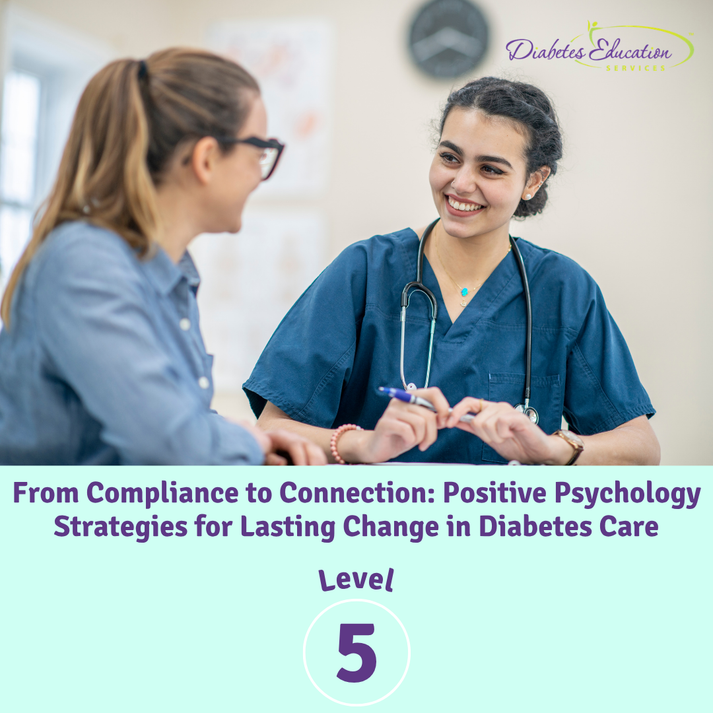
People living with diabetes are often well informed about actions needed to shift into a “healthy lifestyle”, yet often struggle to sustain health behaviors over time. This webinar introduces a positive psychology lens for diabetes care, showing how clinicians can help individuals with diabetes build lifestyles that feel psychologically nourishing, not just medically correct. Rather than focusing solely on risk and problem-solving, we’ll explore how to weave well-being, motivation, and strengths into everyday diabetes education and support.
Drawing on the PERMA framework—Positive Emotion, Engagement, Relationships, Meaning, and Accomplishment—participants will learn practical strategies to enhance motivation, resilience, and self-management. We’ll examine how PERMA aligns with key behavior-change principles such as autonomy, connection, and confidence-building, and translate these ideas into simple questions, reframes, and counseling approaches that can be used immediately in healthcare professionals’ practice.