
Subscribe
eNewsletter

Ready to get certified?
Free CDCES Coach App

eNewsletter
Free CDCES Coach App

JZ is excited for 2021 and wants to work on some New Years resolutions. Which of the following would be considered a SMART behavioral goal for the New Year?
Click here to test your knowledge!
This series is designed for health care professionals who are interested in getting started in diabetes education and for those actively working toward becoming a Certified Diabetes Care and Education Specialist. Each course in this series provides the critical building blocks and foundation for those entering the diabetes field. Plus, they prepare you to advance to our Level 2 Standards of Care Intensive Courses.
Join us for our 2021 Live Webinar Updates. All courses air at 11:30 a.m. (PST)
Instructor: Beverly Thomassian RN, MPH, CDCES, has been Board Certified in Advanced Diabetes Management for over 20 years. She is an Associate Clinical Professor at UCSF and Touro University and a nationally recognized diabetes expert.
Sign up for Diabetes Blog Bytes – we post one daily Blog Byte from Monday to Friday. And of course, Tuesday is our Question of the Week. It’s Informative and FREE! Sign up below!
[yikes-mailchimp form=”1″]
Accreditation: Diabetes Education Services is an approved provider by the California Board of Registered Nursing, Provider 12640, and Commission on Dietetic Registration (CDR), Provider DI002. Since these programs are approved by the CDR it satisfies the CE requirements for the CDCES regardless of your profession.*
The use of DES products does not guarantee the successful passage of the CDCES exam. CBDCE does not endorse any preparatory or review materials for the CDCES exam, except for those published by CBDCE.
The Winter Solstice, on December 21, marked the shortest day in the Northern Hemisphere. People in New York got just over 9 hours 15 minutes of sun, while those in Anchorage Alaska got fewer than 5.5 hours.

Lack of light can contribute to depression. The idea that people are more susceptible to depression in the winter months wasn’t picked up until the 1980’s when South African psychiatrist Norman Rosenthal moved to the US and noticed a change in his mood during the New York winters. Dr. Rosenthal, Dr. Al Lewy, and Dr. Thomas Wehr investigated and identified Seasonal Affective Disorder (SAD). In 1987 it was included in DSM.(1)
This winter 2020 is an extra dark one. A recent study showed that depression symptom prevalence was more than 3-fold higher during the COVID-19 pandemic than before. During the pandemic, many people are making a lower-income or have no income, have depleted their savings, and have more exposure to stressors, which were all associated with a greater risk of depression. (2)
Studies show that people with diabetes are more susceptible to depression. Depression is three times as prevalent in people with diabetes when assessed by self-report. The combination of diabetes and depression present a major clinical challenge as the outcomes of both conditions are worsened in the presence of the other. Quality of life is worse, diabetes self-management is impaired, the incidence of complications is increased, and life expectancy is reduced. (3)
Refer to mental health providers as needed. As I am writing this blog my sister texted me that she is feeling very sad, unmotivated, and just wants to sleep. Diabetes Education Services has resources to help us screen our clients for depression in the Psychological Care Assessment Resource Page.
Can food, in particular a golden spice, help those of us without the more serious clinical depression cope this winter with milder winter blues?
Turmeric is a plant with a very long history of medicinal use, dating back 4000 years. In parts of Southeast Asia, turmeric is used not only as a principal spice but also as a component in religious ceremonies.
Turmeric, derived from the root of Curcuma longa, a flowering plant of the ginger family, is a gold-colored spice commonly used in the Indian subcontinent, not only for health care but also for the preservation of food and as a yellow dye for textiles. Curcumin, which gives the yellow color to turmeric, was first isolated almost two centuries ago, and its structure as diferuloylmethane was determined in 1910.
Since the time of Ayurveda (1900 BCE) numerous therapeutic activities have been assigned to turmeric for a wide variety of diseases and conditions. Extensive research within the last half-century has proven that most of these activities, once associated with turmeric, are due to curcumin. Curcumin has been shown to exhibit antioxidant, anti-inflammatory, antiviral, antibacterial, antifungal, and anticancer activities. (4)
“Curcumin can influence several mechanisms in the body; in particular, it is a powerful natural anti-inflammatory and antioxidant. This has relevance to depression because people with depression have greater inflammation and oxidative stress, which can affect all major organs of the body, including the brain”, reports Adrian Lopresti, PhD., a clinical psychologist and researcher at the School of Psychology and Exercise Science at Murdoch University. (5)
Due to curcumin’s anti-inflammatory effect, a 2013 review of studies suggests that curcumin can decrease the level of glucose in the blood, as well as other diabetes-related complications. (6) 500-1000 mg of curcumin per day has been found to promote the anti-inflammatory effect. (7) 1 teaspoon of fresh turmeric has about 200 mg of curcuminoids. Curcumin’s bioavailability can be enhanced by 2000% by combining it with black pepper (piperine is the major active component). (8)
Try turmeric tea or add turmeric to scrambled eggs, to rice as it is cooking, to stews. You can also try my favorite before bed treat, Golden Milk.

Directions
Simply pour all ingredients into a small saucepan, whisk to combine ingredients. Heat until hot to the touch but not boiling – about 4 minutes. Enjoy warm.
Written by Dawn DeSoto RD, CDCES, our resident Nutrition Content Writer
References
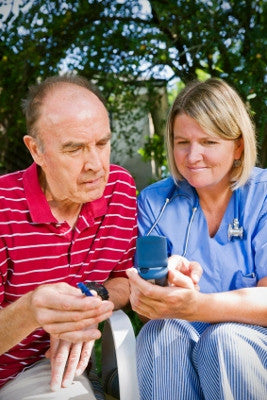
We are updating this course to reflect the 2021 ADA Standards of Care. This presentation will include the latest information on Social Determinants of health, assessment strategies and approaches. We will explore the psychosocial issues that can discourage individuals from adopting healthier behaviors and provides strategies to identify and overcome these barriers.
Life studies are used to apply theory to real life situations. A great course for anyone in the field of diabetes education or for those looking for a new perspective on assessment and coping strategies.
Topics include:
This course is included in: Level 2 – Standards of Care Intensive. Purchase this course individually for $29 or the entire bundle and save 70%.
Enroll in our entire Level 2 – Standards of Care Intensive to join us for the below for Live Webinar Updates. All courses air at 11:30 a.m. (PST)
Sign up for Diabetes Blog Bytes – we post one daily Blog Byte from Monday to Friday. And of course, Tuesday is our Question of the Week. It’s Informative and FREE! Sign up below!
[yikes-mailchimp form=”1″]
Accreditation: Diabetes Education Services is an approved provider by the California Board of Registered Nursing, Provider 12640, and Commission on Dietetic Registration (CDR), Provider DI002. Since these programs are approved by the CDR it satisfies the CE requirements for the CDCES regardless of your profession.*
The use of DES products does not guarantee the successful passage of the CDCES exam. CBDCE does not endorse any preparatory or review materials for the CDCES exam, except for those published by CBDCE.
JR is 63, has diabetes and has a B/P of 162/94 which is repeated on a separate visit. JR also has albuminuria. What would be the recommended pharmacological approach based on the ADA Standards of Care?
Click here to test your knowledge!
This series is designed for health care professionals who are interested in getting started in diabetes education and for those actively working toward becoming a Certified Diabetes Care and Education Specialist. Each course in this series provides the critical building blocks and foundation for those entering the diabetes field. Plus, they prepare you to advance to our Level 2 Standards of Care Intensive Courses.
Join us for our 2021 Live Webinar Updates. All courses air at 11:30 a.m. (PST)
Instructor: Beverly Thomassian RN, MPH, CDCES, has been Board Certified in Advanced Diabetes Management for over 20 years. She is an Associate Clinical Professor at UCSF and Touro University and a nationally recognized diabetes expert.
Sign up for Diabetes Blog Bytes – we post one daily Blog Byte from Monday to Friday. And of course, Tuesday is our Question of the Week. It’s Informative and FREE! Sign up below!
[yikes-mailchimp form=”1″]
Accreditation: Diabetes Education Services is an approved provider by the California Board of Registered Nursing, Provider 12640, and Commission on Dietetic Registration (CDR), Provider DI002. Since these programs are approved by the CDR it satisfies the CE requirements for the CDCES regardless of your profession.*
The use of DES products does not guarantee the successful passage of the CDCES exam. CBDCE does not endorse any preparatory or review materials for the CDCES exam, except for those published by CBDCE.

Today, is Winter Solstice, when we experience the shortest day and longest night of the year. From here we will slowly gain more light each day, marking this as an astronomical shift from darkness to light.
For many cultures, winter solstice marks a day of rebirth, saying goodbye to the past year and a universal deep breath for the future.
Susan Cooper penned a beautiful poem about winter solstice that we are thrilled to share with you below. Given this incredibly difficult year, it seems especially poignant and I hope you enjoy the read.
As a special bonus this year, Jupiter and Saturn will align in the night sky today, December 21st, in an event astronomers call the “great conjunction.”
The last time Jupiter and Saturn came this close was 1623, but that conjunction was too near the sun to be seen by Earthlings. 1226 is actually the most recent time such close conjunction of Jupiter and Saturn was visible to humans.
You can watch it online with webcasts from The Virtual Telescope Project, Slooh at NASA Telescope here.
And so the Shortest Day came and the year died
And everywhere down the centuries of the snow-white world
Came people singing, dancing
To drive the dark away
They lighted candles in the winter trees
They hung their homes with evergreen
They burned beseeching fires all night long
To keep the year alive
And when the new year’s sunshine blazed awake
They shouted, reveling
Through all the frosty ages you can hear them
Echoing behind us—listen!
All the long echoes, sing the same delight
This Shortest Day
As promise wakens in the sleeping land:
They carol, feast, give thanks
And dearly love their friends
And hope for peace.
And now so do we, here, now,
This year and every year.
Welcome, Yule!
This poem is available as a children’s hardcover with beautiful watercolor illustrations by Carson Ellis.

As health care professionals and Diabetes Specialists, how do we keep up to date with all the latest information on diabetes and COVID-19?
How do we prepare people with diabetes for the possibility of a COVID-19 infection and hospitalization?
To help, we have put together a list of free resources by category so you can easily access important and relevant information about COVID-19.
Plus, we have updated our Sick Days / COVID-19 and Diabetes Handout that we invite you to share with colleagues and people living with diabetes.
COVID-19, Sick days & Diabetes: Handout
Updated to reflect the latest CDC guidelines. Reviews sick day instruction for people with diabetes, plus COVID-19 specific information.
Article Library Sections

We have updated this content based on the ADA 2021 Standards of Care.
We are living longer and more people are getting diabetes. The American Diabetes Association has updated the Older Adults Standards, with special attention to considering a reduction of medication and insulin therapy intensity. The older population has unique issues and special needs that require consideration as we provide diabetes self-management education. This online course highlights key areas of assessment, intervention, and advocacy for older clients living with diabetes.
Topics include:
Join us live on December 23rd at 11:30 am (PST)
This course is included in: Level 2 – Standards of Care Intensive. Purchase this course individually for $29 or the entire bundle and save 70%.
Enroll in our entire Level 2 – Standards of Care Intensive to join us for the below for Live Webinar Updates. All courses air at 11:30 a.m. (PST)
All hours earned count toward your CDCES Accreditation Information
Sign up for Diabetes Blog Bytes – we post one daily Blog Byte from Monday to Friday. And of course, Tuesday is our Question of the Week. It’s Informative and FREE! Sign up below!
[yikes-mailchimp form=”1″]
Accreditation: Diabetes Education Services is an approved provider by the California Board of Registered Nursing, Provider 12640, and Commission on Dietetic Registration (CDR), Provider DI002. Since these programs are approved by the CDR it satisfies the CE requirements for the CDCES regardless of your profession.*
The use of DES products does not guarantee the successful passage of the CDCES exam. CBDCE does not endorse any preparatory or review materials for the CDCES exam, except for those published by CBDCE.

Our December 8th Question of the week was a question of interventions. Over 71% of respondents, chose the best answer.
Before we start though, if you don’t want any spoilers and haven’t tried the question yet, you can answer below: Answer Question
Question: A 12-year-old with new-onset hyperglycemia presents to the Emergency Room with positive urine ketones and blood sugar of 283. What action is required most immediately?
Answer Choices:
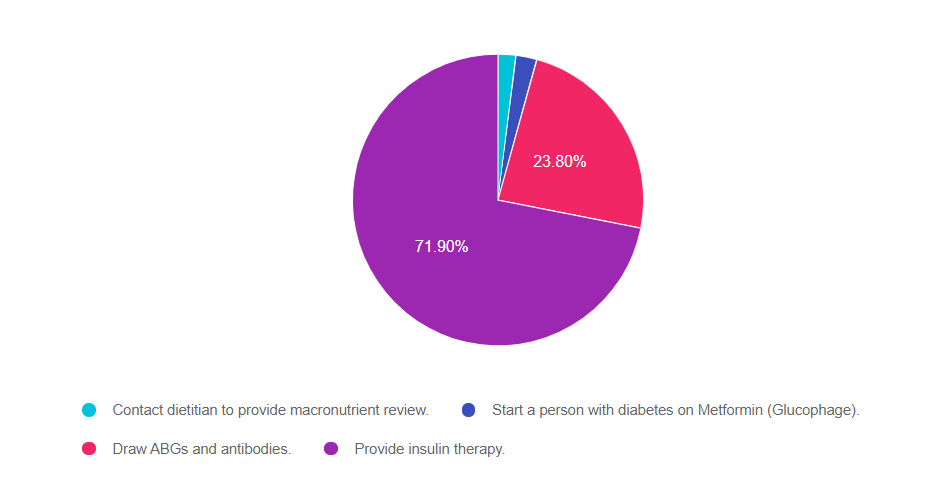
As shown above, the most common choice was option 4, the second most common answer was option 3, then option 2, and finally option 1.
If you are thinking about taking the certification exam, the content of this practice test question will set you up for success. The exam questions won’t have 2 right answers, but alcohol and diabetes is expected content on the exam.
Answer 1 is incorrect. 1.98% chose this answer. “Contact dietitian to provide macronutrient review.” All people with diabetes benefit from a consultation with a dietitian. However, in this crisis situation, the first priority is not a macronutrient review. The first priority is to stop ketosis.
Answer 2 is incorrect. 2.31% of you chose this answer. “Start a person with diabetes on Metformin (Glucophage).” Given that this is a teenager with positive ketones, we are suspecting type 1 diabetes. With that information, starting metformin would not be a recommended intervention.
Answer 3 is incorrect, 23.8% of you chose this answer “Draw ABGs and antibodies.” The question asks what action to take immediately. If you chose this answer, you are on the right track. You want to verify a diagnosis of type 1 diabetes by evaluating if they are acidotic and have positive autoantibodies. An immediate action would include checking ABG’s but not antibodies. Antibodies would most likely be drawn after the patient is stabilized.
Answer 4 is correct, 71.9% of you chose this answer. “Provide insulin therapy. ” Elevated blood glucose and positive ketones always indicate that the person is insulin deficient. When there is not enough circulating insulin, the body can’t use glucose for fuel, so it uses fat for fuel which leads to ketone bodies. To stop fat breakdown, immediate insulin infusion is required along with fluids to treat dehydration.
We hope you appreciate this week’s rationale! Thank you so much for taking the time to answer our Question of the Week and participate in this fun learning activity!

Join Coach Beverly to learn about unexpected causes of hyperglycemia and strategies to get blood glucose levels to goal. Topics include hyperglycemia secondary to medications and insulin deprivation. She also reviews Diabetes Ketoacidosis and Hyperosmolar Hyperglycemic Syndrome, with new information on treating DKA with subq insulin therapy. Treatment strategies for all situations are included.
Topics include:
Sign up for Diabetes Blog Bytes – we post one daily Blog Byte from Monday to Friday. And of course, Tuesday is our Question of the Week. It’s Informative and FREE! Sign up below!
[yikes-mailchimp form=”1″]
Accreditation: Diabetes Education Services is an approved provider by the California Board of Registered Nursing, Provider 12640, and Commission on Dietetic Registration (CDR), Provider DI002. Since these programs are approved by the CDR it satisfies the CE requirements for the CDCES regardless of your profession.*
The use of DES products does not guarantee the successful passage of the CDCES exam. CBDCE does not endorse any preparatory or review materials for the CDCES exam, except for those published by CBDCE.
Blood glucose levels provide an immediate snapshot of a person’s state of inflammation, with or without diabetes.
According to recent research findings, admission glucose is also an excellent predictor of COVID-19 related deaths and severity of illness.
Researchers in Spain retrospectively evaluated over 11,000 patients positive with COVID on admission in 109 hospitals throughout Spain. They also evaluated admission blood glucose levels and their findings were startling.
The researchers were also able to stratify the risk of death based on admissions glucose levels.
For all 11, 000 patients admitted with COVID in this study, the mortality rate was 20%.
For patients with admission glucose of 140 – 180, the mortality rate increased to 33%.
The mortality rate skyrocketed to 41% if admission glucose was 180 mg/dL or greater.
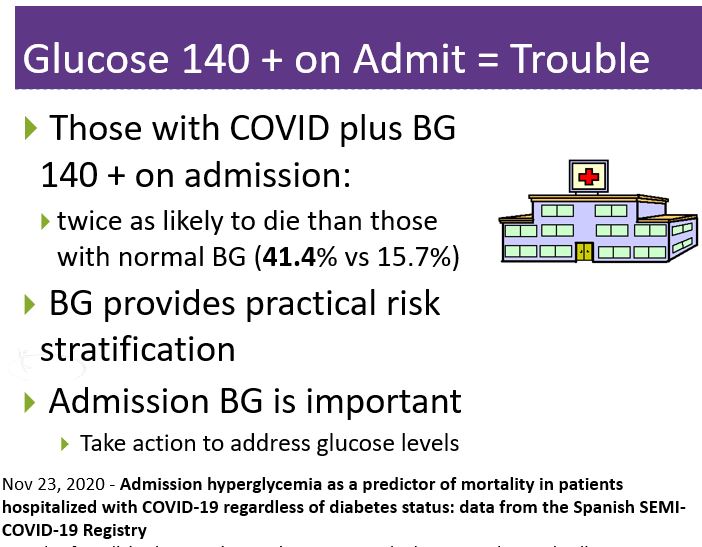
Read More Here Admission hyperglycemia as a predictor of mortality in patients hospitalized with COVID-19 regardless of diabetes status: data from the Spanish SEMI-COVID-19 Registry. November 2020
Annals of Medicine by Francisco Javier Carrasco-Sánchez, MD, PhD, and colleagues. Nov 23, 2020
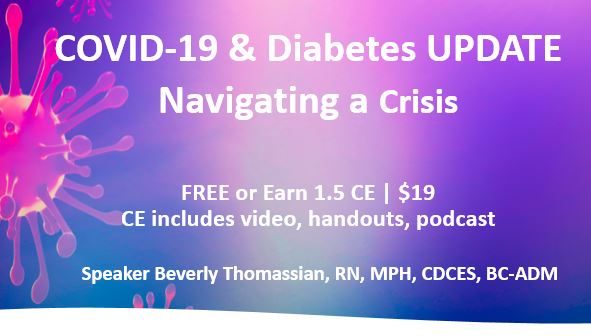
Recorded & Ready for Viewing
Coach Beverly Thomassian, RN, MPH, CDCES, BC-ADM, has completely updated this critical presentation, to bring health care professionals up-to-date on the current state of COVID and its impact on diabetes care. She summarizes key information including critical teaching points and management strategies for people with diabetes who develop a COVID-19 infection.
Topics Include:
Join us to learn critical information about Diabetes and COVID Management
Instructor: Beverly Thomassian RN, MPH, CDCES, has been Board Certified in Advanced Diabetes Management for over 20 years. She is an Associate Clinical Professor at UCSF and Touro University and a nationally recognized diabetes expert.
Sign up for Diabetes Blog Bytes – we post one daily Blog Byte from Monday to Friday. And of course, Tuesday is our Question of the Week. It’s Informative and FREE! Sign up below!
[yikes-mailchimp form=”1″]
Accreditation: Diabetes Education Services is an approved provider by the California Board of Registered Nursing, Provider 12640, and Commission on Dietetic Registration (CDR), Provider DI002. Since these programs are approved by the CDR it satisfies the CE requirements for the CDCES regardless of your profession.*
The use of DES products does not guarantee the successful passage of the CDCES exam. CBDCE does not endorse any preparatory or review materials for the CDCES exam, except for those published by CBDCE.
JL is a 78-year-old with type 2 diabetes who has been taking metformin 1000mg BID for the past year. She checks her BG each morning and says it usually ranges from 100 – 138. Her most recent A1c came back at 9.6% and the provider started her on dapagliflozin (Farxiga) 5 mg daily two days ago. JL arrives at the clinic in a panic and says she has been checking her blood glucose 3 times a day it has “jumped up to 236 and 242”. The diabetes specialist double-checked and verified random glucose of 249. What is the best explanation?
Click here to test your knowledge!
This series is designed for health care professionals who are interested in getting started in diabetes education and for those actively working toward becoming a Certified Diabetes Care and Education Specialist. Each course in this series provides the critical building blocks and foundation for those entering the diabetes field. Plus, they prepare you to advance to our Level 2 Standards of Care Intensive Courses.
Join us for our 2021 Live Webinar Updates. All courses air at 11:30 a.m. (PST)
Instructor: Beverly Thomassian RN, MPH, CDCES, has been Board Certified in Advanced Diabetes Management for over 20 years. She is an Associate Clinical Professor at UCSF and Touro University and a nationally recognized diabetes expert.
Sign up for Diabetes Blog Bytes – we post one daily Blog Byte from Monday to Friday. And of course, Tuesday is our Question of the Week. It’s Informative and FREE! Sign up below!
[yikes-mailchimp form=”1″]
Accreditation: Diabetes Education Services is an approved provider by the California Board of Registered Nursing, Provider 12640, and Commission on Dietetic Registration (CDR), Provider DI002. Since these programs are approved by the CDR it satisfies the CE requirements for the CDCES regardless of your profession.*
The use of DES products does not guarantee the successful passage of the CDCES exam. CBDCE does not endorse any preparatory or review materials for the CDCES exam, except for those published by CBDCE.