
Subscribe
eNewsletter

Ready to get certified?
Free CDCES Coach App

eNewsletter
Free CDCES Coach App
Our August 18th Question of the week quizzed test takers on the difference between a CDCES and BC-ADM. Although 54% of respondents chose the correct answer, 46% did not. We thought that this was an important topic to discuss further, so we can pass on correct info to people living with diabetes.
Before we start though, if you don’t want any spoilers and haven’t tried the question yet, you can answer below: Answer Question
Question: What best describes the difference between a Certified Diabetes Care and Education Specialist (CDCES) and a person Board Certified in Advanced Diabetes Management (BC-ADM)?
Answer Choices:
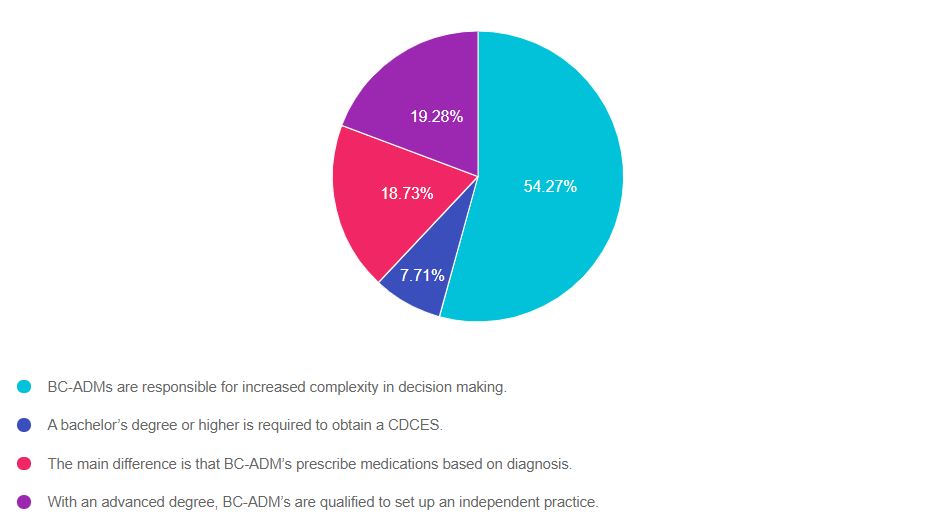
As shown above, the most common choice was option 1, the second most common answer was option 4, then option 3, and finally option 2.
If you are thinking about taking the certification exam, this practice test question will set you up for success. Test writers anticipate possible answers based on the details in the question. They will wave those “juicy answers” right under your nose. Your job is to weed through the particulars, pluck out the most important elements and choose the BEST answer. And remember, sometimes the simplest answer is the best answer.
Answer 1 is correct. 54% chose this answer. “BC-ADMs are responsible for increased complexity in decision making.”
According to the ADCES website:
“The BC-ADM skillfully manages complex patient needs and assists patients with therapeutic problem-solving. Within their discipline’s scope of -practice, healthcare professionals who hold the BC-ADM certification adjust medications, treat and monitor acute and chronic complications and other comorbidities, counsel patients on lifestyle modifications, address psychosocial issues, and participate in research and mentoring.”
Answer 2 is incorrect. 8% of you chose this answer. “A bachelor’s degree or higher is required to obtain a CDCES.”
Eligibility to take the exam is based on licensure, registration, or certification. According to the CDCES website, the following health care professionals meet the discipline requirement.
Answer 3 is incorrect. About 19% of respondents chose this. “The main difference is that BC-ADM’s prescribe medications based on the diagnosis”.
The BC-ADM is a certification exam and it does not confer prescriptive authority. Only those with certain licenses can prescribe medications, and the regulations can vary from state to state. For example, I am a Registered Nurse with a Masters in Public Health. I also have my CDCES and BC-ADM. As a licensed RN, I do not have prescriptive authority. Certification does not change your scope of practice and can come from different organizations. Licensure comes from governmental authority.
Finally, Answer 4 is incorrect. 19% chose this answer. “With an advanced degree, BC-ADM’s are qualified to set up an independent practice.”
This is a juicy answer but is not correct. Let’s say I want to set up shop as a Registered Nurse with a Masters in Public Health. I also have my CDCES and BC-ADM. Even with my BC-ADM, I couldn’t bill for services, and under whose oversight would I see people with diabetes and make treatment recommendations?
Again, it’s not the BC-ADM that creates the opportunity to set up an independent practice. As a licensed RN, I can’t set up an independent practice and bill for my services in my state. Certification does not change your scope of practice and can come from different organizations. Each state’s licensure and scope of practice regulations come from a governmental authority. We must practice within the legal parameters of our scope of practice based on licensure.
We hope you appreciate this week’s rationale! Thank you so much for taking the time to answer our Question of the Week and participate in this fun learning activity!
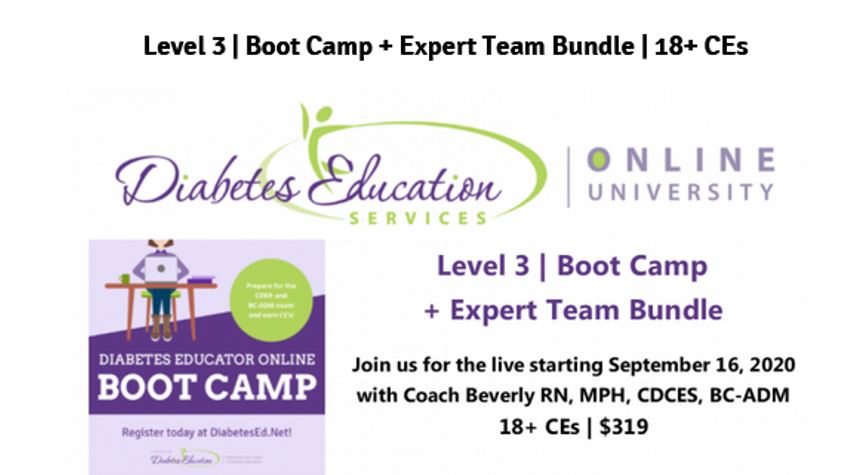
In each webinar, either Coach Beverly, Dr. Isaacs, or Ms. Armstrong, highlight the critical content of each topic area, so you can focus your study time most efficiently. They also launch multiple poll questions to help participants focus on key concepts and assess their knowledge while learning the best test-taking strategies.
2020 Boot Camp Live Stream Webinar Schedule with Coach Beverly
All courses air at 11:30 a.m. (PST)
Can’t make it live?
No worries! All video presentations and podcasts will be available now on-demand.
Sign up for Diabetes Blog Bytes – we post one daily Blog Byte from Monday to Friday. And of course, Tuesday is our Question of the Week. It’s Informative and FREE! Sign up below!
[yikes-mailchimp form=”1″]
Accreditation: Diabetes Education Services is an approved provider by the California Board of Registered Nursing, Provider 12640, and Commission on Dietetic Registration (CDR), Provider DI002. Since these programs are approved by the CDR it satisfies the CE requirements for the CDCES regardless of your profession.*
The use of DES products does not guarantee the successful passage of the CDCES exam. CBDCE does not endorse any preparatory or review materials for the CDCES exam, except for those published by CBDCE.
[yikes-mailchimp form=”1″]

AJ takes 85 units of basaglar at bedtime and 10 -12 units of glulisine (Apridra) at meals, plus metformin and empagliflozin at maximum dose. Fasting blood sugars are 130 or greater and the rest of the day, AJs blood sugars are in the 200s. AJ has a BMI of 32 and an A1c of 9.3%. The diabetes specialist recommends adding semaglutide (Ozempic) 0.5 mg to the regimen.
What teaching information is most important given the addition of this new medication?
Click here to test your knowledge!
In each webinar, either Coach Beverly, Dr. Isaacs, or Ms. Armstrong, highlight the critical content of each topic area, so you can focus your study time most efficiently. They also launch multiple poll questions to help participants focus on key concepts and assess their knowledge while learning the best test-taking strategies.
2020 Boot Camp Live Stream Webinar Schedule with Coach Beverly
All courses air at 11:30 a.m. (PST)
Can’t make it live?
No worries! All video presentations and podcasts will be available now on-demand.
Sign up for Diabetes Blog Bytes – we post one daily Blog Byte from Monday to Friday. And of course, Tuesday is our Question of the Week. It’s Informative and FREE! Sign up below!
[yikes-mailchimp form=”1″]
Accreditation: Diabetes Education Services is an approved provider by the California Board of Registered Nursing, Provider 12640, and Commission on Dietetic Registration (CDR), Provider DI002. Since these programs are approved by the CDR it satisfies the CE requirements for the CDCES regardless of your profession.*
The use of DES products does not guarantee the successful passage of the CDCES exam. CBDCE does not endorse any preparatory or review materials for the CDCES exam, except for those published by CBDCE.
[yikes-mailchimp form=”1″]
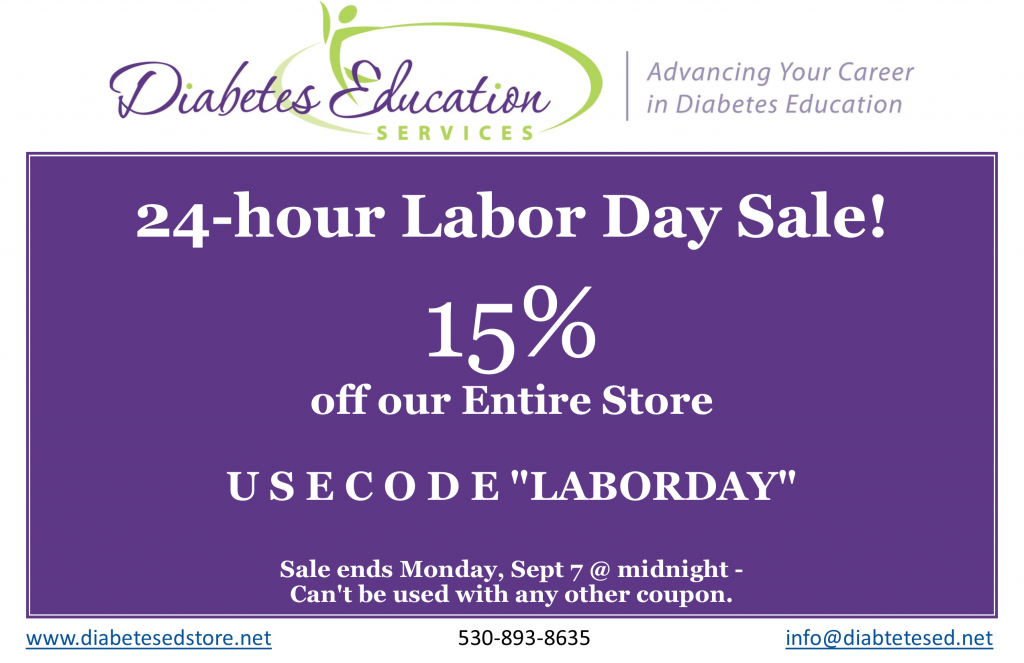
For one day only, we are offering 15% off our entire Online Store to celebrate Labor Day and offer a gift to our community.
Sign up for Diabetes Blog Bytes – we post one daily Blog Byte from Monday to Friday. And of course, Tuesday is our Question of the Week. It’s Informative and FREE! Sign up below!
[yikes-mailchimp form=”1″]
Accreditation: Diabetes Education Services is an approved provider by the California Board of Registered Nursing, Provider 12640, and Commission on Dietetic Registration (CDR), Provider DI002. Since these programs are approved by the CDR it satisfies the CE requirements for the CDCES regardless of your profession.*
The use of DES products does not guarantee the successful passage of the CDCES exam. CBDCE does not endorse any preparatory or review materials for the CDCES exam, except for those published by CBDCE.
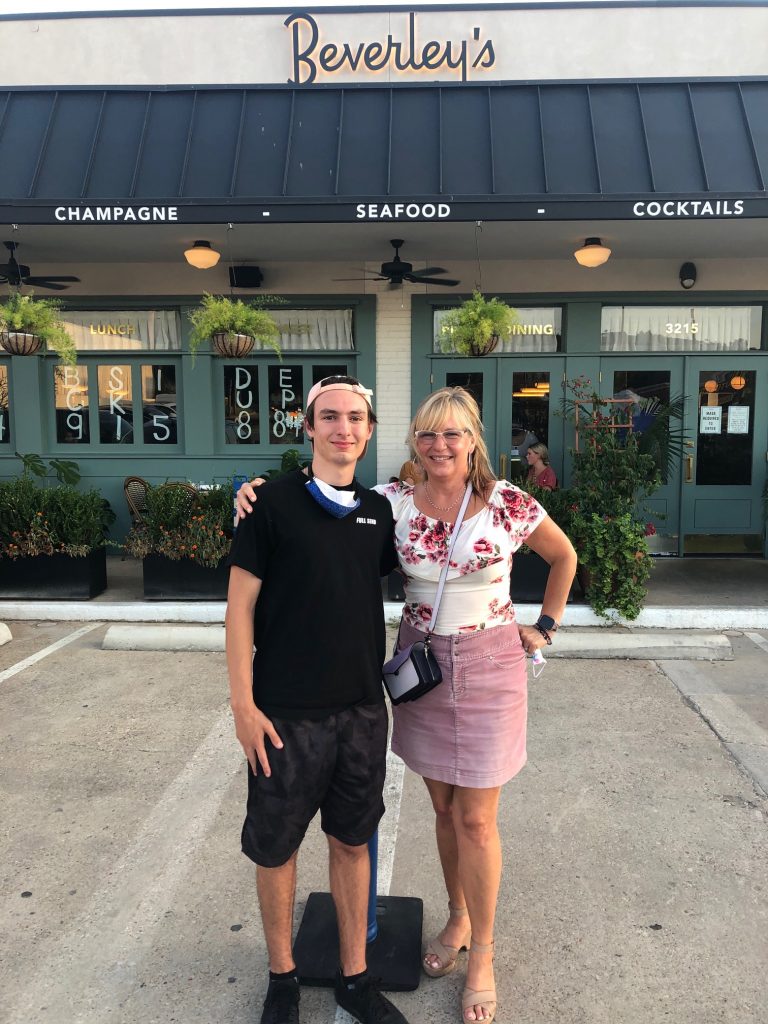
What a year!
Thank you everyone for your support as I shared my adventure of moving my oldest son into his Texas college dorm two weeks ago. He is thriving and excited to live away from home, hang out with other students (while wearing a mask) and attend a combination of virtual and live classroom instruction. My 15-year-old son, Jackson, has stepped into Robert’s role at our company and is doing a great job fulfilling orders and working on special projects.
A special shout out of recognition to all of you who are juggling homeschooling, new working situations, and your lives. This is a tough time for all of us and I miss seeing all of you!
Speaking of virtual instruction, we have great news to share. Our DiabetesEd Boot Camp starts on Sept 16th. We can’t wait to join together with you in the community again as we hunker down to prepare for certification exams.
We are excited to announce that we are offering two Online University Scholarships for diabetes advocates that are “Making a Difference” in their community. Please share it with your colleagues and friends.
In addition, this newsletter explores the importance of promptly recognizing the liver disease and the cost-saving benefits of CGM technology.
Lastly, we love providing our customers with easy-to-find resources, so we put all our most popular Cheat Sheets on one Resource Page for fast access.
During this time of uncertainty and financial hardships, we will be offering frequent discounts. It’s our way of saying thank you with a virtual hug of appreciation.
Warmest regards,
Coach Beverly, Bryanna, and Jackson
Sign up for Diabetes Blog Bytes – we post one daily Blog Byte from Monday to Friday. And of course, Tuesday is our Question of the Week. It’s Informative and FREE! Sign up below!
[yikes-mailchimp form=”1″]
Accreditation: Diabetes Education Services is an approved provider by the California Board of Registered Nursing, Provider 12640, and Commission on Dietetic Registration (CDR), Provider DI002. Since these programs are approved by the CDR it satisfies the CE requirements for the CDCES regardless of your profession.*
The use of DES products does not guarantee the successful passage of the CDCES exam. CBDCE does not endorse any preparatory or review materials for the CDCES exam, except for those published by CBDCE.
For people with type 1 diabetes, access to Continuous Glucose Monitoring (CGM) technology, is considered a standard of care by most experts.
There is plenty of research that demonstrates CGM use is associated with not only improved A1c but significantly decreases time in hypoglycemic range and ketoacidosis rates.

YES.
According to a study presented at the Heart in Diabetes virtual meeting.
After three years of follow-up, the savings were substantial.
“In this study, we showed that it didn’t make any difference how you deliver insulin,” Grunberger said. “This difference is in how you monitor glucose.”
George Grunberger, MD, FACP, MACE, Chairman Grunberger Diabetes Institute and more
Glucose Crises are Expensive
According to Grunberger, the cost of diabetes ketoacidosis (DKA) in the U.S. is over 5 billion dollars a year.
Having a CGM reduces DKA rates, hospitalization, and leads to cost savings.
A study in the United Kingdom showed that for 900 people using the Freestyle Libre (Abbott), DKA episodes were reduced by 80% within six months of using this device.
A study in Belgium followed 1,913 people with type 1 diabetes using the Freestyle Libre CGM.
Not only did they see a dramatic reduction in hospitalizations from DKA and hypoglycemia, but the researchers also observed a fifty percent drop in work absenteeism.
Full Story: Healio (free registration)/Endocrine Today (8/31)
Sign up for Diabetes Blog Bytes – we post one daily Blog Byte from Monday to Friday. And of course, Tuesday is our Question of the Week. It’s Informative and FREE! Sign up below!
[yikes-mailchimp form=”1″]
Accreditation: Diabetes Education Services is an approved provider by the California Board of Registered Nursing, Provider 12640, and Commission on Dietetic Registration (CDR), Provider DI002. Since these programs are approved by the CDR it satisfies the CE requirements for the CDCES regardless of your profession.*
The use of DES products does not guarantee the successful passage of the CDCES exam. CBDCE does not endorse any preparatory or review materials for the CDCES exam, except for those published by CBDCE.
[yikes-mailchimp form=”1″]
LS is a 49-year-old with type 2 diabetes and an A1c of 8.9%. LS has a BMI of 38 with recently discovered steatohepatitis.
Considering the relationship between diabetes and cancer, which of the following statements are true?
Click here to test your knowledge!
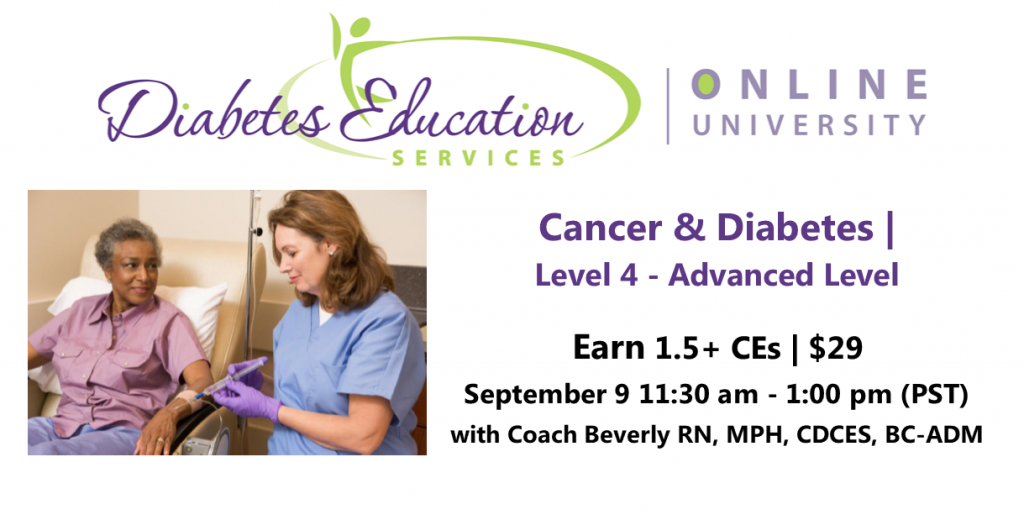
Patients with cancer often experience hyperglycemia secondary to treatment, which can increase risk of infection and compromise their nutritional status. In addition, recent research has identified the link between diabetes and cancer. Join us to learn more about this unexpected link and treatment strategies for steroid-induced hyperglycemia using a case study approach.
Topics Include:
Sign up for Diabetes Blog Bytes – we post one daily Blog Byte from Monday to Friday. And of course, Tuesday is our Question of the Week. It’s Informative and FREE! Sign up below!
[yikes-mailchimp form=”1″]
Accreditation: Diabetes Education Services is an approved provider by the California Board of Registered Nursing, Provider 12640, and Commission on Dietetic Registration (CDR), Provider DI002. Since these programs are approved by the CDR it satisfies the CE requirements for the CDCES regardless of your profession.*
The use of DES products does not guarantee the successful passage of the CDCES exam. CBDCE does not endorse any preparatory or review materials for the CDCES exam, except for those published by CBDCE.
[yikes-mailchimp form=”1″]
On Fridays, I get to provide diabetes care at a local clinic where about half of the people I see are Spanish-speaking only. We do have wonderful interpreters, but I have a strong desire to communicate directly with my clients and really understand what they are saying, in their language.
My Spanish is getting better, but I keep giving myself permission to appreciate where I am now, with the belief that even at my age, I can keep improving.
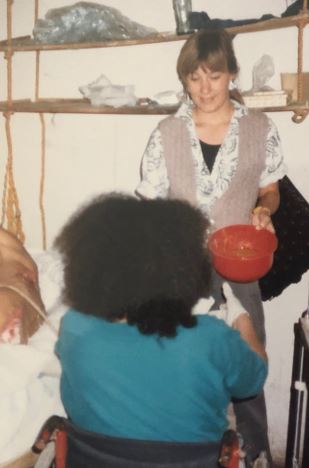
I took a few years of high school Spanish, but never really had a grasp on the language until I signed up to move to a small pueblo in Mexico, in 1987, to volunteer as a rural healthcare worker.
I lived with a local family and helped with daily chores in addition to providing services in the clinic. As part of the “Projecto Projimo”, I helped with everything from cleaning bathrooms to dressing wounds as pictured here. I also attended classes daily in Spanish, to become a “Promotora de Salud”, a community health worker.
Along with learning Spanish, I have gained some other valuable insights that I would like to share.
For the first few months I lived in Mexico, my Spanish was so bad I was reluctant to talk and embarrass myself.
Instead I did a lot of careful listening and observing.
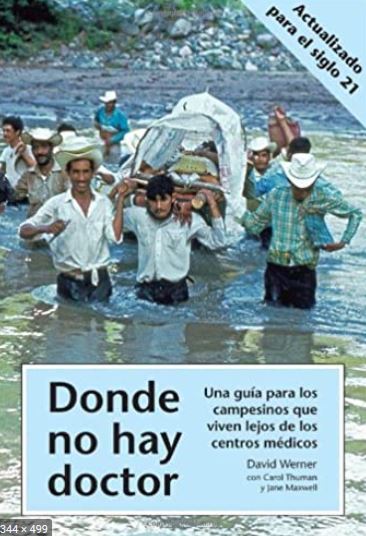
As with anyone acquiring a new language, my brain was looking for patterns and listening for frequently used words. I studied cognates and learned about sentence structure and common phrases in my textbook, “Donde No Hay Doctor – Where There is No Doctor”, which I would read every night before passing out from mental exhaustion.
By the third month of living within this new community, I was able to understand most of the questions being asked and respond with rudimentary sentences. Sometimes I could even conjugate in the past tense. That was 30 years ago.
Now, working in the clinic, I have had to dust off my Spanish language skills, that have been languishing in the recesses of my brain for almost three decades. I have committed myself to expanding my Spanish vocabulary and improving my ability to communicate in ways that are meaningful.
When I meet with our Spanish-speaking clients in my current clinic, to fully understand what they are saying, I have to dedicate my whole being to hearing their diabetes stories.
It all starts with listening.
I am completely present to capture all the words they are saying coupled with their body gestures. Sometimes I get so enraptured in everything they are saying, then when they stop, I forget to ask the next question.
In that silence, we have a moment of understanding and togetherness that goes beyond language.
The funny thing is, in spite of knowing lots of diabetes phrases in Spanish and the names of dozens of fruits and vegetables, plus most of the body parts and medical conditions, there is still one phrase that I need to say with each new person I meet.
When people share their diabetes stories with me, it feels like there is an invisible burden they are carrying on their backs. This burden is reflected in tears or embarrassment for elevated blood sugars. For many, that burden is best described as shame.
They somehow believe it is their fault they have diabetes.
I reassure them, that diabetes is not their fault. It is a complex interplay between genetics, environment, access to healthy foods, stress, inequities, body weight, and age.
Each one of us knows people who don’t eat healthfully, have extra weight and don’t exercise, who never get diabetes.
Let’s help people let go of the shame so they can move toward engaging in self-care that improves their sense of self and well-being.
Let’s remind them that they are worth it!
The outstanding thing I so appreciate is the grace that my Spanish-speaking clients show me.
So many times I can’t remember a vocabulary word, or I will say a phrase in a funny way. There are moments where I stumble and feel bad that I don’t have the ability to accurately express what I am thinking.
No one has ever made me feel bad about my mistakes. They are respectful and just politely ask, “Mande?”, letting me know that they did not understand what I was trying to communicate.
They are simply grateful that I am trying to communicate in their language.
It reminds me to be patient with people who are trying to acquire the English language. Let’s acknowledge the courage it takes to tackle a language that you did not grow up speaking. Let’s offer them grace and the opportunity to practice speaking this new language.
We can also let them know they are safe to make mistakes with us.
Gracias! Coach Beverly
| Please enjoy these FREE resources that we have put together for you: |
|---|

See Full Free Resource Catalog
Sign up for Diabetes Blog Bytes – we post one daily Blog Byte from Monday to Friday. And of course, Tuesday is our Question of the Week. It’s Informative and FREE! Sign up below!
[yikes-mailchimp form=”1″]

Unsure about updates for the 2020 exam?
Coach Beverly offers this FREE webinar to help get you to prepare for the CDCES Exam. All her tips and tricks are meant to ease your mind and reflect the updates to the CDCES content outline.
Instructor: Beverly Thomassian RN, MPH, CDCES, BC-ADM is a working educator who has passed her CDCES Exam 6 times. She is a nationally recognized diabetes expert for over 25 years.
See our Preparing for CDCES Resource Page >>
Test Taking Toolkit (220+ practice questions)
Whether you are preparing for the updated CDCES or BC-ADM exam, this test-taking toolkit is designed to prepare you for success.
This toolkit includes two courses with over 220 practice questions to help you prepare and simulate the exam.
Sign up for Diabetes Blog Bytes – we post one daily Blog Byte from Monday to Friday. And of course, Tuesday is our Question of the Week. It’s Informative and FREE! Sign up below!
[yikes-mailchimp form=”1″]
Accreditation: Diabetes Education Services is an approved provider by the California Board of Registered Nursing, Provider 12640, and Commission on Dietetic Registration (CDR), Provider DI002. Since these programs are approved by the CDR it satisfies the CE requirements for the CDCES regardless of your profession.*
The use of DES products does not guarantee the successful passage of the CDCES exam. CBDCE does not endorse any preparatory or review materials for the CDCES exam, except for those published by CBDCE.