
Subscribe
eNewsletter

Ready to get certified?
Free CDCES Coach App

eNewsletter
Free CDCES Coach App
Join Coach Beverly for an exploration into the 30 feet of lumen that affects daily well-being. This one-hour complimentary journey will expand participants view of how trillions of bacterial hitchhikers profoundly influence our health.

FREE webinar, Getting to the Gut – Meet Your Microbiome, airs Tuesday, November 12, 2019 at 11:30 a.m. Pacific Standard Time.
Beverly will discuss how foods, the environment and our medical practices impact gut bacteria over time and strategies we can take to protect these old friends.
Since we are anticipating a full-house, plan to arrive at the webinar at least 15 minutes early to hold your spot (first come, first serve basis). Don’t worry if you miss the live version, we will send you a link to the recorded version later that day.
Register below if you want to join us live, November 12 at 11:30 a.m. PST:
We offer this course as part of our Level 4 Bundle as well as an individual course! If you’re hoping for CE credit, you can purchase the individual course or the Level 4 Bundle in our store. Purchase comes with video, podcast, handouts, test, and CE Certificate.
Sign up for Diabetes Blog Bytes – we post one daily Blog Byte from Monday to Friday. And of course, Tuesday is our Question of the Week. It’s Informative and FREE! Sign up below!
[yikes-mailchimp form=”1″]
People with diabetes who delay getting blood pressure to target may be more likely to have heart attacks and strokes than their counterparts who manage it promptly, a recent study suggests.
A study conducted by Dr. Sridharan Raghavan of University of Colorado Anschutz Medical Campus, examined data on over 43,000 participants. Participants were all people with diabetes who started treatment for high blood pressure between 2002 and 2007.
Those who waited until their blood pressure was more elevated before beginning treatment were 10% more likely to have events like fatal heart attacks and strokes.
Raghavan stressed that lowering blood pressure in people with diabetes with hypertension “can mitigate some of the risk of atherosclerotic cardiovascular disease.” The study indicates that people with diabetes may have improved outcomes with a lower systolic blood pressure target than the ADA target of 140 mmHg. The American Heart Associations and the American College of Cardiology’s guidelines are to start treatment when systolic blood pressure is above 130 mmHg.
Using the lower standard of 130 systolic instead of starting treatment at the higher 140 systolic standard may result in fewer deaths from heart attacks and strokes.
Read the full study here.
Sign up for Diabetes Blog Bytes – we post one daily Blog Byte from Monday to Friday. And of course, Tuesday is our Question of the Week. It’s Informative and FREE! Sign up below!
[yikes-mailchimp form=”1″]Our November Newsletter celebrates Diabetes Awareness month, so it is brimming with free resources! Find out how you can get free monofilaments and raise awareness for diabetes and diagnosis.
Sign up for our Monthly Newsletter

Our Diabetes Detective Team scans the diabetes news to discover the most relevant info that Diabetes Educators need in their daily practice. We post one daily Blog Byte from Monday to Friday. And of course, Tuesday is our Question of the Week. It’s Informative and FREE! Sign up below!
Sign up for Diabetes Blog Bytes – we post one daily Blog Byte from Monday to Friday. And of course, Tuesday is our Question of the Week. It’s Informative and FREE! Sign up below!
[yikes-mailchimp form=”1″]
For last Tuesday’s Question of the week, about 55% of respondents chose the correct answer. Although the majority of people chose the correct answer, we wanted to write a rationale to this particular question since it highlights an important issue that people with diabetes may be facing.
Before you read any spoilers, if you haven’t tried the question of the week from October 29, you can take your best guess here:
Question of the week on October 29:
JR is 15 and has had type 1 diabetes for the past 2 years. JR started insulin pump therapy a few months ago and noticed that their weight increased by over 5 pounds. JR is very worried about weight gain. JR’s mom called the diabetes educator to share her concerns and added that JRs daily insulin usage significantly decreased over the past few weeks. What is the most likely reason for this insulin usage decrease?
Answer Options:
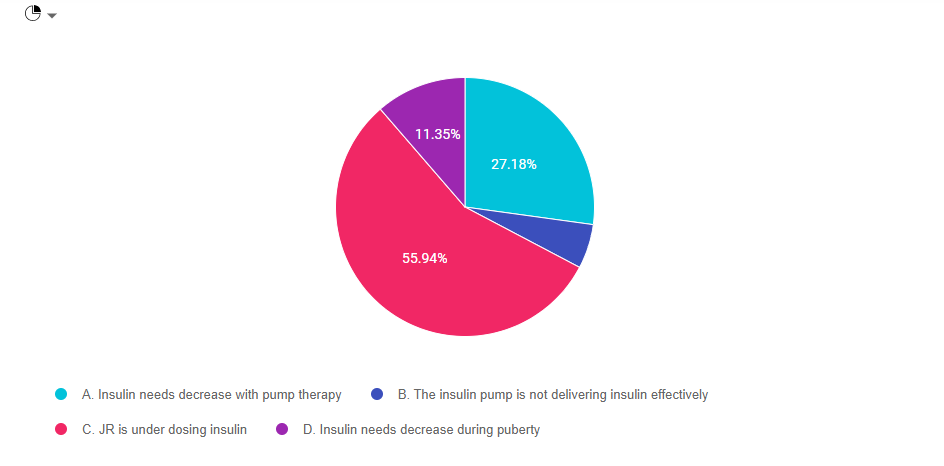
As shown above, the most common choice was option 3, the second most common answer was option 1, then option 4, and finally option 2.
Congratulations! Most of you chose the right answer. Let’s explore the options in a little more detail.
Option 3 (C) is the correct answer: JR is under dosing insulin. In the scenario, JR has gained weight. This is coupled with the fact the JR’s insulin usage has decreased. These two items of information are red flags that JR is purposely decreasing insulin usage to let blood sugars run above target to lose weight. Sometimes this is termed “diabulimia”. It is important to recognize and address this issue right away to prevent potential complications secondary to acute and chronic hyperglycemia.
Option 1 is incorrect. Although insulin needs do decrease when transitioning from Multiple Daily Injections to insulin pump therapy, they don’t decrease significantly after pump therapy is established as characterized in this scenario.
Option 2 is incorrect since this vignette gives two key pieces of information: “JR is worried about weight gain” and “JR’s mom called the diabetes educator to share her concerns.” Although option 2 may be considered, by re-reading the question you can identify option 3 as the better answer between the two because of the details in the vignette. A great test taking strategy is to use the process of elimination to get down to two options, then apply careful, critical reading techniques to find the best answer.
Option 4 is incorrect because insulin needs do not decrease during puberty. In fact, puberty causes significant insulin resistance, which leads to increased insulin needs.
Want to learn more about insulin pump therapy and dosing? Check out our Technology Toolkit:
Sign up for Diabetes Blog Bytes – we post one daily Blog Byte from Monday to Friday. And of course, Tuesday is our Question of the Week. It’s Informative and FREE! Sign up below!
[yikes-mailchimp form=”1″]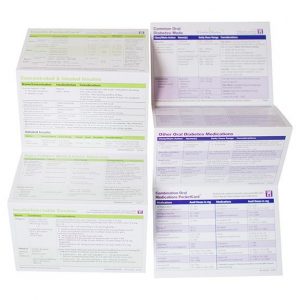
We have updated our printed and digital Meds PocketCard. You can view for FREE in the CDCES Coach App and Online or order your very own laminated version.
Updates include:
FREE Shipping – Order your laminated pocketcard(s) and enjoy FREE shipping on ALL quantities, no matter how many you order. Order your PocketCards today!
Sign up for Diabetes Blog Bytes – we post one daily Blog Byte from Monday to Friday. And of course, Tuesday is our Question of the Week. It’s Informative and FREE! Sign up below!
[yikes-mailchimp form=”1″]Americans purchase nearly 600 million pounds of candy every year just for Halloween. That means lots of extra calories and sugar temptations for days and weeks to come.
One strategy to decrease temptation and consumption, is to remove these sugary treats from your home and donate leftover candy to persons or organizations in need. Donating provides a great opportunity to teach children about sharing and kindness, while supporting healthy food choices.

Operation Gratitude
Operation Gratitude sends care packages to U.S. troops stationed in overseas and first responders stateside. The organization’s mission is simple: to put a smile on soldiers’ faces. Kids are encouraged to include letters and pictures, too.
Soldiers’ Angels
Soldiers’ Angels organizes Treats for Troops annually. Visit the website to find a donation drop-off point, or register to start a drive of your own.
Operation Shoebox and Any Soldier
These are two more organizations that collect and send care packages to troops overseas. Operation Shoebox accepts individually wrapped candies all year long. Meanwhile, Any Soldier allows you to decide which branch of the armed forces you’d like to support: Army, Navy, Air Force, or Marines.
Sign up for Diabetes Blog Bytes – we post one daily Blog Byte from Monday to Friday. And of course, Tuesday is our Question of the Week. It’s Informative and FREE! Sign up below!
[yikes-mailchimp form=”1″]In a recent panel discussion moderated by David Holtzman, Chairman of Neurology at Washington University in St. Louis, researchers discussed the association between blood sugar and Alzheimer’s. It seems that keeping blood glucose in target may reduce risk of developing Alzheimer’s.

“The risk for dementia is elevated about twofold in people who have diabetes or metabolic syndrome,” Holtzman says. “But what’s not been clear is, what’s the connection?”
To explore this link, one team experimented on two different groups of mice. In one group, they fed the mice only sugar and fat dense foods. In the other, they gave them a protein called ApoE2. ApoE2 positively affects glycolysis, which allows brain cells to turn sugar into energy. That increase in energy helps brain cells to get rid of toxins associated with Alzheimer’s.
After the treatments were put into place, the mice who were fed a high fat and sugar diet were more lethargic and developed memory loss. In contrast, the mice who were fed ApoE2 were much more energetic and their brains even seemed healthier than before.
What Holtzman and other researchers are discovering is that sugar and fat consumption and other factors such a sleep quality seem to have a real impact on the brains’ ability to function and may be associated with development of Alzheimer’s.
Read more about this article here.
Learn more about the relationship between Gut Health and Brain Health by joining our FREE Getting to the Gut – Meet Your Microbiome Webinar – Nov 12th at 11:30 am PST.
Sign up for Diabetes Blog Bytes – we post one daily Blog Byte from Monday to Friday. And of course, Tuesday is our Question of the Week. It’s Informative and FREE! Sign up below!
[yikes-mailchimp form=”1″]