
Subscribe
eNewsletter

Ready to get certified?
Free CDCES Coach App

eNewsletter
Free CDCES Coach App
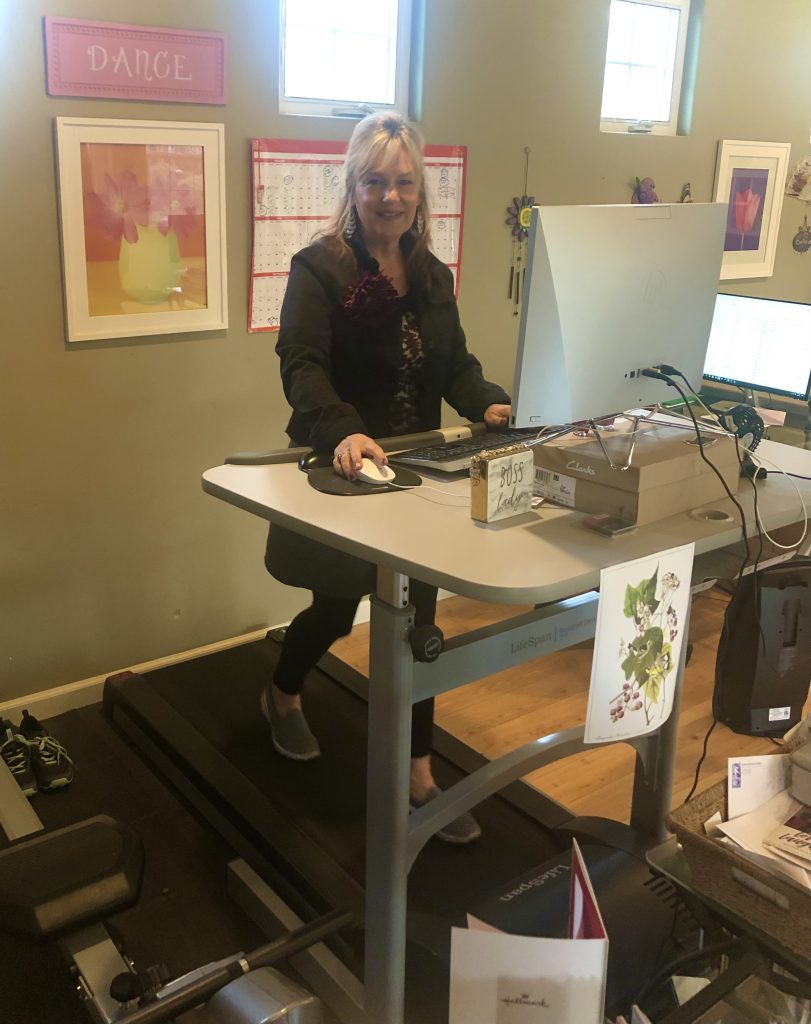
I started walking while working 7 years ago after reading research on how “sitting was the new smoking”. I purchased my treadmill desk in 2013 and since that time, I have been walking 7 miles a day, through a combination of my treadmill desk and outdoor strolls.
Over the past 7 years, I have accumulated almost 18,000 miles in an attempt to prevent heart disease, cancer, and a myriad of other chronic health problems. But it seems there is more to the story.
The Terry Gross interview with Daniel Lieberman, a professor at Harvard in the department of human evolutionary biology, put my beliefs into question. Dr. Lieberman recently penned a book called “Exercised”, which details his research finding and dispels some commonly held myths.
Besides being a super-smart paleoanthropologist and professor, Lieberman has also spent a lot of time with indigenous hunter-gatherers in Africa and Latin America. He has observed and cataloged how much time they spend walking, running, lifting, carrying, and sitting.
Based on current hunter-gathering behaviors, Dr. Lieberman calculates our ancestors walked about 5 miles a day or 10,000 steps. The average adult in America walks about half of that distance or 5,000 steps a day which equals 2.5 miles. This number might be even lower over the past year, given the pandemic and people working from home.
Even though we walk less than our ancestors, Lieberman is encouraging. He says if 10,000 steps feel out of reach, it’s okay to aim for less, as long as the person focuses on movement and engaging muscles to prevent atrophy. Any movement is better than no movement!
“The more we study physical activity, the more we realize that it doesn’t really matter what you do,” Lieberman says. “You don’t have to do incredible strength training … to get some benefits of physical activity. There’s all different kinds of physical activity, and it’s all good in different ways.”
Daniel lieberman
2. Hunter-gatherers sit a lot less than modern humans.
Not true. Surprisingly, research on hunter-gatherers reveals that they sit for 10 hours a day on average, which is the same amount of times the average American sits.
Humans are designed to conserve energy in case of a lack of adequate nutrition. Most hunter-gatherers Lieberman studied don’t have chairs, but they spent a great deal of time sitting. This lack of chairs is actually associated with better spine and back health (see more below)
3. Sitting is really that bad for us.
Interrupted sitting is a far better approach than nestling your body in a comfy chair for hours at a time.
Time spent sitting at work isn’t the major problem. It’s leisure time sitting for hours at a time that is associated with poor health outcomes like heart disease, cancer, or diabetes.
But regardless of sitting at work or home, just getting up every once in a while, every 10 minutes or so makes a big difference in health outcomes.
Try to intentionally get up frequently to go to the bathroom or pet the dog or make yourself a cup of tea. Even though you’re not spending a lot of energy, you’re turning on your muscles. Since muscles are the largest organ in your body, using them decreases inflammation and burns fat and glucose.
4. You can prevent back pain by getting lumbar support or a fancy chair.

Another myth.
Up until recently, only the upper class had chairs with a seatback. Most human beings usually sat on the ground, stools, or benches. The problem with chairs with backs is that sitting becomes more of a passive activity since you use fewer muscles to stabilize your upper body.
Using chairs with seat backs result in weaker back muscles that begin to atrophy due to disuse.
Chairs with lumbar support and lots of cushioning may encourage sitting for longer periods of time, which may further contribute to muscle loss.
5. Getting 8 hours of sleep a night is essential for well being
Based on Lieberman’s research of people who live in places where there is no electricity and computer screens, they don’t sleep more hours than the average American.
People in regions without electricity sleep on average 6.7 to 7.1 hours a night.
Lieberman says we need to stop sleep shaming.
It is true, that not getting enough sleep (4-5 hours a night) can be detrimental to health. But, if a person is getting 6 or 7 hours of sleep a night and they feel fine, that is what is most important.
Read the complete article here: Just Move: Scientist Author Debunks Myths About Exercise and Sleep
Please see our Exercise Resource Page for handouts to share
Save your spot for our
Virtual DiabetesEd Specialist Conference | April 15-17, 2021

Whether you are new to diabetes or a seasoned expert, you’ll benefit from this virtual conference with the latest research plus critical content that you can immediately apply to your clinical practice. If you are interested in taking the CDCES or BC-ADM exam or are seeking a state-of-the-art review of current diabetes care, this course is for you.
Entire Program Fee: $399
Dates: April 15-17, 2021
3 Expert Speakers
CEs: 30+ CE hours
Live Webinar Schedule: All webinars start and end times are in Pacific Standard Time
Come join our Virtual DiabetesEd Specialist Program.
Team of expert faculty includes:
In addition to informative lectures, we also use group activities and case studies to highlight the essential knowledge, skills, and strategies needed to succeed in diabetes education today!
Prepare for CDCES or BC-ADM certification or earn hours for renewal.
Your registrations include access to all the Online Sessions plus Bonus Courses through December 31st, 2021.
This virtual program includes:
3 day live webinar courses from April 15th-17th (20 CEs) + enrollment in our Bonus Bundle (14.0+ CEs) from now through December 2021.
View full Conference Schedule and Faculty.
Sign up for Diabetes Blog Bytes – we post one daily Blog Byte from Monday to Friday. And of course, Tuesday is our Question of the Week. It’s Informative and FREE! Sign up below!
[yikes-mailchimp form=”1″]
The use of DES products does not guarantee the successful passage of the CDCES exam. CBDCE does not endorse any preparatory or review materials for the CDCES exam, except for those published by CBDCE.
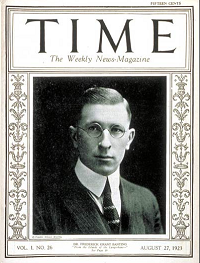
World Diabetes Day is celebrated in honor of Dr. Fredrick Banting, whose leadership, tenacity, and belief led to the discovery of insulin.
The discovery of insulin has saved the lives of countless millions of people over the past hundred years and will continue to save millions of lives in the near future and beyond.
During a hot summer in 1921, Dr.Banting secured space to test out his theory at the University of Toronto. Along with his colleague, Charles Best, and a bare-bones lab, they conducted dozens of experiments on dogs, which ultimately led to the discovery of insulin.


Dr. Banting and Charles Best began their experiments ligating the pancreases of dogs, thinking this would prevent destruction by the digestive pancreatic juices, and then isolating the extract from the islet cells. They then processed the extract from the islet cells and injected this extract they called “insulin” into diabetic dogs. According to an audio interview with Dr. Best, by July 1921, they had 75 positive examples of insulin lowering blood glucose levels in dogs.

In February 1922, doctor Frederick Banting and biochemist John Macleod published their paper on the successful use of an alcohol-based pancreatic extract for normalizing blood glucose levels in a human patient.
Here are some photos of the first insulin bottles produced by the University of Toronto and Eli Lilly.
Soon, word of their discovery got out and the race was on to produce enough insulin to treat the flood of type 1 patients arriving in Toronto to receive this miracle injection.
But, as with any amazing discovery, there is always more to the story.
One of the biggest barriers to Banting was the simple fact that he was not involved in the field of diabetes research. The idea leading to the discovery of insulin came to him after preparing a lecture on the pancreas and diabetes, a subject he knew little about. He wasn’t a trained researcher and thus securing support for the project was initially difficult.
First Children to Receive Insulin
The first patient to receive insulin was a ‘welfare’ case at Toronto General Hospital – no clinical trial structure to say the least. People from Canada/US flooded into Toronto to receive treatment. Banting struggled with the lack of accessibility of insulin – volume needed issues of purification.
The earliest patients were “selected”, some youths from Canada/US, some soldiers with diabetes (probably because of Banting’s service in the First World War), and then later some select private patients. During this time they were working hard to increase the volume and continue to improve the purification process. Insulin was available for testing in the US, namely through Dr. Elliot Joslin in the late summer of 1922.
Takes a Team

While Best played a critical and important role, credit must also go to Professor Macleod, from the University of Toronto, who provided the lab space, showed Dr. Banting how to operate on dogs, provided his student Best and suggested they switch from saline to alcohol to purify the ‘extract’. Dr. Macleod also secured the support of JB Collip, the 4th man on the team, and the first person to purify insulin for human use. Best is also known for pushing Banting to return to the research during a particularly dark period of failure.
Dr. Banting – Fun and Interesting Facts
Want to Learn More About Dr. Banting?
Visit Banting House FaceBook Page
Sign up for Diabetes Blog Bytes – we post one daily Blog Byte from Monday to Friday. And of course, Tuesday is our Question of the Week. It’s Informative and FREE! Sign up below!
[yikes-mailchimp form=”1″]

RJ is 52 with type 1 diabetes and a minor stroke last year. RJ takes an ACE Inhibitor, insulin, and a statin.
According to ADA Standards of Care 2021, what is the blood pressure target for RJ?
Click here to test your knowledge!
This course is an essential review for anyone in the field of diabetes. This course summarizes the 2021 updates to the American Diabetes Association’s Standards of Medical Care in Diabetes and provides critical teaching points and content for health care professionals involved in diabetes care and education.
Earn 2.0 CEs and get ready to lead the charge to implement best care practices for the New Year.
Topics Include:
Sign up for Diabetes Blog Bytes – we post one daily Blog Byte from Monday to Friday. And of course, Tuesday is our Question of the Week. It’s Informative and FREE! Sign up below!
[yikes-mailchimp form=”1″]
Accreditation: Diabetes Education Services is an approved provider by the California Board of Registered Nursing, Provider 12640, and Commission on Dietetic Registration (CDR), Provider DI002. Since these programs are approved by the CDR it satisfies the CE requirements for the CDCES regardless of your profession.*
The use of DES products does not guarantee the successful passage of the CDCES exam. CBDCE does not endorse any preparatory or review materials for the CDCES exam, except for those published by CBDCE.
What are the treatment options for people with type 1 diabetes with a COVID infection hospitalized for Diabetes KetoAcidosis (DKA)?
The typical treatment for DKA is fluids coupled with an IV insulin drip. Given the frequent monitoring and ICU bed required for treatment of DKA with an insulin drip, there has been a renewed interest in treating DKA with subcutaneous or sub-q insulin.
But after doing some research, I discovered an excellent 2004 paper co-authored by Dr. Guillermo Umpierrez et al. on using Sub-Q Insulin to Treat DKA. After completing a study comparing treatment of DKA using sub-q insulin vs. insulin drip, the author’s conclude that sub-Q insulin treatment is a safe and effective alternative treatment to IV insulin in the management of people with mild or moderate DKA.
With a little more digging, I found 2 more recent papers that suggest considering Sub-Q insulin treatment as an option for mild or moderate DKA.
It is important to note that sub-Q insulin treatment for DKA is NOT recommended for patients with arterial hypotension, severe and complicated DKA, or with HHS.
Insulins: Use either rapid acting lispro or aspart insulin.
1st Bolus: Starting dose is 0.1 or 0.2 or 0.3 units/kg of insulin (depending on initial blood glucose and clinical presentation)
Example: Pt weighs 100 kg, give 100kg x 0.1 – 0.2 – 0.3 units/kg of insulin = 10 or 20 or 30 units insulin sub-q bolus respectively.
Next Step – Sub-q insulin every 2 hours | Give 0.1 – 0.2 units of insulin /kg every 2 hours until blood glucose is less than 250.
Example: Pt weighs 100 kg, give 100kg x 0.1 – 0.2 units/kg of insulin = 10 or 20 units insulin sub-q bolus respectively every 2 hours.
Blood glucose less than 250 | Now give 1/2 the sub-q insulin dose every 2 hours. Calculate 0.05 to 0.1 units/kg every 2 hours until glucose at target and ketosis is resolved.
Example: Pt weighs 100 kg, give 100kg x 0.05 – 0.1 units/kg of insulin = 5 or 10 units insulin sub-q bolus respectively every 2 hours.
Using scheduled subcutaneous insulin allows for safe and effective treatment in the emergency room and step-down units without the need for ICU care. Umpierrez et al
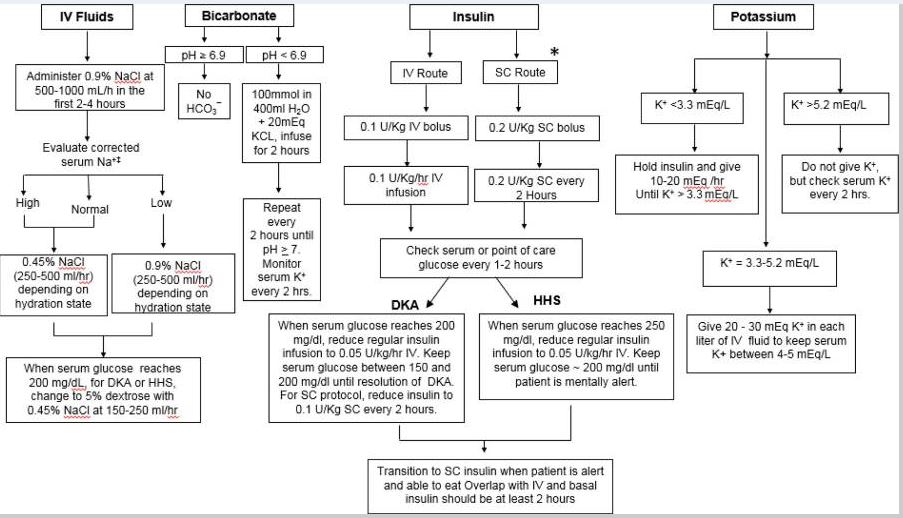
Please see reference chart and articles below for more detailed information.
Of course, fluid and electrolyte status needs to be assessed before starting insulin.
If the K+ is less than 3.3, hold insulin and start with IV fluids (NS or LR) first with potassium replacement. Once the K is stable, start the insulin injection every 2 hours (see article and flow chart below).
Thank you for reading this article. Please share any feedback or your experiences using sub-q insulin for DKA. We always love to hear from you. You can email us at [email protected]
Eledrisi MS, Elzouki AN. Management of Diabetic Ketoacidosis in Adults: A Narrative Review. Saudi J Med Med Sci. 2020;8(3):165-173. doi:10.4103/sjmms.sjmms_478_19
Fayfman M, Pasquel FJ, Umpierrez GE. Management of Hyperglycemic Crises: Diabetic Ketoacidosis and Hyperglycemic Hyperosmolar State. Med Clin North Am. 2017;101(3):587-606. doi:10.1016/j.mcna.2016.12.011
Join Coach Beverly to learn more about causes and treatment of hyperglycemic crisis. (opens in a new tab)”>Find out more here>>

This course is included in: Level 2 – Standards of Care. Purchase this course individually for $19 or the entire bundle and save 70%.
This 60-minute course discusses common causes of hyperglycemia crises. Topics include hyperglycemia secondary to medications and insulin deprivation. The difference and similarities between Diabetes Ketoacidosis and Hyperosmolar Hyperglycemic Syndrome are also covered. Treatment strategies for all situations are included.
Topics include:
Sign up for Diabetes Blog Bytes – we post one daily Blog Byte from Monday to Friday. And of course, Tuesday is our Question of the Week. It’s Informative and FREE! Sign up below!
[yikes-mailchimp form=”1″]
Accreditation: Diabetes Education Services is an approved provider by the California Board of Registered Nursing, Provider 12640, and Commission on Dietetic Registration (CDR), Provider DI002. Since these programs are approved by the CDR it satisfies the CE requirements for the CDCES regardless of your profession.*
The use of DES products does not guarantee the successful passage of the CDCES exam. CBDCE does not endorse any preparatory or review materials for the CDCES exam, except for those published by CBDCE.
Unsure about updates for this mastery level 2021 exam?
Join us to get ready to succeed a the CDCES Exam. This course will transform your test anxiety into calm self-confidence and test-taking readiness.
We will review sample test questions and the reasoning behind choosing the right answers. After registering, you will receive a confirmation email containing information about joining the webinar.
Instructor: Beverly Thomassian RN, MPH, CDCES, BC-ADM is a working educator who has passed her CDCES Exam 6 times. She is a nationally recognized diabetes expert for over 25 years.
The 5th Edition ADCES Desk Reference & 5th Edition Review Guide Bundle –our most popular AADE Book Bundle for exam preparation!
What is included in the ADCES Book Bundle?
The Art & Science of Diabetes Self-Management Education Desk Reference – 5th Edition
Major Features:
ADECES Review Guide for the Diabetes Care and Education Specialist Exam – 5th Edition
Includes an answer key with rationales for all questions included in the guide!
Major Features:
3 self-assessment tests that cover three main content sections on the CDCES Exam:
Sign up for Diabetes Blog Bytes – we post one daily Blog Byte from Monday to Friday. And of course, Tuesday is our Question of the Week. It’s Informative and FREE! Sign up below!
[yikes-mailchimp form=”1″]
Accreditation: Diabetes Education Services is an approved provider by the California Board of Registered Nursing, Provider 12640, and Commission on Dietetic Registration (CDR), Provider DI002. Since these programs are approved by the CDR it satisfies the CE requirements for the CDCES regardless of your profession.*
The use of DES products does not guarantee the successful passage of the CDCES exam. CBDCE does not endorse any preparatory or review materials for the CDCES exam, except for those published by CBDCE.

For our January 12th Question of the Week, over 58% of respondents chose the best answer!
Before we start though, if you don’t want any spoilers and haven’t tried the question yet, you can answer below: Answer Question
Question:
JR is on metformin 2000mg, empagliflozin 25mg, semaglutide 1.0mg, and 100 units of glargline insulin. A1C is 8.9% and JR weighs 100kg.
Answer Choices:
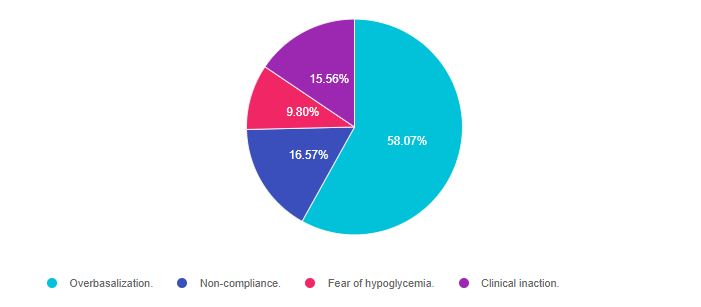
As shown above, the most common choice was option 1, the second most common answer was option 2, then option 4, and finally option 3.
If you are thinking about taking the certification exam, the content of this practice test question will set you up for success. It addresses a common ADA Standard 9 and approaches to managing hyperglycemia with type 2 diabetes. This standard is brief with very helpful tables and algorithms. A must-read section for anyone ready to be more actively involved in advocacy and pharmacologic management of diabetes.
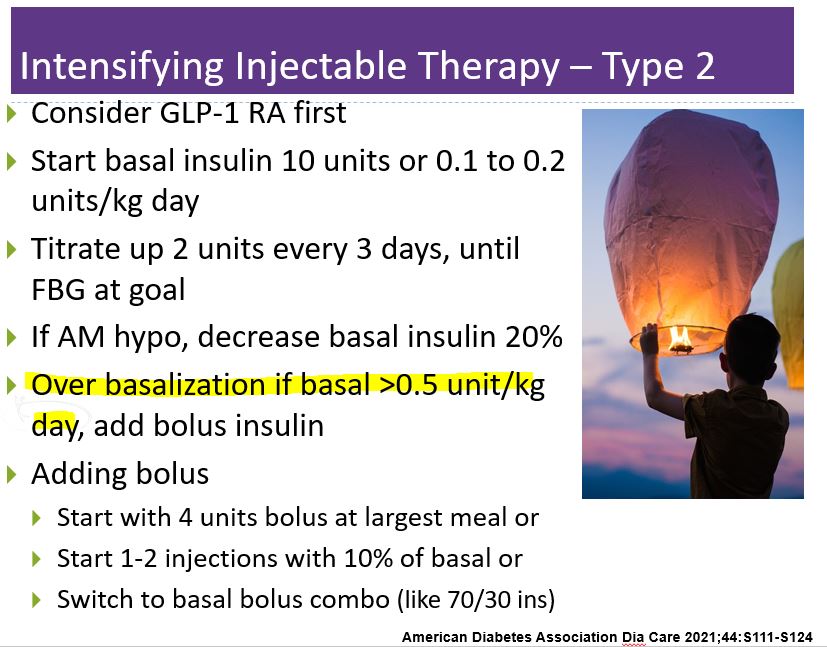
Answer 1 is correct. 58.07% chose this answer. ” Overbasalization.” This is the best answer, because JR is on 3 diabetes medications plus 100 units of basal insulin, and their glucose is still above target. This treatment plan isn’t working. If we look at the ADA Guidelines, (section 9 outlined on a slide below), it states if the basal insulin is more than 0.5 units/kg/day, we need to take further action.
JR weighs 100kg. The max dose of basal insulin based on his body weight should be 50 units (100kg x 0.5 = 50 units). Yet, JR is on 100 units. What are possible solutions?
According to ADA Algorithm, we could add 10% of the current basal as bolus insulin, or 10 units one or two meals a day.
Or we could convert it to combo insulin, like 70/30 insulin. To do that conversion, first, decrease total basal insulin by 80% for safety.
100 units x 0.8 = 80 units. Then give 2/3 in the morning and 1/3 before dinner.
80 x 2/3 = about 50 units in the morning and 80 x 1/3 or about 30 units before dinner. If worried about potential hypoglycemia, the dose could be decreased even further. The main goal is to get glucose to the goal.
Answer 2 is incorrect. 16.57% of you chose this answer. “Non-compliance.” According to the information in the case study, JR is taking all of the medications as directed. The issue is that the medication plan is not effective. And, more than that, the term “non-compliance” has been replaced with focusing on the person’s strengths (strength based approach) and what the actions the individual IS taking.
Answer 3 is incorrect, 9.80% of you chose this answer “Fear of hypoglycemia.” The answer is tempting. Since JR is on 100 units of basal insulin, hypoglycemia seems like a looming possibility. However, we see that the A1c is 8.9% and JR doesn’t mention hypoglycemia. It is very unlikely that low blood sugar is an issue.
Answer 4 is incorrect, 15.56% of you chose this answer. “Clinical inaction.” It is true that more action is required, and the term we use for this is lack of movement to improve glucose levels is called “Clinical inertia”. However, in answering the question, “what best describes this clinical picture”, “overbasalization” is the standout answer.
We hope you appreciate this week’s rationale! Thank you so much for taking the time to answer our Question of the Week and participate in this fun learning activity!
Humans are hard-wired to seek comfort and relief in moments of stress.
Biologically, this is called homeostasis, which means maintaining a steady state of balance.

With the ongoing trauma of the pandemic, many of us are seeking comfort and a way to occupy our minds. Many people have adopted new hobbies to keep themselves busy, with sourdough bread baking being a popular choice. Bread products are comfort for many of us. I have not made bread as many others have, but I have been craving bread products and eating more bread, potatoes, and ice cream.
“Anything that challenges our state of balance, or any situation of lack, is deemed a stressor. This could be hunger, an uncomfortable position, feeling cold, or feeling afraid or insecure,” Dr. Eva Selhub, resiliency expert explains.
This feeling triggers an automatic reaction to leave or alleviate the uncomfortable situation, like putting on something warm if you are cold, or overeating when you are feeling insecure.
“By addressing the problem, the brain’s reward centers are stimulated along with the release of neurotransmitters like dopamine and serotonin”, continues Dr. Selhub.
At the same time, the stress hormone cortisol goes down. Solving a discomfort, then, gives us a sense of euphoria and ease. Also, carbohydrates especially lead to the increase of serotonin, the happiness hormone, which gives us the sense of feeling better.
According to Julie Ohana, a culinary art therapist, (culinary art therapy helps people communicate and manage stress through cooking), “there is a big reason people have been stress baking. When times are turned upside down we look for ways to cope”, she says. “The heart of the explanation is that cooking and baking bring comfort. The process helps aid the baker and the finished product helps comfort the person or people receiving the delicious outcome. Having control over something right now is important since so much in the world is unknown and out of our hands. When I am in the kitchen, I know what I can expect. For many, the act of baking is also calming because baking is a form of mindfulness. When we are inundated by the news and scary information, it’s important that we all take time away from the scary stuff and reset our minds and thoughts.”
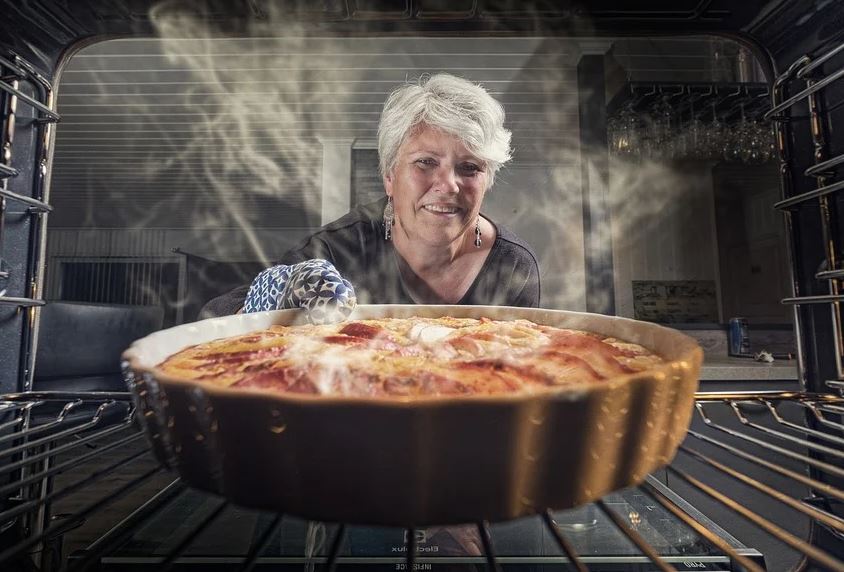
Cooking sourdough bread and binge eating carbohydrates might be physiologically and psychologically comforting for some, but for our clients living with diabetes, carbohydrate cravings and binge eating can play havoc on blood sugar control, weight management, and emotional health. I had a client confide in me that when a friend brought her a warm loaf of sourdough bread she ate the whole loaf in one sitting.
TW: Mention of eating disorders below
Binge eating disorder (BED) is a severe, life-threatening, but treatable eating disorder. It is characterized by periods of uncontrolled, impulsive, or continuous eating beyond the point of comfortably full. BED is one of the newest eating disorders formally recognized in the DSM-5. Bulemia is characterized by recurrent binge eating with purging. Anorexia is centered around an obsessive fear of weight gain and involves self-starvation and often excessive weight loss. Eating disorders affect 9% of the population. 28.8 million Americans will have an eating disorder in their lifetime. Eating disorders are among the deadliest mental illness, secondary only to opioid overdose. The global economic cost of eating disorders is $64.7 billion annually. (1)
Hotline calls to the National Eating Disorders Association are up 70-80% since the beginning of the pandemic. “The risk of eating disorders is going to increase whenever there are higher levels of stress,” Lauren Smolar, Senior Director for the National Association of Eating Disorders tells us.
A survey in the International Journal of Eating Disorders in July found 62% of people in the US with anorexia experienced a worsening of symptoms as the pandemic hit. Nearly a third of Americans with binge eating disorder reported an increase in episodes. (2)
Women with T1D have nearly 2.5 times the risk of developing an eating disorder compared to those without diabetes with bulemia is the most common eating disorder in women with T1D. (3) Among women with type 2 diabetes, BED is more common. “Diabulemia” is an eating disorder characterized by intentionally withholding insulin to result in weight loss. Diabulemia is shockingly common; as many as a third of women with T1D report insulin restriction.
Overeating sourdough bread or other foods in the pandemic may be a red flag to us as Diabetes Care and Education Specialists to screen for possible eating disorders. In my career as a dietitian and CDCES, I have seen a lot of people who struggle with eating disorders. With compassion, we can help our clients understand the psychology of why they are binge eating.
There are a number of virtual support groups and free resources currently being offered at nationaleatingdisorder.org. On this site, there is a five-minute quiz to help determine whether our clients might need professional support.
For me, comfort foods include foods with a variety of textures, flavors, and nutrients! This recipe is a favorite of mine.

Ingredients
Instructions
This article is written by our resident nutrition expert, Dawn DeSoto, RD, CDCES
Citations
Whether you are new to diabetes or a seasoned expert, you’ll benefit from this virtual conference with the latest research plus critical content that you can immediately apply to your clinical practice.
Entire Program Fee: $399
Program Flyer: Download
Dates: Recorded & Ready for Viewing!
Live Webinar Schedule: All webinars start and end times are in Pacific Standard Time
Program Schedule & Expert Bios
What is the Diabetes Educator Course?
If you are interested in taking the CDCES or BC-ADM exam or are seeking a state of the art review of current diabetes care, this course is for you. Our team of expert faculty has been fine-tuning this course for over fifteen years, and we know what you need. In addition to informative lectures, we also use group activities and case studies to highlight the essential knowledge, skills, and strategies needed to succeed in diabetes education today!
In this course, the same speakers will cover the same content as outlined in the Live Seminar. For more details see our Virtual DiabetesEd Specialist Conference Schedule and Faculty.
Prepare for CDCES or BC-ADM certification or earn hours for renewal.
Come join our Virtual DiabetesEd Specialist Program.
Your registrations include access to all the Online Sessions plus Bonus Courses through December 31st, 2021.
This virtual program includes:
3 day live webinar courses from April 15th-17th (20 CEs) + enrollment in our Bonus Bundle (14.0+ CEs) from now through December 2021.
View full Conference Schedule and Faculty.
Sign up for Diabetes Blog Bytes – we post one daily Blog Byte from Monday to Friday. And of course, Tuesday is our Question of the Week. It’s Informative and FREE! Sign up below!
[yikes-mailchimp form=”1″]
Accreditation: Diabetes Education Services is an approved provider by the California Board of Registered Nursing, Provider 12640, and Commission on Dietetic Registration (CDR), Provider DI002. Since these programs are approved by the CDR it satisfies the CE requirements for the CDCES regardless of your profession.*
The use of DES products does not guarantee the successful passage of the CDCES exam. CBDCE does not endorse any preparatory or review materials for the CDCES exam, except for those published by CBDCE.
MT is 59 and her most recent A1c was 10.3%. The diabetes specialist suggested they add insulin to her other 3 oral diabetes medications to lower A1c. MT was not ready for insulin, so the specialist agreed that they would try adding on glipizide 5mg BID and evaluate the response for one month.
After 2 weeks, MT calls and is very upset about her frequent low blood sugars (66, 68, 69) that are happening between 3 pm and 6 pm a few times a week. MT works in the field starting at 5 am and gets her lunch break at 10 am and eats her dinner again at 6 pm.
Which of the following is the best recommendation?
Click here to test your knowledge!
Diabetes is complicated! This course starts with a brief introduction to the CDCES Exam content and philosophy. Then we move to discuss the underpinnings of pancreas dysfunction and the different types of diabetes. Insulin resistance is addressed as well as the diagnostic criteria for diabetes.
Intended Audience: A great course for anyone in the field of diabetes education seeking evidence-based information supporting lifestyle changes.
Instructor: Beverly Thomassian RN, MPH, CDCES, BC-ADM is a working educator and a nationally recognized diabetes expert.
This course is part of our Level 3 – Boot Camp. Enroll in our entire Level 3 – Boot Camp to join us for the following 2021 Live Webinar Updates. All courses air at 11:30 a.m. (PST)
Join us for our 2021 Live Webinar Updates. All courses air at 11:30 a.m. (PST)
Sign up for Diabetes Blog Bytes – we post one daily Blog Byte from Monday to Friday. And of course, Tuesday is our Question of the Week. It’s Informative and FREE! Sign up below!
[yikes-mailchimp form=”1″]
Accreditation: Diabetes Education Services is an approved provider by the California Board of Registered Nursing, Provider 12640, and Commission on Dietetic Registration (CDR), Provider DI002. Since these programs are approved by the CDR it satisfies the CE requirements for the CDCES regardless of your profession.*
The use of DES products does not guarantee the successful passage of the CDCES exam. CBDCE does not endorse any preparatory or review materials for the CDCES exam, except for those published by CBDCE.