For last week’s practice question, we quizzed participants on TIR (Time of Range) of 89% , and what is your concern. 62.2% of respondents chose the best answer. We want to clarify and share this important information, so you can pass it on to people living with diabetes and your colleagues, plus prepare for exam success!
Before we start though, if you don’t want any spoilers and haven’t tried the question yet, you can answer it below: Answer Question
JZ is proud of their Time of Range of 89%. You notice their time below range is 7%. JZ uses a rapid-acting insulin pen 4–6 times daily to keep glucose in target range and occasionally increases the glargine dose when evening glucose is elevated.
What is your primary concern?
- Is JZ consistently rotating injection sites to prevent lipohypertrophy?
- What is JZ’s rationale for adjusting the glargine dose?
- How is JZ feeling about their frequency of hypoglycemia?
- Does JZ adjust insulin for physical activity?
Getting to the Best Answer
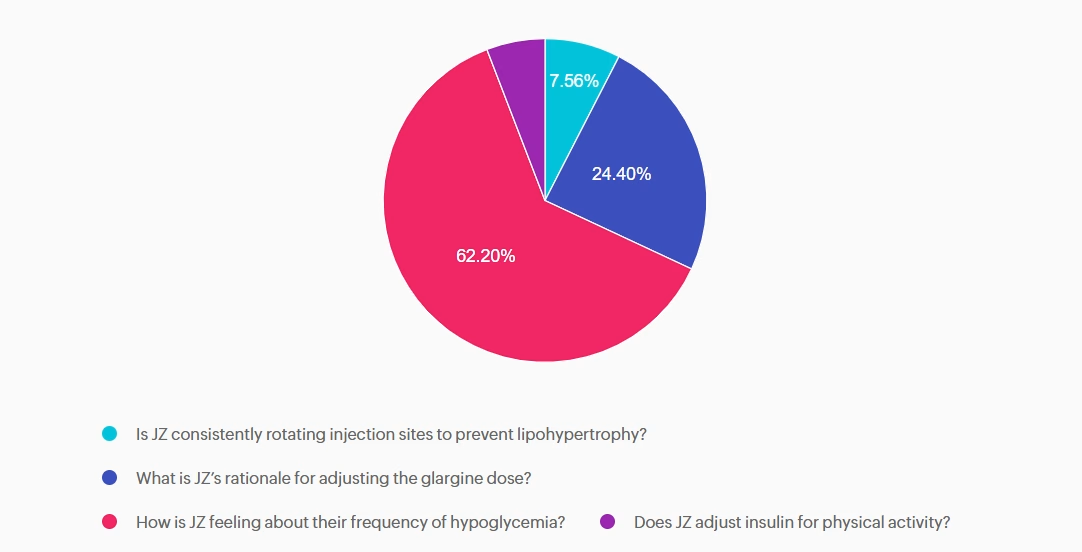
Answer A is incorrect: 7.56% chose this answer, “Is JZ consistently rotating injection sites to prevent lipohypertrophy?” Injection site rotation is important for preventing lipohypertrophy and absorption variability, but not the most immediate safety risk.
Answer B is incorrect: 24.4% chose this answer, “What is JZ’s rationale for adjusting the glargine dose?” Basal insulin is generally titrated based on overnight and fasting blood glucose levels, not reactively based on the evening glucose. This is clinically relevant, but still secondary to hypoglycemia risk.
Answer C is correct: 62.2% chose this answer, “How is JZ feeling about their frequency of hypoglycemia?” Since JZ is experiencing hypoglycemia more than the target below target range of 5%, we want to explore their feelings around their diabetes and diabetes distress.
Answer D is incorrect: 5.84% chose this answer, “Does JZ adjust insulin for physical activity?” Adjusting insulin for exercise is essential for self-management, yet the first priority is identifying whether dangerous lows are occurring.
We hope you appreciate this week’s rationale! Thank you so much for taking the time to answer our Question of the Week and participate in this fun learning activity!
Set Yourself Up With Certification Success
Get exam-ready with confidence.
Course credits through AMA PRA Category 1 Credits™, ACPE, ANCC, and CDR!
Full accreditation details are available on the registration page

Our CDCES Boot Camp Online Prep Bundle is a comprehensive, high-impact program built specifically for healthcare professionals preparing for the Certified Diabetes Care and Education Specialist (CDCES) exam who want to level up their clinical knowledge and skills.

This evidence-based study bundle is a comprehensive BC-ADM Boot Camp designed for advanced-level healthcare professionals preparing for the Board Certified in Advanced Diabetes Management (BC-ADM) exam and will also provide you with state-of-the-art information to level up your clinical practice.
What's Included?
CDCES Boot Camp
- 30+ expert-led courses from the fundamentals to the ADA standards, to test strategies and exam mastery! Includes Levels 1, 2 and 3.
- 50+ CE credits (AMA PRA Category 1™, ACPE, ANCC, CDR accredited). IN
- 400+ practice questions to test your knowledge and build confidence
- Multiple learning formats: video presentations, audio podcasts, and downloadable handouts
- 1 full year of on-demand access to study at your own pace
BC-ADM Boot Camp
- 30+ expert-led courses covering advanced diabetes management, ADA standards, medication review, insulin calculations and tech topics! Includes advanced levels 2, 3, 4.
- 50+ CE credits (AMA PRA Category 1™, ACPE, ANCC, CDR accredited).
- 400+ practice questions to test your knowledge and build BC-ADM test confidence.
- Multiple learning formats: video presentations, audio podcasts, and downloadable handouts
- 1 full year of on-demand access to study at your own pace
Virtual DiabetesEd Training Conference
Why Should I Attend?
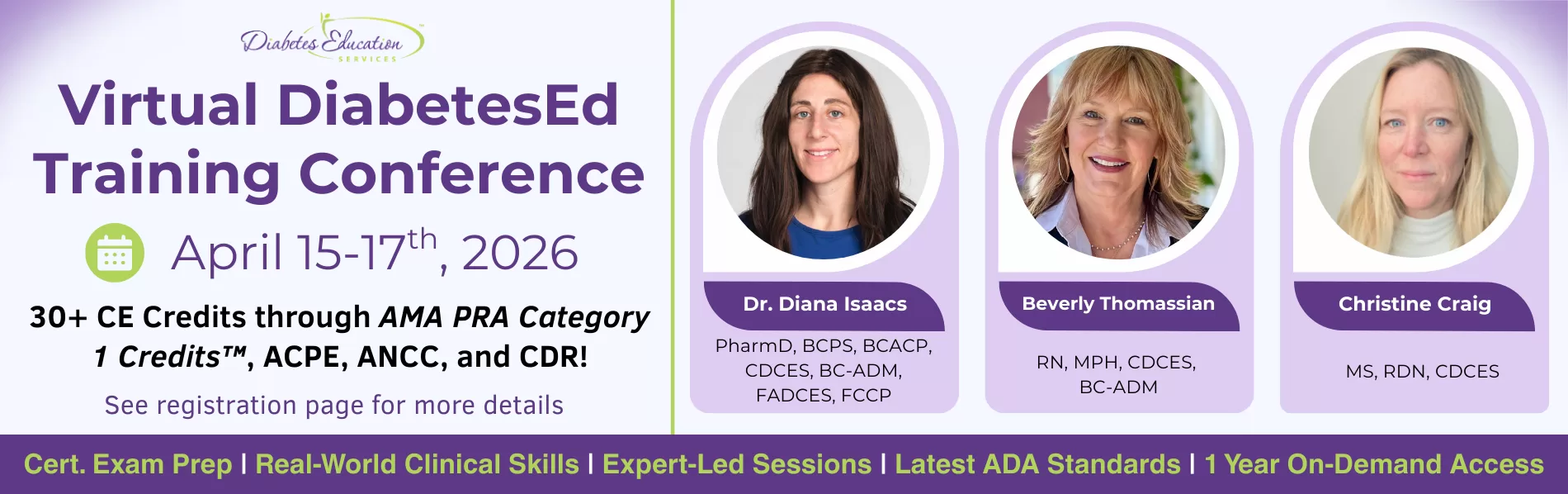
Join national experts including Dr. Diana Isaacs (Cleveland Clinic), Beverly Thomassian (30+ years of experience), and Christine Craig for high-impact, virtual learning—no travel required.
✔ Learn from National Experts — Anywhere
Get the same expert-level instruction you’d receive in person, delivered live to your home or office.
✔ Interactive & Flexible
- Live Q&A and real-time case discussions
- Direct engagement with faculty
- Full session recordings with 1-year access if you can’t attend live
What's Included?
- 19.5 CEs from the 3-day interactive conference + 17+ bonus CEs from 11 on-demand courses. (30+ total CEs are AMA PRA Category 1™, ACPE, ANCC, CDR accredited)
- Less than $15 per credit!
- Expert-led sessions: ADA Standards, medications, insulin therapy, behavior change, CGM, medical nutrition therapy
- Interactive Q&A with expert faculty during live sessions
- 1-year access to all recordings that you can watch on your schedule
- Study material for CDCES and BC-ADM exam prep
3 Ways to Register
Practical, Ready-to-Use Strategies
Walk away with tools you can apply immediately in clinical practice or while preparing for CDCES or BC-ADM exams. From insulin dosing protocols to behavior change strategies that work in the real world—this content bridges theory and practice.
Hear What Our Community Has to Say