Digital literacy is a key social determinant of health, yet up to one-third of Americans struggle with basic digital literacy skills.¹ In diabetes care, this means many struggle with using, understanding, and applying digital information to improve glycemic control.² As diabetes healthcare providers, how do we know if our clients have low digital literacy? Here are five signs of low digital literacy to watch for in your practice.
1. Difficulty with Technology
- Struggling with using standard technology devices. You may hear: “I have a smartphone, but I don’t know how to use it.”
- Forgetting passwords and needing assistance to log into devices or accounts.
- Not knowing how to download an app on their smartphone or tablet.
2. Device Confusion
- Difficulty understanding how devices connect and share information.
- Confusing diabetes devices. You may hear: “My CGM gives me my insulin.”
- Thinking the insulin pump is “autopilot” and does not enter carbohydrates or meal announcements into the pump.
3. Fear Factor
- Communicating fear of diabetes technology. You may hear: “I just don’t trust those things!” and “What if it gives me the wrong dose?”
- Avoiding eye contact or changing the subject when discussing diabetes technology.
- Expressing worry of becoming overwhelmed with diabetes technology.
4. Technology Comprehension
- Not recognizing or acting on the device alerts and alarms.
- Difficulty interpreting glucose graphs and trend arrows.
- Struggling with troubleshooting the diabetes tech device. You may hear: “I just don’t know why this thing beeps all the time.”
5. Avoidance of Technology
- Shutting down discussion of diabetes technology. You may hear: “I’m too old to learn how to use that.”
- Unwilling to learn how to use the device because the spouse or another family member manages it on their behalf.
- Frequently rescheduling or not coming to training sessions to learn how to use the diabetes device
Improving Digital Literacy
Diabetes healthcare professionals are vital in supporting clients to improve their digital literacy.
✅Acknowledge their fears and concerns. Ask open-ended questions to understand their concerns. During your conversations, address any myths or misconceptions they may have about diabetes technology.
✅ Offer support and assistance with improving their digital literacy skills. Whether it is one-on-one education or in group classes, offer device education sessions tailored to those with low digital literacy.
✅ Increase the frequency of phone calls or in-person check-ins to monitor progress with the diabetes device. Support the client at every step of their learning journey and help them stay accountable for their personal diabetes goals.
References:
- Information Technology & Innovation Foundation. (2021, November 29). Assessing the state of digital skills in the U.S. economy. Retrieved from https://itif.org/publications/2021/11/29/assessing-state-digital-skills-us-economy/
- Huang, E. S., Sinclair, A., Conlin, P. R., Cukierman-Yaffe, T., Hirsch, I. B., Huisingh-Scheetz, M., Kahkoska, A. R., Laffel, L., Lee, A. K., Lee, S., Lipska, K., Meneilly, G., Pandya, N., Peek, M. E., Peters, A., Pratley, R. E., Sherifali, D., Toschi, E., Umpierrez, G., . . . Munshi, M. (2023). The growing role of technology in the care of older adults with diabetes. Diabetes Care, 46(8), 1455. https://pmc.ncbi.nlm.nih.gov/articles/PMC10369127/#B47
Learn More From Our Technology Expert:
Dr. Diana Isaacs
During Our Virtual DiabetesEd Training Conference
April 15th-17th, 2026
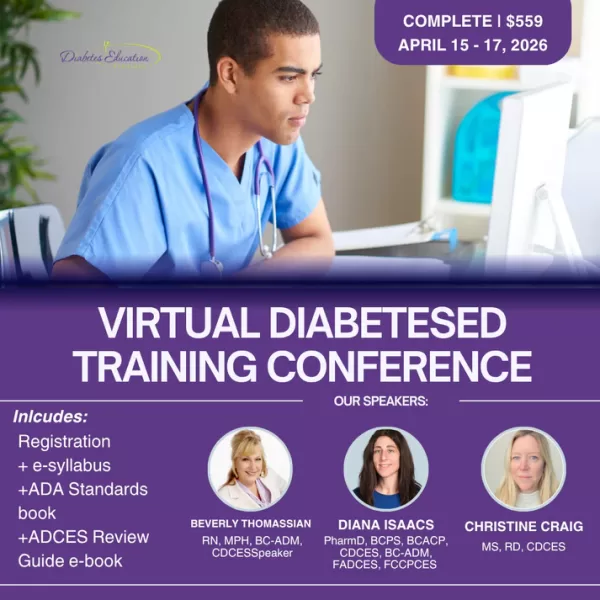
Gain fresh insights, practical tools, and a deeper understanding of the latest in person-centered diabetes care. Our expert team brings the ADA Standards of Care to life—covering medications, behavior change, technology, and more!
If you’re preparing for the CDCES or BC-ADM exam, this conference, paired with a handful of free bonus courses, serves as the ideal study companion! Plus, this content counts toward the ADA Standards requirements for CDCES Renewal.
With interactive co-teaching, we keep sessions engaging, relevant, and fun.
Let’s learn and grow together!
Course credits through AMA PRA Category 1 Credits™, ACPE, ANCC, and CDR!
Program Objectives:
Upon completion of this activity, participants should be able to:
- Describe the current ADA Standards for diagnosis, goals, and person-centered diabetes management across the lifespan.
- Demonstrate insulin pattern management and dosing strategies in clinical scenarios.
- Implement timely screening and risk reduction strategies for microvascular and cardiovascular complications.
- Incorporate behavior change techniques and medical nutrition therapy to support people with diabetes self-management and lifestyle adjustment.