
Subscribe
eNewsletter

Ready to get certified?
Free CDCES Coach App

eNewsletter
Free CDCES Coach App

Type 1 Diabetes Resources
Below is a list of helpful online resources for Type 1 Diabetes. They include sites for national organizations like the American Diabetes Association (ADA), sites for diabetes interest groups, and other participant organizations that provide helpful diabetes tips and opportunities to join online groups.
Click the links below to visit the website:

For our February 9th Question of the Week, over 50% of respondents chose the best answer!
Before we start though, if you don’t want any spoilers and haven’t tried the question yet, you can answer below: Answer Question
Question: RT is a 49-year-old with type 1 diabetes, admitted to a local hospital to treat Diabetes Ketoacidosis (DKA). RT is on an insulin drip, fluids and potassium replacement therapy and is getting hungry. The IV insulin is running at 2 units an hour and the RTs usual insulin dose at home is 12 units glargine at bedtime and 3-4 units of lispro before meals.
Before stopping the IV insulin, what is the most important action?
Answer Choices:
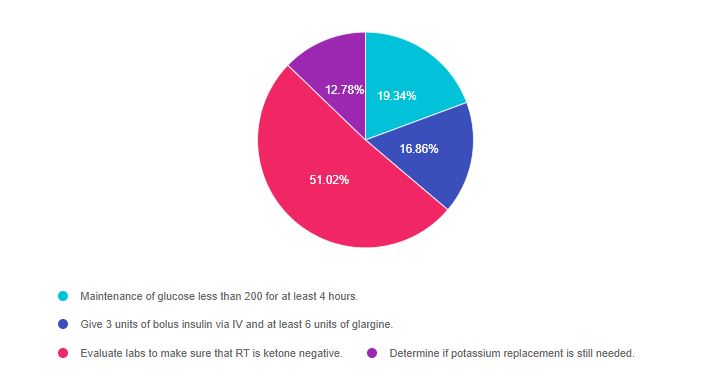
As shown above, the most common choice was option 3, the second most common answer was option 1, then option 2, and finally option 4.
If you are thinking about taking the certification exam, the content of this practice test question will set you up for success. There are questions on in-hospital care of diabetes and treating hyperglycemic crises.
Before we answer this question, we thought we would provide a quick summary of the basics of DKA.
Diabetes Ketoacidosis occurs because there is not enough insulin to use glucose for fuel. The body turns to fat for fuel and this causes a build-up of ketone bodies in the blood and urine. Since ketone bodies are acids, they lower the pH of the blood potentially causing a life-threatening acidosis.
Insulin therapy is required to stop acidosis.
Additionally, even if the glucose is under 200, the person can still be “under insulinized” and ketotic. That is why the insulin drip can only be stopped when the person is ketone negative and no longer burning fat for fuel. One sign that they are moving out of ketosis is that they become hungry. Ketone bodies are very irritating to the GI system and cause nausea and sometimes significant abdominal pain.
If the insulin drip is stopped too early, when the person is still positive for ketones, they are at risk of going back into DKA.
Potassium – When people are experiencing ketosis they are insulin deprived. This lack of insulin allows potassium to leave the cells and enter the bloodstream. Much of this excessive extracellular potassium is then renally excreted. When insulin therapy is started, this pushes potassium back into the cells and can cause a dangerous drop in serum potassium levels. For this reason, most people with DKA will need potassium replacement.
It is critically important to evaluate potassium before starting insulin therapy in someone with DKA. If the potassium is less than 3.3 mEq/L, the guidelines recommend providing potassium replacement therapy first, then starting insulin when potassium levels are stable.
See our blog Treating DKA with SubQ Insulin here for more details.
Answer 1 is incorrect, 19.34% chose this answer. “Maintenance of glucose less than 200 for at least 4 hours”. Even if the glucose is under 200, the person can still be “under insulinized” and ketotic. That is why the insulin drip can only be stopped when the person is ketone negative and no longer burning fat for fuel.
Answer 2 is incorrect 16.86% of you chose this answer. “Give 3 units of bolus insulin via IV and at least 6 units of glargine”. It is true that subq insulin needs to be administered about 2 hours before stopping the IV insulin since the half-life of IV insulin is only minutes. But, most important is that we need to make sure their acidosis is resolved. If the insulin drip is stopped too early, when the person is still positive for ketones, they are at risk of going back into DKA.
Answer 3 is correct 51.02% of you chose this answer “Evaluate labs to make sure that RT is ketone negative” YES, this is the BEST Answer. If they are ketone negative and blood sugars are under 200, we can inject subq basal insulin about 2 hours before stopping the drip to stabilize glucose levels. Then we provide subq insulin replacement therapy based on prior history and body weight.
Answer 4 is incorrect 12.78% of you chose this answer. “Determine if potassium replacement is still needed” Of course, we are keeping a close eye on potassium, but an IV is not required to administer potassium since it can be given orally. In addition, the most important factor in determining if the IV insulin can be stopped is the state of ketosis.
We hope you appreciate this week’s rationale! Thank you so much for taking the time to answer our Question of the Week and participate in this fun learning activity!
Join Coach Beverly to learn more about the causes and treatment of hyperglycemic crisis.

This course is included in: Level 2 – Standards of Care. Purchase this course individually for $19 or the entire bundle and save 70%.
This 60-minute course discusses common causes of hyperglycemia crises. Topics include hyperglycemia secondary to medications and insulin deprivation. The difference and similarities between Diabetes Ketoacidosis and Hyperosmolar Hyperglycemic Syndrome are also covered. Treatment strategies for all situations are included.
Topics include:
Sign up for Diabetes Blog Bytes – we post one daily Blog Byte from Monday to Friday. And of course, Tuesday is our Question of the Week. It’s Informative and FREE! Sign up below!
[yikes-mailchimp form=”1″]
Accreditation: Diabetes Education Services is an approved provider by the California Board of Registered Nursing, Provider 12640, and Commission on Dietetic Registration (CDR), Provider DI002. Since these programs are approved by the CDR it satisfies the CE requirements for the CDCES regardless of your profession.*
The use of DES products does not guarantee the successful passage of the CDCES exam. CBDCE does not endorse any preparatory or review materials for the CDCES exam, except for those published by CBDCE.
Virtual DiabetesEd Specialist Conference | April 15-17, 2021
Whether you are new to diabetes or a seasoned expert, you’ll benefit from this virtual conference with the latest research plus critical content that you can immediately apply to your clinical practice.
Entire Program Fee: $399
Dates: April 15-17, 2021
Live Webinar Schedule: All webinars start and end times are in Pacific Standard Time
Coach Beverly Thomassian, RN, MPH, BC-ADM, CDCES
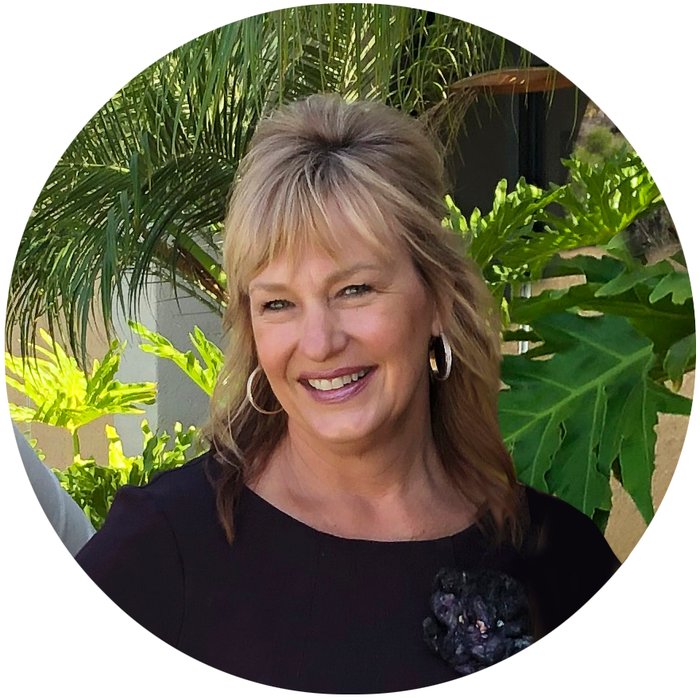
Author, Nurse, Educator, Clinician and Innovator, Beverly has specialized in diabetes management for over twenty years. As president and founder of Diabetes Educational Services, Beverly is dedicated to optimizing diabetes care and improving the lives of those with diabetes.
Diana Isaacs, PharmD, BCPS, BC-ADM, BCACP, CDCES
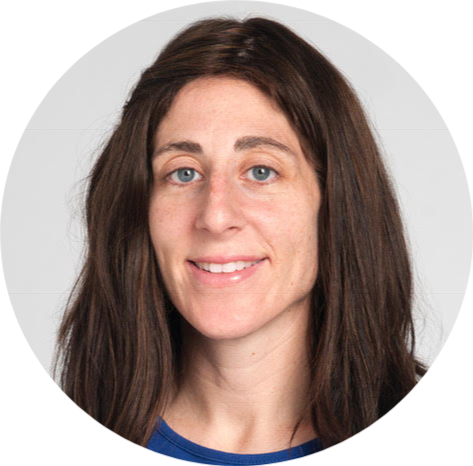
We are thrilled to welcome our newest speaker, Diana Isaacs, who will be joining our Virtual and Live Courses!
Dr. Isaacs was named 2020 AADE Diabetes Educator of the Year for her educational platform promoting the use of CGM for people with diabetes and other innovations. Dr. Isaacs was awarded the Ohio Pharmacists Association Under 40 Award in 2019. Dr. Isaacs has served in leadership roles for several pharmacies and diabetes organizations. She has numerous diabetes publications and research projects with a focus on medications, CGM and diabetes technology.
As the CGM Program Coordinator and clinical pharmacist specialist in the Cleveland Clinic Diabetes Center, Dr. Isaacs brings a wealth of clinical knowledge combined with extensive research experience to this program.
Diabetes Meds and Insulin Toolkit – with Dr. Diana Isaacs | 4.0 CEs
April 15 10:30 am – 12:30 BREAK and 1:15 – 3:15 PST
*Topics include:
Technology Toolkit with CV Management Update – Dr. Diana Isaacs | 4.0 CEs –
April 16 with 8:30—12:30 am
Ashley LaBrier, MS, RD, CDCES

Ashley is an educator, dietitian, and the Diabetes Education Program Coordinator at the Salinas Valley Medical Clinic’s Diabetes & Endocrine Center. Her work with people living with diabetes focuses on the value of healthy nutrition and movement to improve well-being.
Ashley is passionate about providing person-centered education to empower those who live with diabetes. Having been diagnosed with type 1 diabetes herself nearly 20 years ago, she combines her professional knowledge with personal experience and understanding.
April 17 with Ashley LaBrier, MS, RD, CDCES
8:30 am — 12:30 pm PST
*Dates and times subject to change. Course start and end time are for Pacific Standard Timezone.
Bonus Courses – Course registration includes FREE enrollment into our Level 2 Standard of Care Course Series including:
Team of expert faculty includes:
In addition to informative lectures, we also use group activities and case studies to highlight the essential knowledge, skills, and strategies needed to succeed in diabetes education today!
Prepare for CDCES or BC-ADM certification or earn hours for renewal.
Your registrations include access to all the Online Sessions plus Bonus Courses through December 31st, 2021.
This virtual program includes:
3 day live webinar courses from April 15th-17th (20 CEs) + enrollment in our Bonus Bundle (14.0+ CEs) from now through December 2021.
View full Conference Schedule and Faculty.
Sign up for Diabetes Blog Bytes – we post one daily Blog Byte from Monday to Friday. And of course, Tuesday is our Question of the Week. It’s Informative and FREE! Sign up below!
[yikes-mailchimp form=”1″]Accreditation: Diabetes Education Services is an approved provider by the California Board of Registered Nursing, Provider 12640, and Commission on Dietetic Registration (CDR), Provider DI002. Since these programs are approved by the CDR it satisfies the CE requirements for the CDCES regardless of your profession.*
The use of DES products does not guarantee the successful passage of the CDCES exam. CBDCE does not endorse any preparatory or review materials for the CDCES exam, except for those published by CBDCE.

LS is 79 years old and their most recent A1c is 7.4%. LS takes metformin 1000 mg twice daily and sitagliptin (Januvia) plus 14 units of basaglar at before sleep at 2am. LS is excited that they started using a Freestyle Libre sensor and shows you the glucose trends. You notice that glucose levels rise to 250 – 350 in between noon to 4pm.
What is the next best action?
Click here to test your knowledge!
Save your spot for our
Virtual DiabetesEd Specialist Conference | April 15-17, 2021
Whether you are new to diabetes or a seasoned expert, you’ll benefit from this virtual conference with the latest research plus critical content that you can immediately apply to your clinical practice.
Entire Program Fee: $399
Dates: April 15-17, 2021
Live Webinar Schedule: All webinars start and end times are in Pacific Standard Time
Come join our Virtual DiabetesEd Specialist Program.
Whether you are new to diabetes or a seasoned expert, you’ll benefit from this virtual conference with the latest research plus critical content that you can immediately apply to your clinical practice. If you are interested in taking the CDCES or BC-ADM exam or are seeking a state of the art review of current diabetes care, this course is for you.
Team of expert faculty includes:
In addition to informative lectures, we also use group activities and case studies to highlight the essential knowledge, skills, and strategies needed to succeed in diabetes education today!
Prepare for CDCES or BC-ADM certification or earn hours for renewal.
Your registrations include access to all the Online Sessions plus Bonus Courses through December 31st, 2021.
This virtual program includes:
3 day live webinar courses from April 15th-17th (20 CEs) + enrollment in our Bonus Bundle (14.0+ CEs) from now through December 2021.
Sign up for Diabetes Blog Bytes – we post one daily Blog Byte from Monday to Friday. And of course, Tuesday is our Question of the Week. It’s Informative and FREE! Sign up below!
[yikes-mailchimp form=”1″]Accreditation: Diabetes Education Services is an approved provider by the California Board of Registered Nursing, Provider 12640, and Commission on Dietetic Registration (CDR), Provider DI002. Since these programs are approved by the CDR it satisfies the CE requirements for the CDCES regardless of your profession.*
The use of DES products does not guarantee the successful passage of the CDCES exam. CBDCE does not endorse any preparatory or review materials for the CDCES exam, except for those published by CBDCE.
by Robert Frost
Have you ever taken the road less traveled? What did you learn about yourself and would you take that road again?
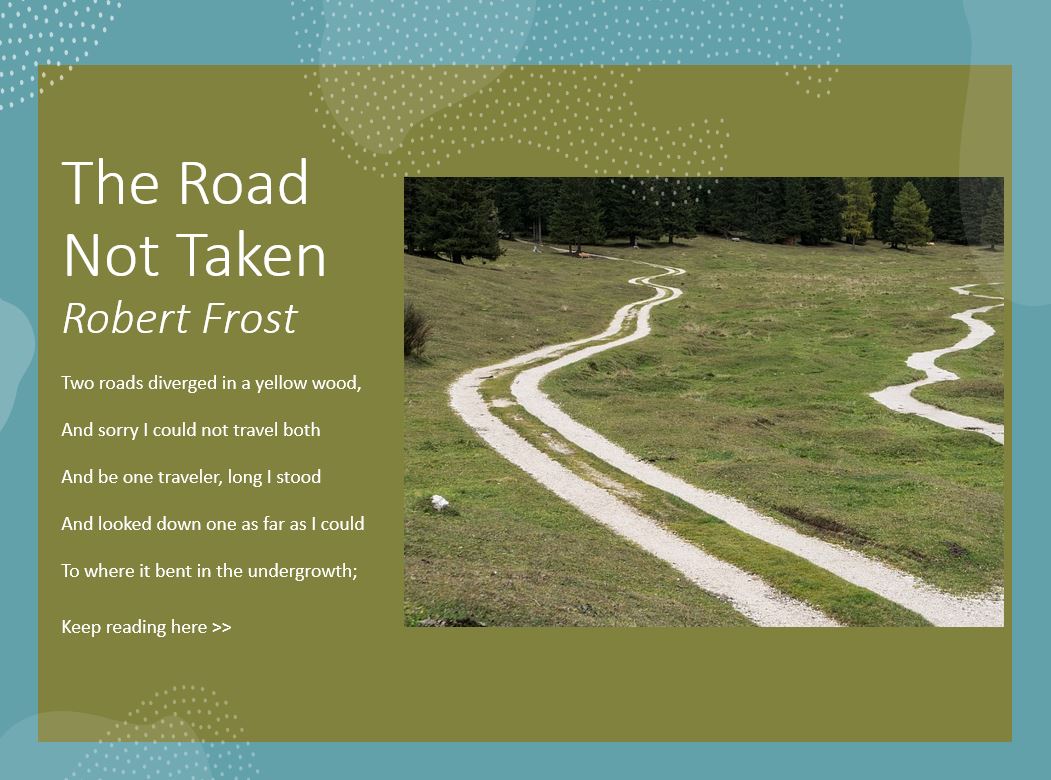
Two roads diverged in a yellow wood,
And sorry I could not travel both
And be one traveler, long I stood
And looked down one as far as I could
To where it bent in the undergrowth;
Then took the other, as just as fair,
And having perhaps the better claim,
Because it was grassy and wanted wear;
Though as for that the passing there
Had worn them really about the same,
And both that morning equally lay
In leaves no step had trodden black.
Oh, I kept the first for another day!
Yet knowing how way leads on to way,
I doubted if I should ever come back.
Two roads diverged in a wood, and I—
I took the one less traveled by,
And that has made all the difference.
I shall be telling this with a sigh
Somewhere ages and ages hence:
Two roads diverged in a wood, and I—
I took the one less traveled by,
And that has made all the difference.
For our February 2nd Question of the Week, over 75% of respondents chose the best answer!
Before we start though, if you don’t want any spoilers and haven’t tried the question yet, you can answer below: Answer Question
Question: JL is 65 years old and has diabetes. JL tells you they had two different pneumonia vaccines in the past, but they are wondering what vaccinations they need this year.
What is the BEST answer?
Answer Choices:
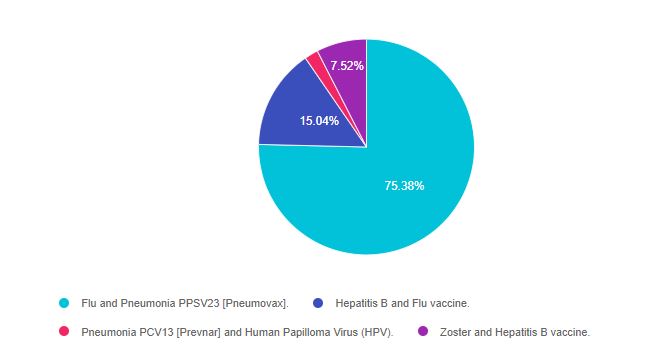
As shown above, the most common choice was option 1, the second most common answer was option 2, then option 4, and finally option 3.
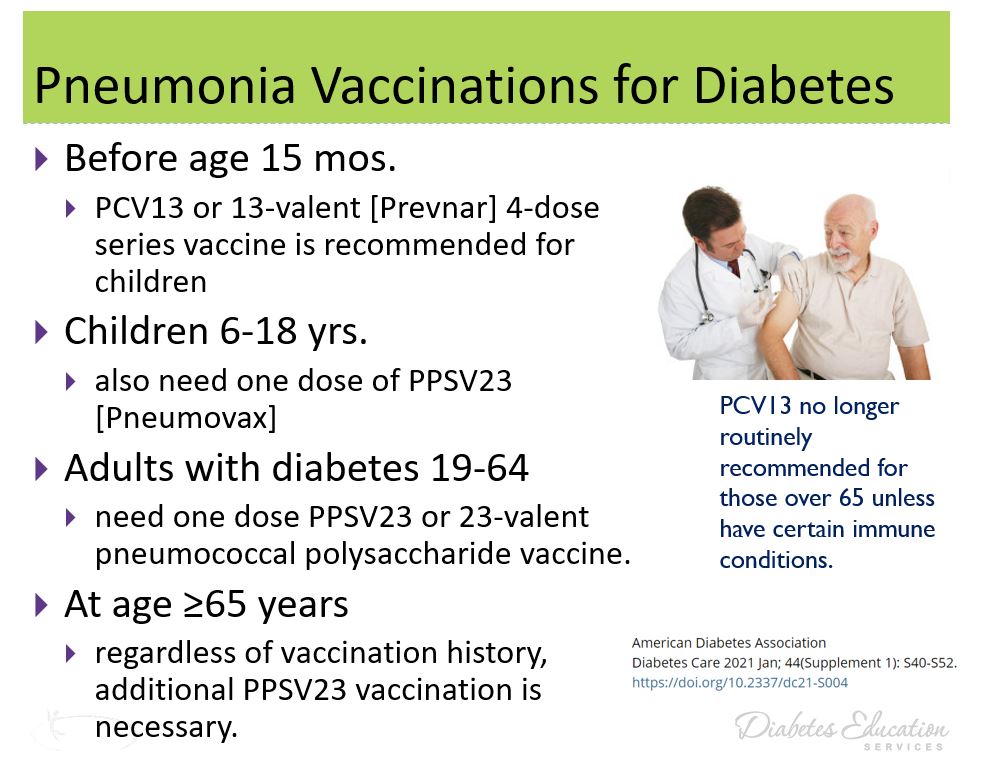
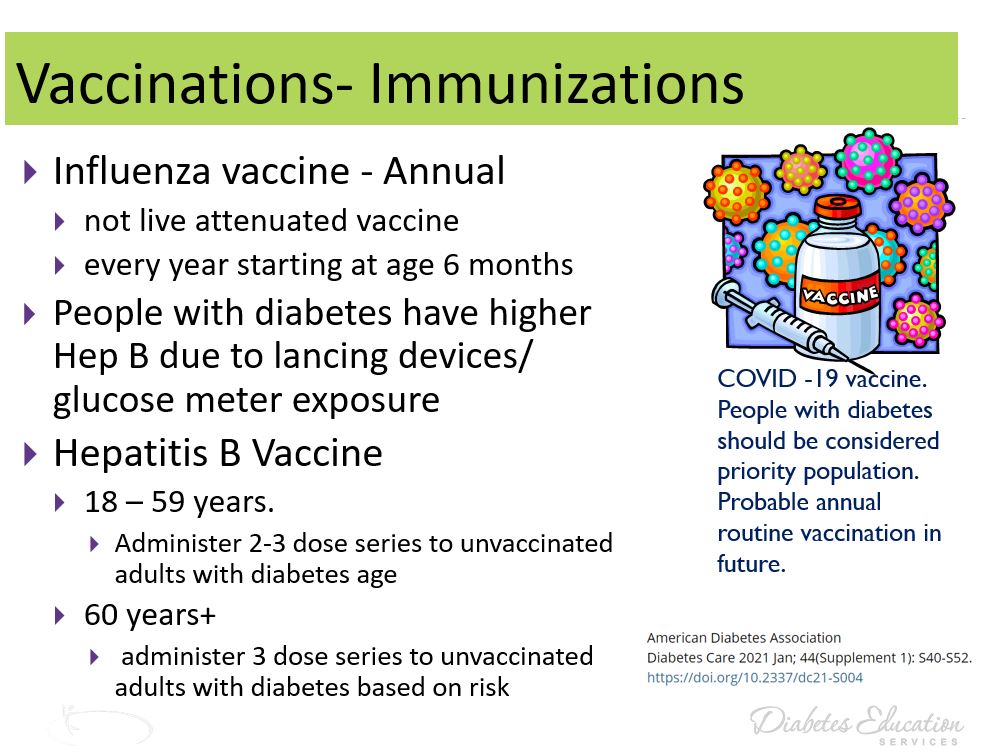
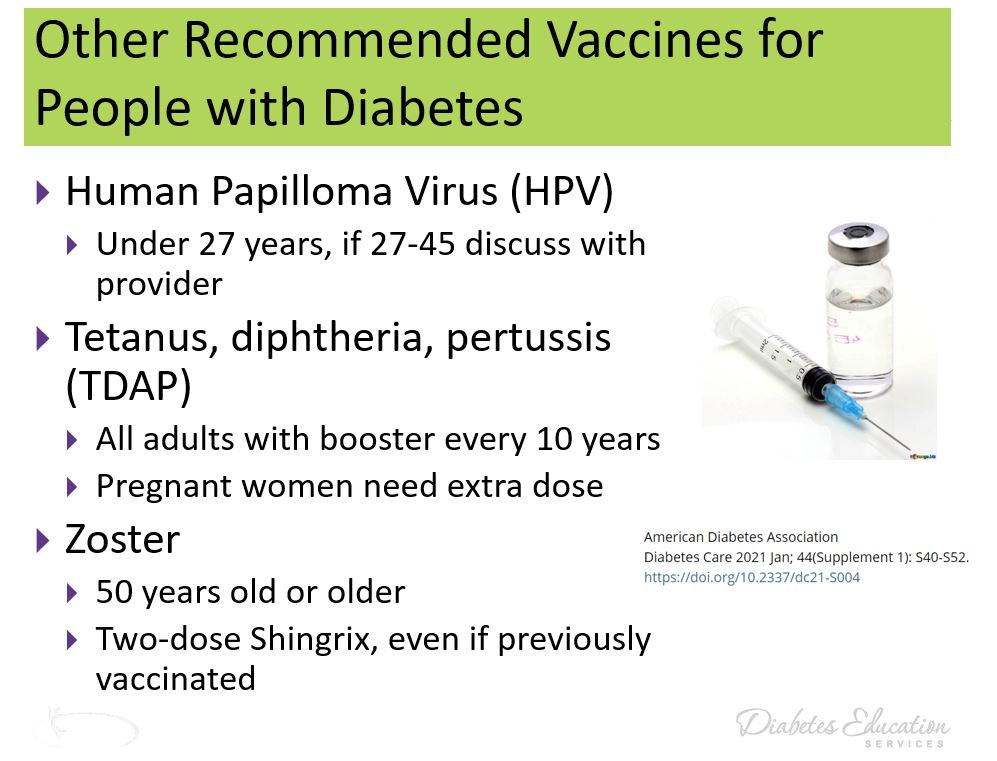
If you are thinking about taking the certification exam, the content of this practice test question will set you up for success. We have posted Vaccination Slides below from our Annual Standards of Care 2021 Webinar update.
Answer 1 is correct 75.38% chose this answer. “Flu and Pneumonia PPSV23 [Pneumovax]” The 2021 ADA Standards provide much clearer guidelines on vaccinations. People with diabetes need a flu vaccine yearly and a pneumonia vaccine, PPSV23, after they turned 65 regardless of previous pneumonia vaccine history.
Answer 2 is incorrect 15.04% of you chose this answer. “Hepatitis B and Flu vaccine.” The flu vaccine is correct. For people aged 65 or older, the hepatitis vaccine is only administered if the person is at increased risk of hepatitis and is based on a cost-benefit discussion with their provider.
Answer 3 is incorrect 2.05% of you chose this answer “Pneumonia PCV13 [Prevnar] and Human Papilloma Virus (HPV) vaccine” The ADA no longer recommends that people 65 years and older routinely receive the PCV13 vaccine. The HPV vaccine is recommended for people up to the age of 27 and if indicated up to the age of 45.
Answer 4 is incorrect 7.52% of you chose this answer. “Zoster and Hepatitis B vaccine” Zoster vaccine is recommended for people over the age of 50 with diabetes. However, for people aged 65 or older, the hepatitis vaccine is only administered if the person is at increased risk of hepatitis and is based on a cost-benefit discussion with their provider.
We hope you appreciate this week’s rationale! Thank you so much for taking the time to answer our Question of the Week and participate in this fun learning activity!
Sign up for Diabetes Blog Bytes – we post one daily Blog Byte from Monday to Friday. And of course, Tuesday is our Question of the Week. It’s Informative and FREE! Sign up below!
[yikes-mailchimp form=”1″]Accreditation: Diabetes Education Services is an approved provider by the California Board of Registered Nursing, Provider 12640, and Commission on Dietetic Registration (CDR), Provider DI002. Since these programs are approved by the CDR it satisfies the CE requirements for the CDCES regardless of your profession.*
The use of DES products does not guarantee the successful passage of the CDCES exam. CBDCE does not endorse any preparatory or review materials for the CDCES exam, except for those published by CBDCE.
RT is a 49-year-old with type 1 diabetes, admitted to a local hospital to treat Diabetes Ketoacidosis (DKA). RT is on an insulin drip, fluids and potassium replacement therapy and is getting hungry. The IV insulin is running at 2 units an hour and the RTs usual insulin dose at home is 12 units glargine at bedtime and 3-4 units of lispro before meals.
Before stopping the IV insulin, what is the most important action?
Click here to test your knowledge!
Save your spot for our
Virtual DiabetesEd Specialist Conference | April 15-17, 2021
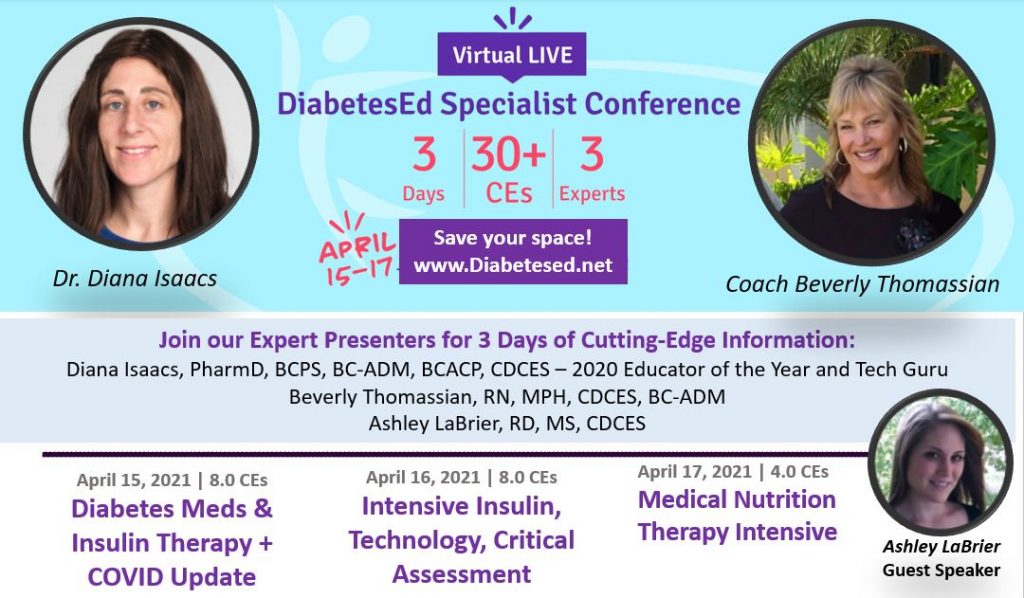
Whether you are new to diabetes or a seasoned expert, you’ll benefit from this virtual conference with the latest research plus critical content that you can immediately apply to your clinical practice. If you are interested in taking the CDCES or BC-ADM exam or are seeking a state-of-the-art review of current diabetes care, this course is for you.
Entire Program Fee: $399
Dates: April 15-17, 2021
3 Expert Speakers
CEs: 30+ CE hours
Live Webinar Schedule: All webinars start and end times are in Pacific Standard Time
Come join our Virtual DiabetesEd Specialist Program.
Team of expert faculty includes:
In addition to informative lectures, we also use group activities and case studies to highlight the essential knowledge, skills, and strategies needed to succeed in diabetes education today!
Prepare for CDCES or BC-ADM certification or earn hours for renewal.
Your registrations include access to all the Online Sessions plus Bonus Courses through December 31st, 2021.
This virtual program includes:
3 day live webinar courses from April 15th-17th (20 CEs) + enrollment in our Bonus Bundle (14.0+ CEs) from now through December 2021.
View full Conference Schedule and Faculty.
Sign up for Diabetes Blog Bytes – we post one daily Blog Byte from Monday to Friday. And of course, Tuesday is our Question of the Week. It’s Informative and FREE! Sign up below!
[yikes-mailchimp form=”1″]The use of DES products does not guarantee the successful passage of the CDCES exam. CBDCE does not endorse any preparatory or review materials for the CDCES exam, except for those published by CBDCE.
New ADA Standards recognize food insecurity and its impact on mental wellness
In the first pages of the ADA 2021 Standards, there is important and detailed information addressing population health. This in-depth focus explores the Social Determinants of Health, acknowledging their impact on diabetes self-care and outcomes.
Our feature article, contributed by Bryanna, draws our attention to the mental toll associated with food insecurity. People with diabetes are at higher risk of not having enough food to eat due to socioeconomics. This is especially true for single mothers and people of color with diabetes.
We explore the social impact and provide resources that diabetes specialists can share with those who are experiencing food insecurity and distress.
In addition, I investigate some potential myths around exercise, sitting, and sleep. Are modern humans lazier and more under-slept than our ancestors? Regardless of the data, I’m not ready to give up my treadmill desk anytime soon!
February kicks off Black History Month and provides me with a perfect opportunity to recognize and celebrate a colleague that I worked with over 30 years ago. Ms. Davis made me feel proud to be a nurse and role modeled professionalism coupled with compassion.
Our rationale of the week quizzed test takers on the latest 2021 ADA Medication Algorithms and addresses a common medication management issue. See what you think.
With chilly weather blanketing much of the United States, it’s a perfect time for some recipes that not only nourish our bodies but warm us up. We’ve put together our most popular winter recipes by Dawn Desoto, RD, CDCES.
We love celebrating our DiabetesEd Online graduates. Most recently we are thrilled to congratulate Susan George for passing her BC-ADM Exam and sharing her story with us.
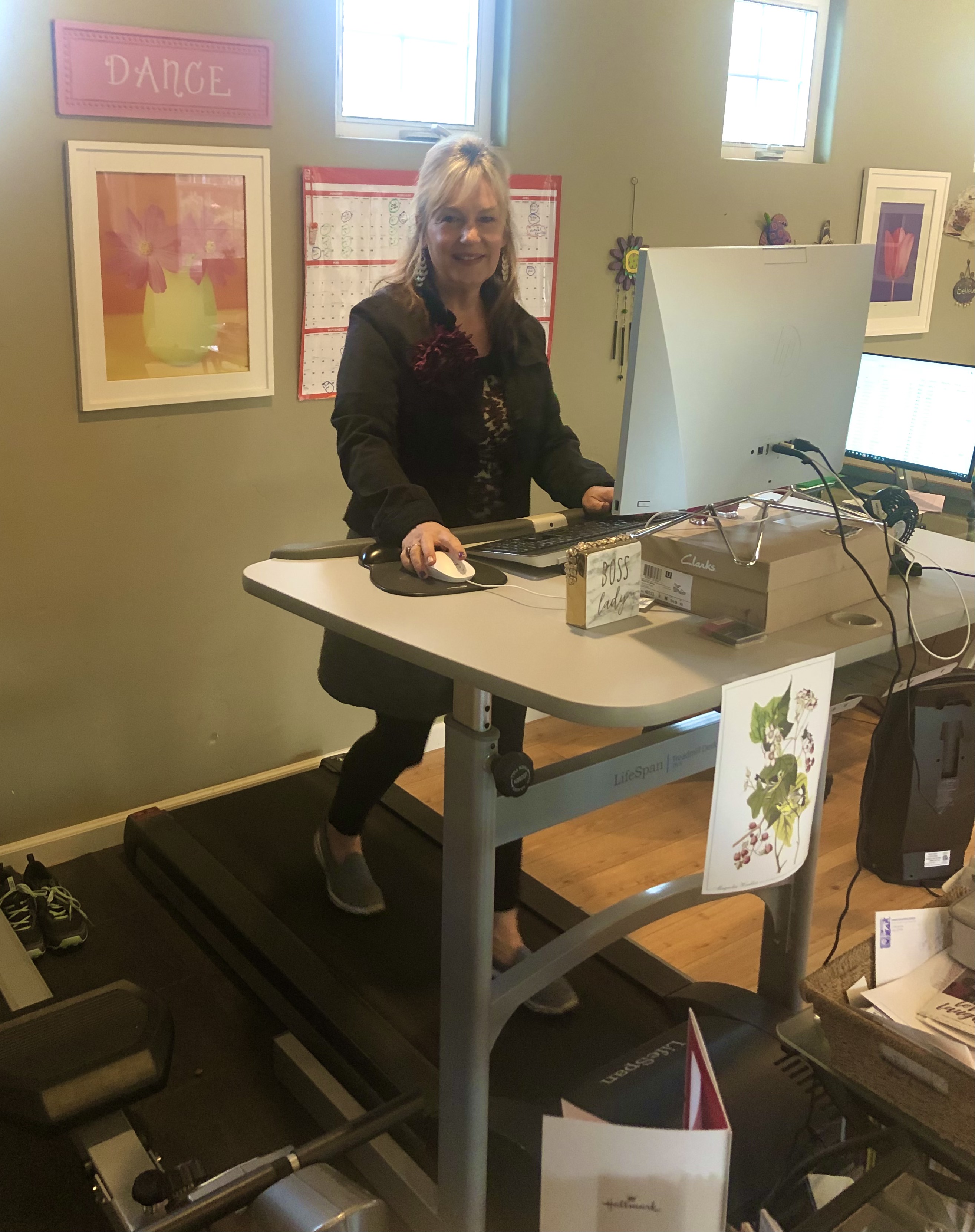
Lastly, this Monday, I got my second dose of the Pfizer COVID-19 vaccine at 7:30am. One hour later, I was clocking miles on my treadmill (pictured above). I did experience some chills and body aches that evening, but by the end of day 2, I felt great!
With affection and wishes for health,
Coach Beverly, Bryanna, Dawn, and Jackson
Click here to read our full February 2021 newsletter.
Most Popular 2020 Blogs
Featured Items

See Full Free Resource Catalog
Sign up for Diabetes Blog Bytes – we post one daily Blog Byte from Monday to Friday. And of course, Tuesday is our Question of the Week. It’s Informative and FREE! Sign up below!
[yikes-mailchimp form=”1″]Accreditation: Diabetes Education Services is an approved provider by the California Board of Registered Nursing, Provider 12640, and Commission on Dietetic Registration (CDR), Provider DI002. Since these programs are approved by the CDR it satisfies the CE requirements for the CDCES regardless of your profession.*
The use of DES products does not guarantee the successful passage of the CDCES exam. CBDCE does not endorse any preparatory or review materials for the CDCES exam, except for those published by CBDCE.