
Subscribe
eNewsletter

Ready to get certified?
Free CDCES Coach App

eNewsletter
Free CDCES Coach App
Free Med Pocket Cards
Which of the following best describes the proper technique for using a 10-gram monofilament to assess protective sensation in a person with diabetes?
Can’t make it live? Don’t worry – you have access to the recorded version for a year after purchase!
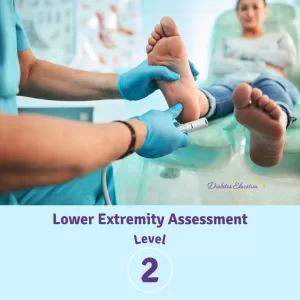
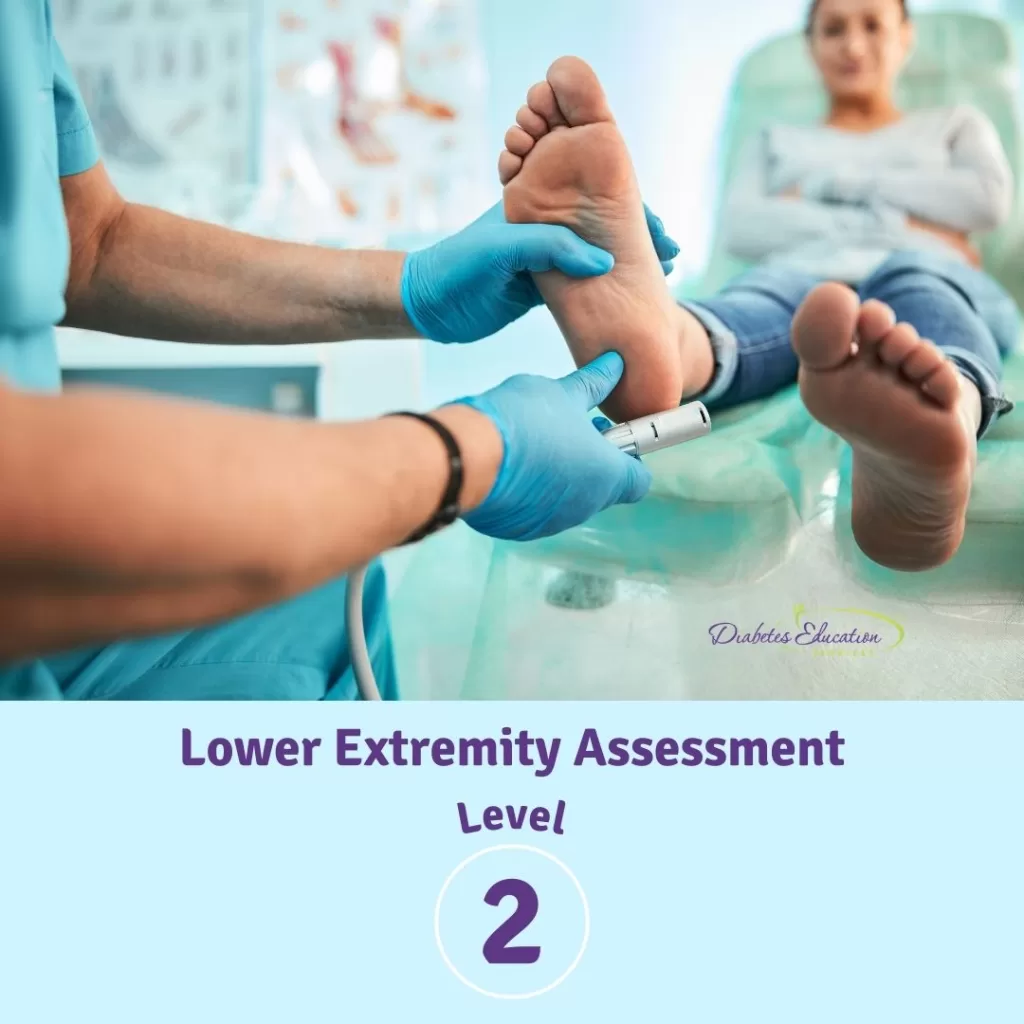
People with diabetes are at increased risk of Lower Extremity Complications. This course reviews the steps involved in performing a detailed assessment of the lower extremities, including how to use a monofilament and tuning fork to detect neuropathy. We also discuss the significance of the Ankle Brachial Index and strategies to prevent lower extremity complications.
All hours earned count toward your CDCES Accreditation Information
The use of DES products does not guarantee the successful passage of the certification exam. CBDCE and ADCES do not endorse any preparatory or review materials for the CDCES or BC-ADM exams, except for those published by CBDCE & ADCES.
For last week’s practice question, we quizzed participants on What Stage of Change? 58% of respondents chose the best answer. We want to clarify and share this important information, so you can pass it on to people living with diabetes and your colleagues, plus prepare for exam success!
Before we start though, if you don’t want any spoilers and haven’t tried the question yet, you can answer it below: Answer Question
BT was started on a GLP-1 and is losing weight. BT has read articles about the importance of strength training to maintain muscle. They ask you questions about whether using weights or resistance bands is better.
According to the transtheoretical model, what stage of change is BT in?
Answer Choices:
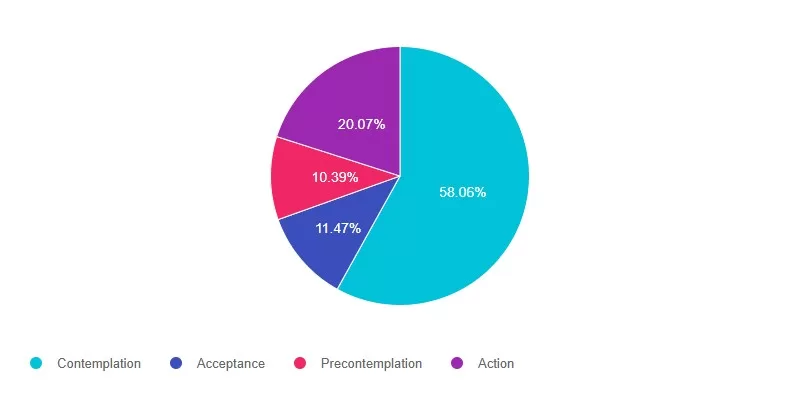
Answer 1 is correct. 58% chose this answer, “Contemplation.” GREAT JOB! When people are in contemplation stage, they are aware of the need for change and are actively considering making a change within the next six months. They are weighing the pros and cons of changing their behavior. In this situation BT is contemplating two different approaches to strengthening exercises,
Answer 2 is incorrect. 11% of you chose this answer, “Acceptance.” Even though BT may be accepting the need to get active, acceptance is not one of the stages in the transtheoretical model. This was one of those juicy answers.: -)
Answer 3 is incorrect. About 10% of respondents chose this, “Precontemplation.” This answer is tempting, but in precontemplation, individuals are not yet considering changing behavior. They may be unaware of the need for change or may have a resistant attitude toward it. BT wants to increase activity, but is choosing between two strength training options.
Finally, Answer 4 is incorrect. 20% chose this answer, “Action.” This person is not quite at the action stage. Action is when Individuals are actively modifying behavior, implementing plans, and making observable changes in their behavior, environment, or lifestyle.
We hope you appreciate this week’s rationale! Thank you so much for taking the time to answer our Question of the Week and participate in this fun learning activity!

Session 1 – May 8th
with Beverly Thomassian at 11:30am to 12:30pm PST
Session 2 – May 15th
with Dr. Diana Isaacs at 11:30am to 2:30pm PST
Gain confidence in interpreting Glucose Profile Report (AGP) & CGM data using a person-centered approach!
If you are preparing for certification exams or want to up your game using CGM data to improve outcomes, this course is for you.
We still have room available for the May 8th kick off date.
With diabetes technology entering all aspects of diabetes care, figuring out how to make sense of all the data can seem overwhelming. Join Diana Issacs and Coach Beverly for a truly unique learning experience. Dr. Isaacs has a special knack for breaking down the essential elements of the Ambulatory Glucose Profile (AGP) report to provide participants with a clear road map for data interpretation. She includes many sample practice cases utilizing CGM data for various types of people with diabetes including type 2 and people with type 1 not on pumps.
Coach Beverly will build on Dr. Isaacss’ presentation. She will expand the focus to include steps to collaborate with the person with diabetes. Using a case study approach, she will provide strategies to integrate the AGP with person-centered care that empowers individuals to experience increased confidence in their diabetes self-management.
By attending this interactive workshop, participants will become more confident in interpreting the AGP and continuous glucose monitor (CGM) data and determining needed medication and lifestyle adjustments with a person-centered approach.
Topics include:
Review CGM key metrics and individualize time in-range goals.
Learn how to recognize patterns with the AGP report efficiently.
Recommend lifestyle and medication adjustments based on CGM data.
Utilize the AGP report coupled with a person centered approach when meeting with a person with diabetes.
The use of DES products does not guarantee the successful passage of the certification exam. CBDCE and ADCES do not endorse any preparatory or review materials for the CDCES or BC-ADM exams, except for those published by CBDCE & ADCES.
BT has a history of stroke and new diagnosis of diabetes with an A1C of 6.9%.
Which of following treatment strategies is most appropriate for a person with new type 2 diabetes and established cardiovascular disease (CVD)?
All hours earned count toward your CDCES and BC-ADM Certification Accreditation Information
Register above or simply visit our Online Store at DiabetesEd.net. While most webinars are available to attend at no cost, you have the option to purchase the session if you wish to earn Continuing Education (CE) credits.
For more information or any questions, please email [email protected].
Accreditation: Diabetes Education Services is an approved provider by the California Board of Registered Nursing, Provider 12640, and our Level 4 | The Impact of Adverse Childhood Experiences on Health awards 1.0 CPEUs in accordance with the Commission on Dietetic Registration’s CPEU Prior Approval Program.
All hours earned count toward your CDCES Accreditation Information

Ready to elevate your diabetes care expertise? Our new expert-led Level 5 Series is designed for healthcare professionals who want to stay ahead of the curve in a rapidly evolving field. Led by a dynamic and diverse faculty of leading experts and educators, each session dives into cutting-edge topics—including emerging therapies, technology integration, and social determinants of health.
Whether you’re looking to deepen your clinical knowledge, expand your toolkit, or lead with innovation, this series will keep you at the forefront of diabetes care and education.
Join us and transform your practice—one course at a time.
All hours earned count toward your CDCES Accreditation Information
For last week’s practice question, we quizzed participants on Sleep and ADA Recommendations. 71% of respondents chose the best answer. We want to clarify and share this important information, so you can pass it on to people living with diabetes and your colleagues, plus prepare for exam success!
Before we start though, if you don’t want any spoilers and haven’t tried the question yet, you can answer it below: Answer Question
Question:
A 62-year-old with type 1 diabetes presents for their follow-up visit. They report struggling with fatigue, poor sleep quality, and difficulty with glucose management despite taking medications as prescribed. Upon review, you find their A1C is 7.6%, and their average nightly sleep duration is 4.5-6 hours per night.
Based on the 2025 ADA Standards of Care, which of the following interventions would be the most appropriate next step to address sleep and glucose management?
Answer Choices:
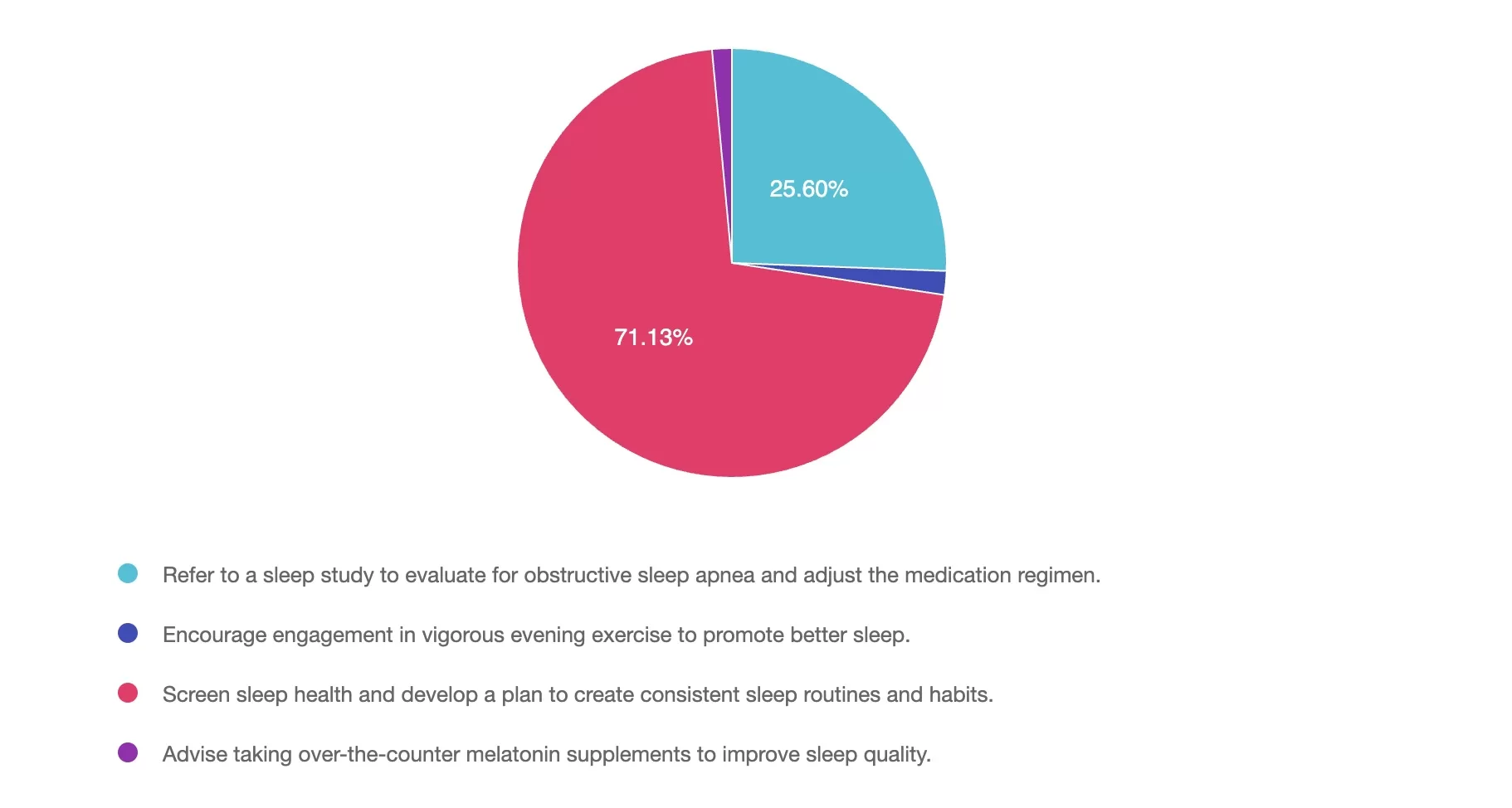
Answer 1 is incorrect. 25% chose this answer, “Refer to a sleep study to evaluate for obstructive sleep apnea and adjust the medication regimen.” While a sleep study may be recommended for suspected sleep disorders, such as sleep apnea (for example: loud snoring, daytime sleepiness), the first step should be a comprehensive sleep health screening. This screening helps identify potential causes of poor sleep, including symptoms of sleep disorders, disruptions from diabetes management (for example: nocturnal hypoglycemia, frequent urination), or anxiety about sleep. Based on the findings, appropriate treatment modifications and referrals can then be made.
Answer 2 is incorrect. 1% of you chose this answer, “Encourage engagement in vigorous evening exercise to promote better sleep.” Although exercise can improve sleep quality, vigorous evening exercise may increase alertness, making it harder to fall asleep. In individuals with type 1 diabetes, this timing of exercise can also increase the risk of nighttime hypoglycemia, further disrupting sleep. Before recommending vigorous exercise, it’s important to first assess sleep habits to better understand the underlying causes of poor sleep quality.
Answer 3 is correct. About 71% of respondents chose the BEST ANSWER – GREAT JOB! “Screen sleep health and develop a plan to create consistent sleep routines and habits.” The 2025 ADA Standards emphasize the importance of screening for sleep health and providing guidance on sleep-promoting routines and habits. Based on screening results, referrals to sleep medicine programs, adjustment in medications or behavioral therapy programs are a few that may be appropriate. Prioritizing improved sleep duration and consistency can support better glucose management, reduce fatigue, and enhance overall well-being.
Finally, Answer 4 is incorrect. 1% chose this answer, “Advise taking over-the-counter melatonin supplements to improve sleep quality.” While melatonin may be helpful for certain sleep disorders, its use should be evaluated on a case-by-case basis and is not recommended within the ADA 2025 Standards of Care. The first-line recommendation should focus on screening to better determine appropriate actions.
We hope you appreciate this week’s rationale! Thank you so much for taking the time to answer our Question of the Week and participate in this fun learning activity!
The use of DES products does not guarantee the successful passage of the certification exam. CBDCE and ADCES do not endorse any preparatory or review materials for the CDCES or BC-ADM exams, except for those published by CBDCE & ADCES.

Spring into New Course Offerings!
You are gonna love this new course bundle we are officially launching – today. This new Level 5 Expert-led Series, designed for HCPs committed to staying at the leading edge of this fast-evolving field, is ready. Featuring a dynamic and diverse faculty of top experts and educators, each session explores timely, advanced topics—such as emerging therapies, nutrition, integrating new technologies, and addressing social determinants of health. Join us to sharpen your clinical skills, broaden your care strategies, or drive innovation.
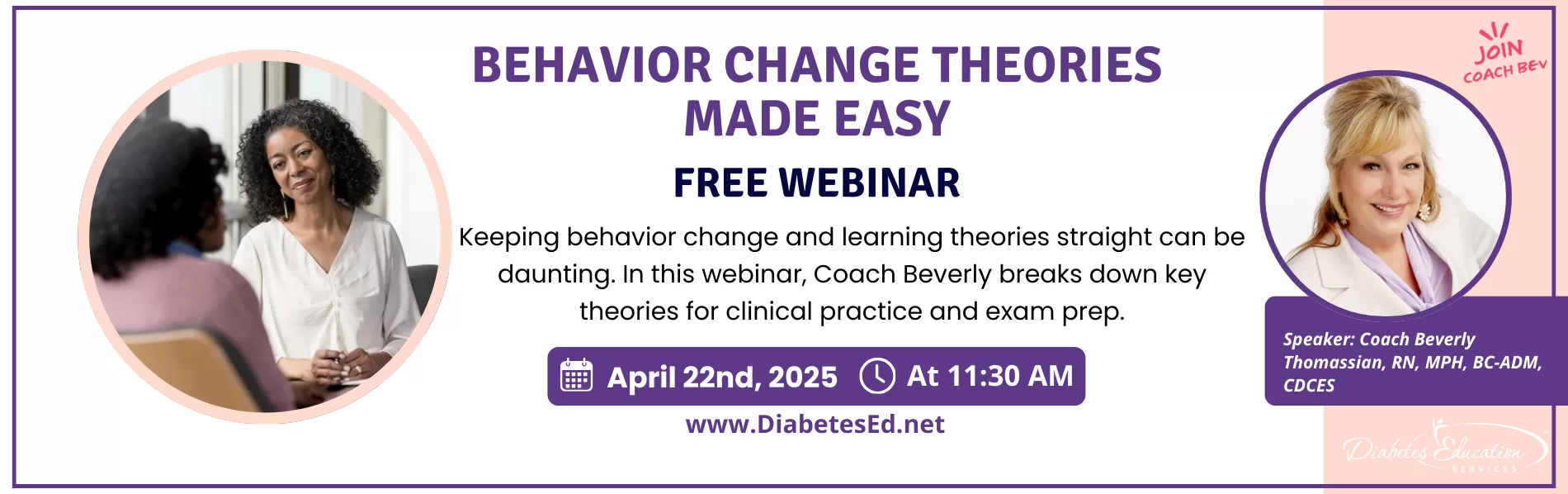
Also, if you are taking the CDCES or BC-ADM exam this year, you won’t want to miss our FREE Behavior Change Theories Made Easy webinar. Coach Bev will save you hours of studying tedious theories and provide you with a summary of the information you need to know for exam success.
There is still time to sign up for our ADA Standards Webinars. Don’t worry if you can’t make it live. Once you register, you can access the recorded version for a year. Save 10% on our online courses, by entering coupon code Success10 at checkout.
With love,
Coach Beverly, Bryanna, Tiffany, Christine, & Katarina
BT was started on a GLP-1 and is losing weight. BT has read articles about the importance of strength training to maintain muscle. They ask you questions about whether using weights or resistance bands is better.
According to the transtheoretical model, what stage of change is BT in?
Keeping all the behavior change and learning theories straight can be daunting, especially if you are trying to get to the “best” answer for certification exams. Coach Beverly feels your pain and wants to help out. To say thanks for 25 years, she’s hosting a FREE Behavior Change Webinar to sort out and dissect the theories most relevant in clinical practice and for exam preparation.
All hours earned count toward your CDCES Accreditation Information
The use of DES products does not guarantee the successful passage of the certification exam. CBDCE and ADCES do not endorse any preparatory or review materials for the CDCES or BC-ADM exams, except for those published by CBDCE & ADCES.
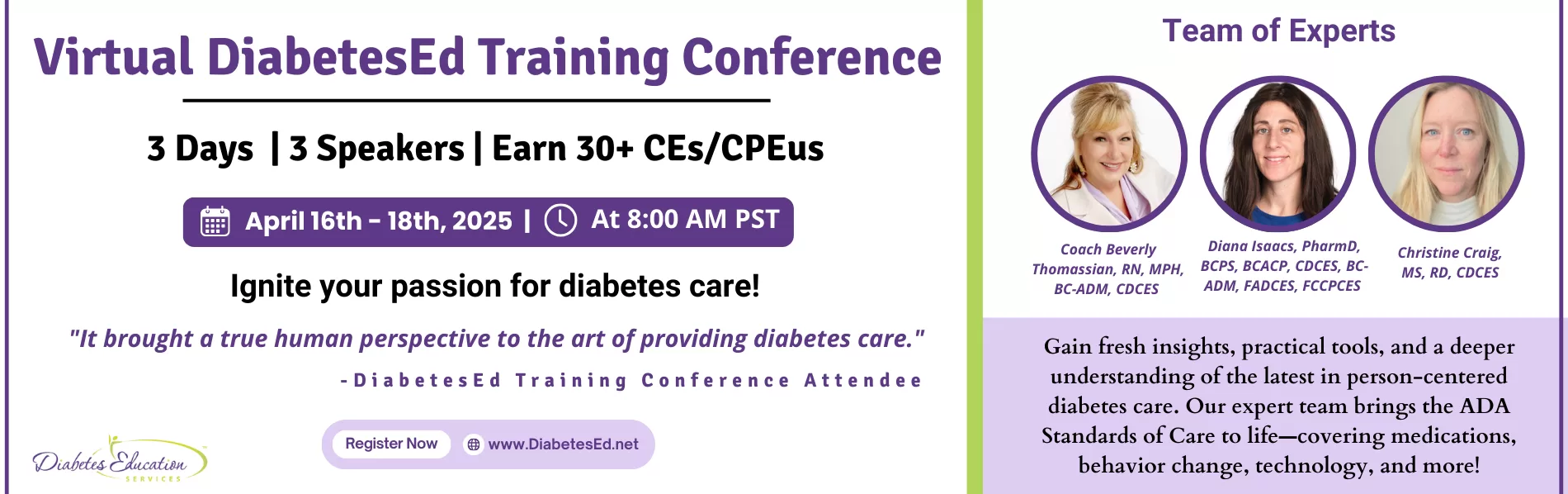
The Virtual Conference starts next week. If you haven’t secured your spot yet, this is your final opportunity to register and join us.
Gain fresh insights, practical tools, and a deeper understanding of the latest in person-centered diabetes care. Our expert team brings the ADA Standards of Care to life—covering medications, behavior change, technology, and more! If you’re preparing for the CDCES or BC-ADM exam, this conference—paired with free bonus courses—serves as the ideal study companion!
With interactive co-teaching, we keep sessions engaging, relevant, and fun. Let’s learn and grow together!

Our expert team transforms complex diabetes science into clear, practical insights—keeping it real, engaging, and fun! The faculty includes:
The use of DES products does not guarantee the successful passage of the certification exam. CBDCE and ADCES do not endorse any preparatory or review materials for the CDCES or BC-ADM exams, except for those published by CBDCE & ADCES.