
Subscribe
eNewsletter

Ready to get certified?
Free CDCES Coach App

eNewsletter
Free CDCES Coach App
Recently, metformin was in the news regarding a potential risk of N-Nitrosodimethylamine (NDMA) contamination during medication production. The Food and Drug Administration (FDA) tested Metformin products to evaluate NDMA levels.

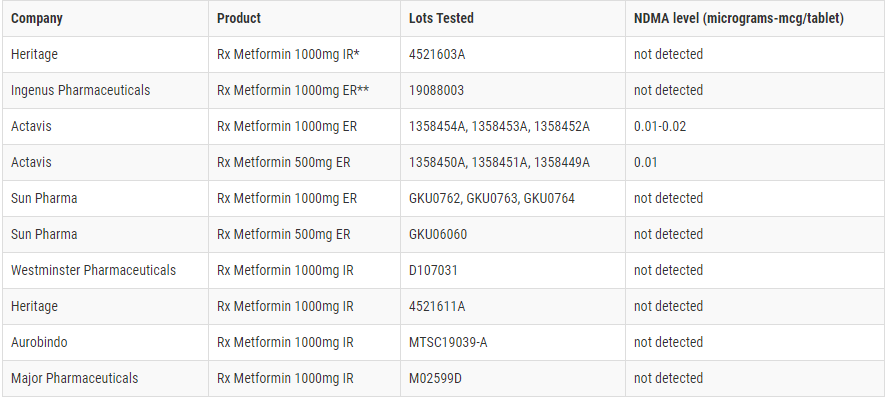
In Metformin’s products, NDMA is not listed under the active pharmaceutical ingredients. However, after some testing, the FDA did find “low levels” of NDMA in a few Metformin products (see chart below).
“Most metformin drug products tested showed no detectable levels of NDMA, while others showed low levels of NDMA,” FDA said, noting that the low levels are similar to what one would be exposed to from grilled or smoked meats.
The FDA advises that “patients should continue taking Metformin to keep their diabetes under control. ”
Of the products tested, both Actavis’ Rx Metformin 1000mg ER and Rx Metformin 500mg ER contained trace amounts of NDMA. The FDA explained that these low levels found (at 0.01-0.02 micrograms-mcg/tablet) are akin to exposure to NDMA through grilled or smoked meats. The daily intake limit for NDMA is 0.096 micrograms, which the FDA regards as “reasonably safe for human ingestion based on lifetime exposure.”
So far, the FDA has not recommended Metformin recalls in the US. Though other countries, like Singapore, have recalled a few Metformin products containing NDMA “above the internationally acceptable level.”
Click here to read more. Download Diabetes Medication PocketCards here.
Sign up for Diabetes Blog Bytes – we post one daily Blog Byte from Monday to Friday. And of course, Tuesday is our Question of the Week. It’s Informative and FREE! Sign up below!
[yikes-mailchimp form=”1″]

We receive so many great questions from our community about carb counting, so we’ve gathered all of our favorite, most trusted carb counting resources in one place for you.
Our goal is to make counting carbs simpler, clearer, and less overwhelming. We hope this collection answers your questions and gives you the confidence to manage carb counting with ease!
Exam note: If there is a question about carb counts using the exchange list, know that milk contains 12gms of carb. Thanks, Coach Bev
Diabetes Exchange List – a brief summary of serving size and carbohydrate counts for common foods. Excellent study tool for the exam.
Carb Counting Quick Reference English – We created this Carb Counting Quick Reference sheet based on the ADA handbook.
Carb Counting Quick Reference – Spanish – We created this Carb Counting Quick Reference sheet based on the ADA handbook.
CalorieKing – includes curated food database with nutrition information, including many fast-food chains and restaurants.
Diabetes Tracker – The American Journal of Preventive Medicine ranked this app, which has no free version, No. 1. It boasts an intensive and easy-to-follow educational component in addition to features for monitoring blood glucose, carbs, net carbs and more. Easy to see the big picture with daily and weekly reports. For some, it may be worth the extra expense.
Undermyfork – Undermyfork automatically combines glucose data from CGM, FGM, or BGM with the meal pictures and calculates postprandial Time in Range for each meal. Tag meal photos with keywords to compare your glycemic response to the same meals and situations.
Glucose Buddy(diabetes logbook manager) Simple to navigate, Glucose Buddy helps users manage their blood sugar, insulin dosages, and carb intake. Other features track exercise, blood pressure, and weight. Sync data to print it out or view online.
Hedia – digital diabetes personal assistant, developed with insulin using people with diabetes in mind, to increase time-in-range. Allows tracking data in a personal logbook and gives suggestions on carb amounts and insulin doses with a food database designed by nutrition experts.
Apps that Help Improve Time in Range – see our latest cheat sheet on helpful apps for diabetes self-management.


Our Diabetes Detective Team scans the diabetes news to discover the most relevant info that Diabetes Educators need in their daily practice. We post one daily Blog Byte from Monday to Friday. And of course, Tuesday is our Question of the Week. It’s Informative and FREE! Sign up below!

Come join us at our, DiabetesEd Specialist Course in historic Sacramento, CA. Whether you are new to diabetes or a seasoned expert, you’ll leave our live seminar with the latest research plus teaching tools you can immediately apply to your clinical practice.
If you are interested in taking the CDCES exam or are seeking a state of the art review of current diabetes care, this course is for you. Our team of expert faculty has been fine-tuning this course for over fifteen years, and we know what you need. In addition to informative lectures, we also use group activities and case studies to highlight the essential knowledge, skills, and strategies needed to succeed in diabetes education today!
Sign up for Diabetes Blog Bytes – we post one daily Blog Byte from Monday to Friday. And of course, Tuesday is our Question of the Week. It’s Informative and FREE! Sign up below!
[yikes-mailchimp form=”1″]
A recent study published by BMJ Journals – Gut indicates that enjoying a Mediterranean diet (MedDiet) can promote healthier aging.
The study was conducted over a 12 month period across a large cohort of more than 600 individuals aged 65–79 years, within 5 different European countries (UK, France, Netherlands, Italy, and Poland). The researchers evaluated the differences in the gut microbiota in each individual before and after the year of consuming a MedDiet.
The results indicate that consuming a MedDiet improved cognitive function and the gut microbiome of those in the study.
The positive effects of these alterations showed that there was an increase in fatty acid production and a decrease in “secondary bile acids, p-cresols, ethanol, and carbon dioxide.” These changes were associated with lower frailty and improved cognitive function and an overall decrease in inflammatory markers, such as C-reactive protein and interleukin-17.
This study shows that changing to a MedDiet can have a positive impact on people as they age.
Read more by clicking here.
Want to learn more about the Mediterranean diet? Click here.
Sign up for Diabetes Blog Bytes – we post one daily Blog Byte from Monday to Friday. And of course, Tuesday is our Question of the Week. It’s Informative and FREE! Sign up below!
[yikes-mailchimp form=”1″]

March is the National Nutrition Month!
To kick things off, Coach Beverly has collected an entire page of plant-based eating resources. This page includes recipes, instructional videos, reading materials, and more!
We hope this list informs and inspires you!
Click here to read more.
Sign up for Diabetes Blog Bytes – we post one daily Blog Byte from Monday to Friday. And of course, Tuesday is our Question of the Week. It’s Informative and FREE! Sign up below!
[yikes-mailchimp form=”1″]
Our Diabetes Detective Team scans the diabetes news to discover the most relevant info that Diabetes Educators need in their daily practice. We post one daily Blog Byte from Monday to Friday. And of course, Tuesday is our Question of the Week. It’s Informative and FREE! Sign up below!
Come join us at our, DiabetesEd Specialist Course in historic Sacramento, CA. Whether you are new to diabetes or a seasoned expert, you’ll leave our live seminar with the latest research plus teaching tools you can immediately apply to your clinical practice.
If you are interested in taking the CDCES exam or are seeking a state of the art review of current diabetes care, this course is for you. Our team of expert faculty has been fine-tuning this course for over fifteen years, and we know what you need. In addition to informative lectures, we also use group activities and case studies to highlight the essential knowledge, skills, and strategies needed to succeed in diabetes education today!
Sign up for Diabetes Blog Bytes – we post one daily Blog Byte from Monday to Friday. And of course, Tuesday is our Question of the Week. It’s Informative and FREE! Sign up below!
[yikes-mailchimp form=”1″]

A new series of recommendations from JDRF/UK has set out to help ensure people with type 1 diabetes can improve access to wearable technology to manage their diabetes.
JDRF Pathway to Choice program released a report capturing the barriers, motivations, and opportunities of people with type 1 diabetes regarding medical technology.
This program in the UK aims to build awareness and access to insulin pumps, CGM’s and Flash glucose meters for persons with type 1 diabetes.
The report has three recommendations;
Karen Addington, JDRF UK’s Chief Executive states, “JDRF believes everyone who wants or would benefit from type 1 diabetes technology should gain access to it”.
As diabetes educators, nurses, doctors, dietitians, and care-givers, we support this effort in the UK for expanding access to technology that can assist people with type 1 diabetes for tighter, healthier glucose control.
Looking forward to the time that this access might be available for all persons with type 1 diabetes!
Read more by clicking here.
Written by Catherine Cullinane RN, CDCES, our resident Technology Thursday Content Writer
Sign up for Diabetes Blog Bytes – we post one daily Blog Byte from Monday to Friday. And of course, Tuesday is our Question of the Week. It’s Informative and FREE! Sign up below!
[yikes-mailchimp form=”1″]
The CDC has released its 2020 annual National Diabetes Statistics Report.
This report showed that diabetes in the U.S. in on the rise. Approximately 13% of adults live with diabetes, with cases rising from 9.5% in 2002 to 13% in 2016. Many (7.3 million) are unaware that they have diabetes, as determined by A1c levels or fasting plasma glucose.
The age-adjusted data indicate that diabetes diagnoses can trend higher depending on socioeconomic status, age, and ethnicity. For example, the percent of adults with diabetes increases with age. 26.8% of those over age 65 have diabetes and new cases of type 1 and type 2 have risen in younger people.
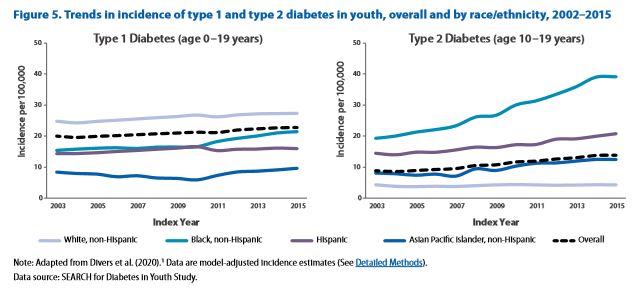
From 2002 to 2015, incidences of type 2 diabetes among children and adolescents rose, with the largest increases of type 2 diabetes among Black non-Hispanic youth.
The report also found that cases are highest among “Native Americans and Alaskan Natives at 14.7%, Hispanic adults at 12.5%, and black adults at 11.7%. The risk increases for those from a lower socioeconomic status.
“Specifically, 13.3% of adults with less than a high school education had diagnosed diabetes vs. 9.7% of those with a high school education and 7.5% of those with more than a high school education” the report states.
The CDC explains that by analyzing the “data from this report [we] can help focus critical type 2 diabetes prevention and diabetes management efforts across the nation.”
Read the full CDC report by clicking here.

We’re updating our DiabetesEd Specialist Boot Camp throughout February and March. See the full schedule here.
In each webinar, Coach Beverly highlights the critical content of each topic area, so you can focus your study time most efficiently. She also launches multiple poll questions to helps students focus on key concepts and assess their knowledge while learning the best test-taking strategies.
Sign up for Diabetes Blog Bytes – we post one daily Blog Byte from Monday to Friday. And of course, Tuesday is our Question of the Week. It’s Informative and FREE! Sign up below!
[yikes-mailchimp form=”1″]