Thank you for being a very important part of our teaching and writing team. Our community is greatly benefitting from your expertise and knowledge. As part of our national CDR Accreditation requirements, please review the following information regarding inclusion and our content philosophy. In addition, please complete and sign (if requested) these wonderful forms and return them to us at your earliest convenience.
Thank you, Beverly, Tiffany, and Bryanna
Table of Contents
Relevant Forms & Links
Lecture Steps & Guidelines
The checklists below are an abbreviated description of each item. For more details, refer to your contract and “Relevant Forms & Links” listed above.
Step 1: Webinar Topic & Paperwork
Timeline: 12 or more weeks before live lecture
- Send Course Proposal to DiabetesEd Team
- Send Resume to DiabetesEd Team
- Webinar Topic/Working Title
- Webinar Description (1 to 2 short paragraphs)
- Webinar Objectives (see "Faculty Letter & Course Objectives" form above)
- List of webinar topics covered (2 to 4 topics)
- Submit Paperwork Packet Form
Step 2: Marketing & Blogs
Timeline: 10 or more weeks before live lecture
- Schedule Webinar Date
- Blog Articles: On course topic, Question and Rationale of the Week. See more info under "Blog Bytes Guidelines" below)
- Distribute Marketing Image to your Social Network (materials provided by DES)
- Webinar Bibliography Draft 1 (an intial version of your bibliography)
Step 3: Content & Webinar
Timeline: 4 or more weeks before live lecture
- Slides
- Schedule Gotowebinar/Tech Orientation with DiabetesEd Team
- List of supplemental resources (optional)
- Post-Assessment Questions (at least 5 for a 1.5 hour webinar)
- Final Webinar Bibliography (include any citations that are added after sending Draft 1 in Step 2)
Lecture Profit Sharing
Profit-Sharing: After the first 50 paid registrations, you will receive $10 per additional registrant. This profit-sharing will continue for one year following the program’s initial airing. At the end of that year, a bonus payment reflecting additional registrations will be issued. This structure will continue annually for up to three years from the original airing date, provided no substantial changes are made to the core content.
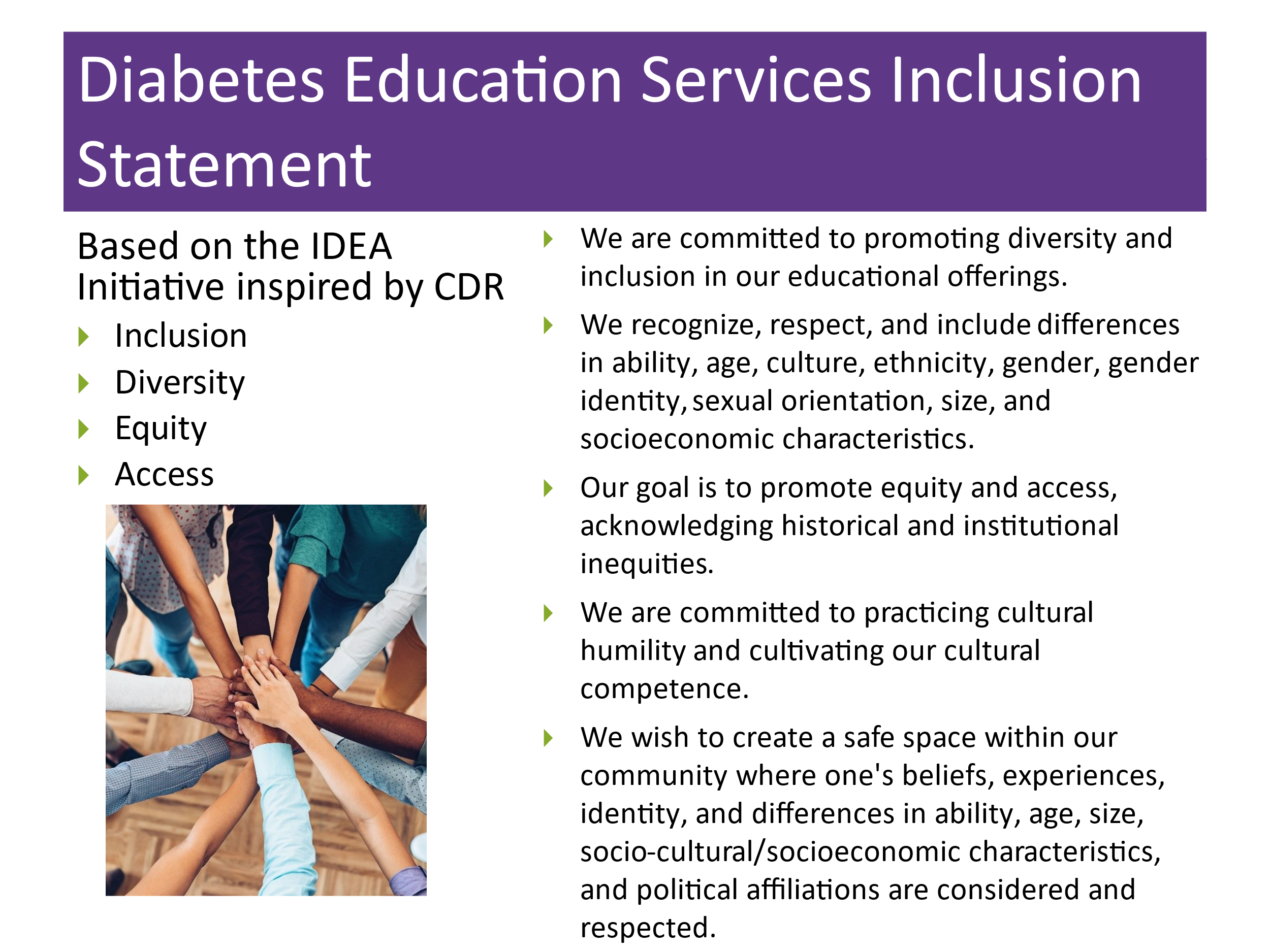
Content Commitment: Inclusion, Diversity, Equity, and Access (IDEA)
This section includes guidelines by CDR and DES for preparing presentations and case studies. We heavily encourage tuning content to align with the IDEA concept and DiabetesEd Services’ Inclusion statement (see image below) to provide the best quality of education for our students.
Fiancial Disclosure Form Details
All prospective planners, faculty, and others who may control educational content in Partners for Advancing Clinical Education (Partners) jointly provided activities are expected to disclose all financial relationships they have had in the past 24 months with ineligible companies, prior to the beginning of the accredited CE activity. An ineligible company is any entity whose primary business is producing, marketing, selling, re-selling, or distributing healthcare products used by or on patients1. There is no minimum financial threshold; Partners asks that you disclose all financial relationships, regardless of the amount with ineligible companies and regardless of the potential relevance of each relationship to the education. Partners must identify and mitigate any relevant financial relationships prior to activity development. In accordance with the ACCME Standards for Integrity and Independence in Accredited Continuing Education, failure to provide disclosure information in a timely manner will result in your disqualification as a potential planner, faculty member, author, activity chair, or reviewer in this activity.
Blog Bytes Guidelines
Blog Structure
A typical format for our Blog Bytes are:
- Hook (1 to 2 sentences): Start with a compelling fact, question, or story to draw readers in.
- Intro Paragraph: Clearly state the topic and why it matters in diabetes care and education.
- Quote: If relevenat, add a quote that brings authenticity or authority to the subject.
- Main Body (4-6 paragraphs): Explain the concept, provide evidence or examples, and connect it to practice. Use section headers to help reader group information quickly.
- Summary/Call to Action: Wrap up with a takeaway or next step. If applicable, direct readers to related resources or tie into a bigger context.
Images:
When images of people are used, they should reflect inclusivity—diverse ages, races, body types, genders, and abilities—and avoid stereotypes.
Use only royalty-free, properly licensed, or original images. We use websites such as Pixabay, Pexels, Canva or, Microsoft Word.
- We can help you find images; just let us know upon submission of your article.
Blog Content Focus Areas
- Person-Centered Language: Use respectful, strengths-based language aligned with ADA and ADCES guidance (e.g., “person living with diabetes,” instead of “diabetic”). Avoid shame-based or judgmental terms. Read more here.
- Gender-neutral language: Use gender-neutral language to model inclusive, person-centered care. Read more here.
- Evidence-Based: Support key points with research or guidelines. Flag new/emerging data where appropriate.
- Social Determinants of Health: Acknowledge how factors such as income, race, location, food access, and healthcare availability influence diabetes outcomes. Strive to approach care and communication with an understanding of how these social and systemic factors shape health behaviors and access to resources.
Blog Tone & Voice
- Warm and professional
- Inclusive and empowering
- Clear and concise – write for busy, informed readers
- Supportive of real-world diabetes care
Blog Target Audience
Our target audience are individuals or groups of diabetes professionals, including RNs, RDs/RDNs, Pharmacists, Nurse Practitioners, Clinical Nurse Specialists, Physician Assistants, Social Workers, and other healthcare providers interested in staying up to date on current practices of care for people with prediabetes, diabetes, and other related conditions. The includes, preventative care, wellness, and, lifestyle along with, education and research.
Question and Rationale of the Week
Blog Structure
In addition to the guidelines above, for the Question and Rationale of the week, we follow the guidelines below.
- Title: a collection of a few words that describe the overall question. E.g. Rationale of the Week | [Clear topic phrased as a question or clinical focus]
- Question:
- List the clinical vignette/lead-in.
- When developing your question, consider that our audience is healthcare professionals using these questions to prepare for certification or increase their knowledge for their clinical practice.
- List the multiple-choice response options (A–D).
- Avoid making C the best answer if possible. People tend to choose that answer naturally.
- To promote critical thinking, try to make the answers challenging, a similar length, and almost correct (one part accurate and one part inaccurate).
- Please, just one best answer (instead of all or none of the above).
- List the clinical vignette/lead-in.
- Rationale:
- For each answer choice, state whether the choice is correct or incorrect.
- Explain why — focusing on clinical reasoning, evidence, or standards (often referencing ADA Standards or other guidelines).
- Emphasize why the correct answer best matches practice guidelines and why the distractors are less accurate. Tie the answer choice interpretations back to real-world practice, and exam practice.
- Summarize the core teaching point — e.g., the key clinical principle or guideline insight.
- Where helpful, connect to ADA Standards, evidence, or real practice scenarios.