Subscribe
eNewsletter

Ready to get certified?
Free CDCES Coach App

eNewsletter
Free CDCES Coach App
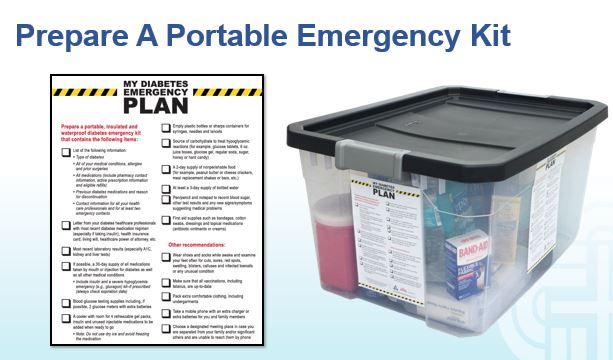
Taking care of ourselves, our families and our patients are our first priorities at this time.
It is very quiet in most neighborhoods this morning; no commuter cars on the streets, no school bus noises, no sounds of children playing. This desolate environment reminds us that there is a lot of unknown for all of us.
It is so important right now to make sure we are all prepared for social distancing and flattening the curve of the spread of this pathogen.
We want to offer a few resources for those living with diabetes to prepare for what’s ahead and how to manage stress during this time. Endocrinologists are urging people that use insulin to plan ahead and have extra supplies on hand.
Written by Catherine Cullinane RN, CDCES, our resident Tech Thursday Content Writer
Sign up for Diabetes Blog Bytes – we post one daily Blog Byte from Monday to Friday. And of course, Tuesday is our Question of the Week. It’s Informative and FREE! Sign up below!
[yikes-mailchimp form=”1″]
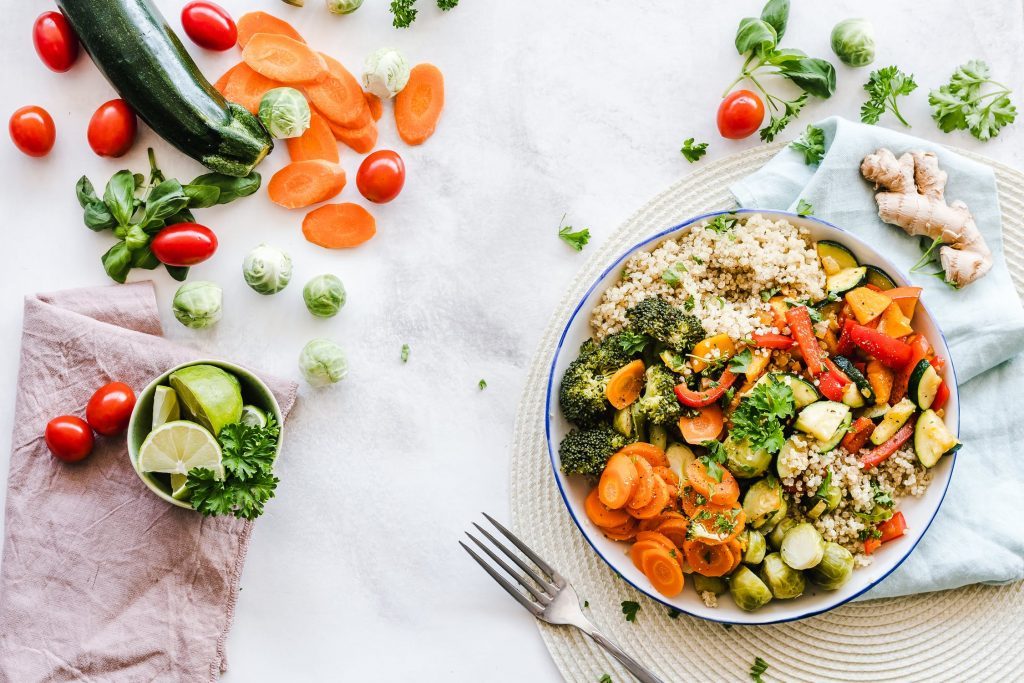
March is the National Nutrition Month!
To kick things off, Coach Beverly has collected an entire page of plant-based eating resources. This page includes recipes, instructional videos, reading materials, and more!
We hope this list informs and inspires you!
Click here to read more.
Sign up for Diabetes Blog Bytes – we post one daily Blog Byte from Monday to Friday. And of course, Tuesday is our Question of the Week. It’s Informative and FREE! Sign up below!
[yikes-mailchimp form=”1″]

We want to send a big thank you to one of our community members, Rachel Newman, RN, who forwarded us these amazing resources!
Below is a list of resources that range from tips to managing diabetes through nutrition and sleep, the health impacts of diabetes and aging, financial assistance, and tips on how to discuss treatment plans with providers.
Diabetes and Aging – The combination of aging and diabetes can even make some health problems worse. This article addresses what to look out for to prevent any further health issues.
Diabetes and Nutrition – Tips for managing blood sugar and how eating well can help manage blood sugar.
Diabetes and Sleep – Steps to get a better night’s sleep and how sleep can help those living with diabetes or prediabetes.
Financial Assistance for Diabetes Patients – Information and assistance for private and government health insurance, local programs, support groups, and medicine-assistance programs.
Talking with Your Doctor about Your Treatment – A great resource to help people with diabetes discuss their treatment plans with their providers.
Sign up for Diabetes Blog Bytes – we post one daily Blog Byte from Monday to Friday. And of course, Tuesday is our Question of the Week. It’s Informative and FREE! Sign up below!
[yikes-mailchimp form=”1″]
Happy Friday! As I get older, font sizes seem to be getting smaller. Excited to see the updated Injectables Algorithm, I turned my ADA Book to Standard 9 and quickly realized that in order to read the print, I had to hold the page inches from my nose. And there was no way could I read the footnotes even using my iphone flashlight to illuminate the words.
Thank goodness I collaborate with wonderful staff who boast youthful eyes and 2020 vision.
Robert (our Assistant Director and my high school senior) set to work recreating a draft of the document on Word. Getting the arrows to line up and fitting all the content in little boxes, was challenging, but he persevered. Taryn added the footnotes and I completed the final editing and the creation of the PDF.
We created this readable version because the algorithm is an important document that can be used to promote a collaborative practice.
Coach Beverly
I consider the ADA Standards my clinical “playbook”. The medication algorithms are of particular importance because it provides us with the opportunity to engage in a collaborative practice with our referring providers. “These are the evidence based medication recommendations from the ADA. I use it as a guide to recommend medication additions or changes”.
Enjoy our font enhanced Figure 9.2: Intensifying to Injectable Therapy
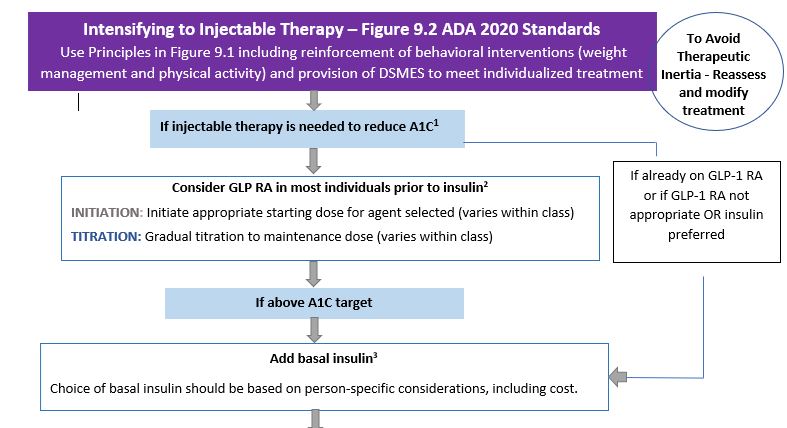
Then we can start a conversation exploring if a collaborative practice and medication adjustments using the algorithm is comfortable for the provider and perhaps include into our practice guidelines.
Enjoy this helpful 2 page reference guide, on us!
The 2020 Standards of Care is ready for viewing. Coach Beverly highlighted changes from 2019-2020 and summarized important need-to-know content for CDCES’s!
Purchase our Level 1 Standards of Care, or buy the full Level 1 bundle to benefit from all the 2020 updates! Earn 9.0 CEs for $109
Sign up for Diabetes Blog Bytes – we post one daily Blog Byte from Monday to Friday. And of course, Tuesday is our Question of the Week. It’s Informative and FREE! Sign up below!
[yikes-mailchimp form=”1″]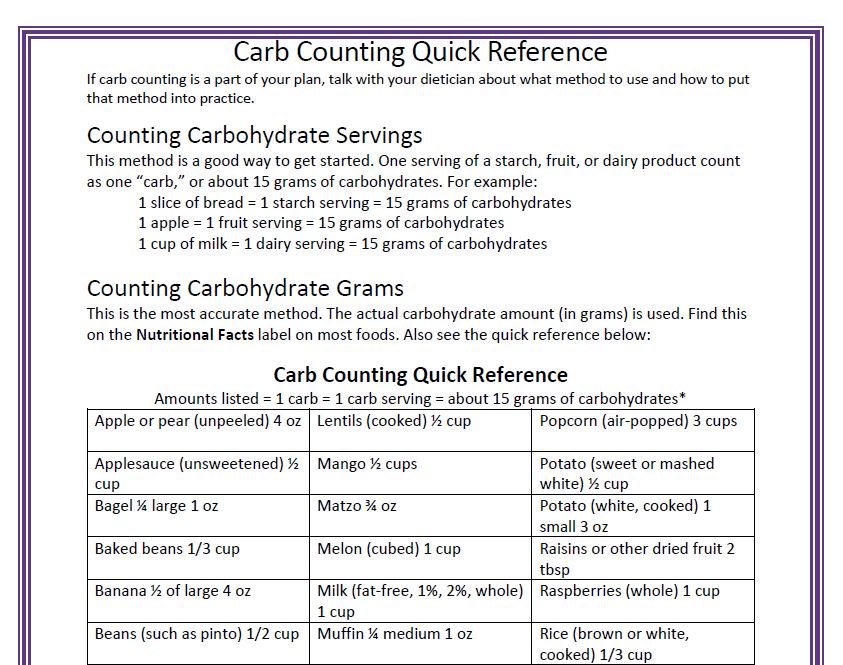
We created this Carb Counting Quick Reference sheet based on the ADA handbook. With the holidays and New Year around the corner, this cheat sheet of the most common carbs with serving size is a perfect reference for people counting carbs. Plus, it is perfect for exam prep for the health care professionals.
If you are studying for the diabetes certification exam, this reference provides the most common 15gm carb sources and their serving size. One exception is the milk serving – this list was created for people with diabetes and was simplified – we have modified it to reflect the actual carb count of a serving of milk (12 grams, not 15 grams of carbohydrates).
Learn more carb counting tips and tricks, and nutrition information in our Level 1 and 3 courses!

Start 2020 off right with Level 1 updates in January, Boot Camp (Level 3) updates in February and March, and a bundle to save on all the courses! We’re here to help make your New Year’s resolution a reality with great, on-demand videos, podcasts, handouts, extra resources, and practice tests to help you succeed at any diabetes certification exam.
Sign up for Diabetes Blog Bytes – we post one daily Blog Byte from Monday to Friday. And of course, Tuesday is our Question of the Week. It’s Informative and FREE! Sign up below!
[yikes-mailchimp form=”1″]Experts are meeting with congress to encourage investigation of the relationship of human exposure to perfluoroakyl and polyperfluoroakyl (PFAS) on weight and osteoporosis.
Early studies have shown a link between greater PFAS exposure and increased risk for endocrine outcomes like BMI >30, but more research is needed specifically to examine factors like exposure timing,” Abby Fleisch, MD, MPH
Read More here – Endocrine Today Article

These commonly found chemical PFA substances are endocrine disrupting chemicals and may be the driving factor responsible for a variety of adverse health outcomes.
PFAS are a large and expanding group of man-made compounds that are widely used to make everyday products more resistant to stains, grease and water, according to the NIH.
PFAS can be found in nonstick cookware, stain-resistant carpeting, to-go containers, cleaning products, drinking water, microwave popcorn, and even fire extinguisher foam. Toxic Free Future advises avoiding common packaged foods with grease repellent coatings (such as pizza and french fry boxes), avoid stain resistance treatments on furniture, and check personal care products for teflon, “fluoro” or “perfluoro.”
Toxic Free Future has created a fantastic educational flyer on PFAS, it’s sources, and easy alternatives:

For more tips on minimizing exposure to PFAS and what can be done about PFAS, you can visit Toxic Free Future’s website here. We also discuss PFAs in our recent FREE Webinar, Getting to the Gut. Click below to get started.
Sign up for Diabetes Blog Bytes – we post one daily Blog Byte from Monday to Friday. And of course, Tuesday is our Question of the Week. It’s Informative and FREE! Sign up below!
[yikes-mailchimp form=”1″]Flu season is upon us! People with diabetes (type 1, type 2, or gestational), even when well-managed, are at high risk of serious flu complications, which can result in hospitalization and sometimes even death.
Many people are reluctant to get the flu shot. Help move them out of pre-contemplation to action with this informative and upbeat instructional video and song!

Is an educational and entertaining method to bring to light information about the Flu and the Flu Shot…through music!
“The Flu Shot Song” by Nurse Master Charlie, provides a general overview and the science behind why the flu vaccine works to prevent the flu; All while using the universal language of music!!!
This upbeat and informational video describes a quick history, along with transmission methods, differentiation, symptoms, prevention, diagnosis and treatment of the flu.
Nurse Master Charlie pictured at the CA AADE Meeting
Contact or follow Nurse Master Charlie
Instagram: Nurse Master Charlie
Facebook: Nurse Master Charlie
YouTube: Nurse Master Charlie
Twitter: Nurse Master Charlie
Email: [email protected]
Sign up for Diabetes Blog Bytes – we post one daily Blog Byte from Monday to Friday. And of course, Tuesday is our Question of the Week. It’s Informative and FREE! Sign up below!
[yikes-mailchimp form=”1″]
This one-hour complimentary journey will expand your view of how trillions of bacterial hitchhikers profoundly influence our health. We will discuss how foods, the environment and our medical practices have impacted our gut bacteria over time and strategies we can take to protect these old friends. You can either view the webinar for free, or to receive 1.0 CE, purchase the webinar below for just $19 (normally $29).
Feedback from a recent participant:
“Beverly never disappoints! Great information presented so nicely. She is interesting and fun.”
“Fabulous webinar!! Great cutting edge information!”
Watch now for free (no CEs):

This webinar is completely free because we love sharing exciting information with our community! However, if you would like CEs you can purchase the individual course or as part of a series.
Sign up for Diabetes Blog Bytes – we post one daily Blog Byte from Monday to Friday. And of course, Tuesday is our Question of the Week. It’s Informative and FREE! Sign up below!
[yikes-mailchimp form=”1″]